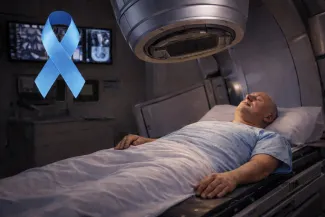
A simple test
Shortly before the COVID pandemic, my doctor took a blood sample, sent it to the lab, and the next day I found out my PSA (prostate-specific antigen) level was higher than they or I would like to see Taking the blood sample was more whim than protocol –I was approaching 60, he’d recently been diagnosed with prostate cancer, and he asked me if I’d ever had a PSA test; I hadn’t, and out came the needle.
Those results kicked off a series of tests, scans, and biopsies, culminating in radiation therapy last summer. Along the way, I had to decide to do nothing for a few years or take action. This is my “journey,” and what it’s like to be on the receiving end of an intense beam of radiation, rather than providing radiation safety oversight over five years for nearly 100 patients, all receiving radiation therapy for prostate cancer.
A biopsy showed a few traces of cancer, and an MRI showed two nodules, and I sat down with my urologist to talk about what it all meant. Most prostate cancers are pretty slow-growing, and mine was fairly small and not very advanced. Realizing that it’s hard to make a mistake, doing nothing I chose “watchful waiting.” To the uninitiated, it looks an awful lot like doing nothing; however, it’s a high-level form of doing nothing, and includes more PSA tests, MRIs, and biopsies, all looking for any changes. Three years ago, one biopsy sample was genetically sequenced, with the results showing that the cancer had a 28% chance of growing, a 10% chance of metastasizing in the next 5 years, and a 5% chance of being fatal within a decade. This added to my concerns, but given the odds were still in my favor, continuing to watch seemed to make sense until my biopsy last May.
Watchful Waiting…Until It Wasn’t
When the biopsy report popped up on the Patient Portal, it was close to the end of a Friday. There were several terms I hadn’t seen before, and as I looked them up, every single new term made things seem worse. By the end of the report, I realized that the watchful waiting was over. As I was digesting this, I got a call from my urologist. She’d seen the biopsy results, knew I had access to them, and didn’t want me to spend the weekend worrying about what they all meant. She spent some time putting the pieces together for me, adding to what I’d found in my searching, and agreeing that it was time to stop watching. Over the next few weeks, I met with her to learn what surgery would entail and with a radiation oncologist to talk about radiation therapy.
Choosing
It turns out that both treatments have the same five-year survival rate (95%), but the complications differ. With surgery, there are the risks of incontinence [1] and impotence, and a need to take things easy for a few weeks while recovering. On the other hand, the prostate is completely gone, so there’s no risk of developing another prostate cancer. Radiation, which focuses on the tumor but leaves much of the prostate intact, may result in recurrence.
I decided to go with the radiation therapy for a few reasons:
- I’ve worked with radiation for over 40 years, and I understand it and how it works
- There was less of a chance of suffering damage to any of the nerves
- A friend had recently had the surgery, and he described more side effects that lasted longer than expected
A week later, I had possibly the best reason to choose the radiation: I was diagnosed with blood clots, a common complication of prostate cancer, and placed on blood thinners, which don’t mix well with surgery. The clots delayed my treatment by a month because radiation therapy required injecting gel into the space between the prostate and rectum, to push the rectum out of the highest-dose radiation field during therapy, and injecting three tiny gold spheres into the prostate to serve as GPS markers of the tumor’s position, for the computer that controlled the therapy. After a PET-CT to confirm the cancer hadn’t spread, my first radiation treatment took place. I had 28 treatments; every working day at around 7:30 in the morning.
About the radiation
The radiation I was exposed to was produced in a linear accelerator (LINAC). Electrons “boil” off a tungsten filament where they’re captured by an electromagnetic field that pushes them at ever-higher energies towards a metal target. When they smash into the target, they produce X-rays, and it’s these X-rays that are used to treat patients. While the primary goal is to give enough radiation to destroy the tumor, an important second goal is to spare the healthy tissues surrounding the tumor.
One way to accomplish both is to use a multi-leaf collimator, which shields the body from radiation. The collimator consists of strips of dense metal, like lead. Each strip can move independently and be shaped to create a hole that’s precisely the size and shape of the tumor to be irradiated, along with a small margin to allow for movement within the radiation field. The new LINACs use dynamic multi-leaf collimators, repositioning the leaves throughout the exposure to treat the tumor from different angles. [2]
A Day In the Life
5:00 AM – My alarm goes off far too early. I drag myself up, make coffee, shower, get dressed, and try to coax my bowels into cooperating. The goal is a full bladder and empty bowels when it’s time for radiation. A full bladder helps shield part of it from exposure; empty bowels (no stool or gas) prevent sensitive tissue from being pushed into the beam.
5:45 AM – I leave my apartment for the subway. Depending on connections, it can take anywhere from two to four trains and up to an hour and a half to reach the hospital.
7:00 AM – The subway deposits me on the Upper East Side. I cross the street, greet the security guard, and head downstairs to Radiation Medicine. I grab more water (more bladder prep) and wait.
7:30 AM – I’m called into the changing room, remove my pants and underwear, put on a gown, and once again reread one of the same two ancient magazines that seem permanently stuck there.
7:45 AM – My name is called. I walk down the hallway, clutching my gown, turning several sharp corners designed to block stray radiation. I lie on the table while the staff aligns me precisely using hip markers and imaging. Foam supports keep my legs still, and I’m given something to hold as a reminder not to move.
7:47 AM – The staff leave, sealing the thick shielding door. The table rises and slides me into position. I hear a soft buzzing that’s a brief CT scan, which checks the gold markers in my prostate and confirms my bladder and bowel prep.
7:48 AM – With a deeper and louder buzz, the LINAC delivers 13 short bursts of radiation from different angles. I feel absolutely nothing.
7:51 AM – After the last beam, the table moves me out. The staff return, help me up, and I change back into my clothes.
By 8:30, after three trains, I’m back at my desk, a few hours daily that I get to repeat 28 times. By my last week of treatment, I’d been exhausted for a month; at first I’d attributed it to waking up early, but at some point I realized some of it’s due to the radiation exposure as well.
Treatment Ends, Recovery Begins
About a week after the final treatment, I began to feel even worse, urgently needing to dash to the toilet to urinate or have one of several daily bowel movements. I also had a fair amount of pain during urination and when I had a bowel movement. This resulted from the inflammation caused by the radiation, along with a urinary tract infection –both eventually relieved with a combination of antibiotics and anti-inflammatories. For the next six weeks, I didn’t dare be more than about a half hour from a toilet for fear of having an accident.
What surprised me most wasn’t the treatment itself; the machine was precise, the staff reassuring, and the radiation completely painless in the moment. It was everything that came afterward: the fatigue, the inflammation, the slow unfolding of side effects that my textbook understanding failed to convey when it was my body. By mid-November, I was back at work, and at Thanksgiving, I was feeling well enough to fly and drive to visit family. I’m not yet back at 100%, but pretty close. I still need to take the occasional dash to the toilet. My last PSA test was outstanding. Radiation therapy may be invisible, but living through it leaves a lasting, deeply human imprint. And now I just need to follow it for…well, the rest of my life. But that’s OK!
[1] It turns out that many surgery patients are incontinent for a few to several weeks following the surgery, although this usually passes (so to speak).
[2] Angles are important –my treatment required 13 angles, delivering a whopping 7000 rem over the course of the therapy; the healthy tissues along each exposure path received a much lower 560 rem during the entire therapy.