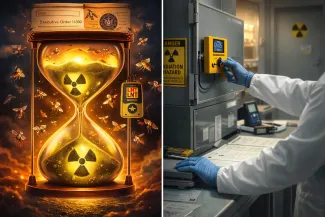
Eighty years ago, the King of Sweden draped a medal around the neck of American geneticist Hermann Müller, bestowing upon him the Nobel Prize in Physiology or Medicine. As with so many awards, Müller’s Nobel came a few decades after the work it recognized – his 1926 discovery that radiation (specifically radium and X-rays) could cause genetic mutations in fruit flies, with other scientists replicating these results over the next few years. Over the next several years, Müller’s results were extended to other organisms, and he noted that higher radiation exposure was correlated with higher mutation rates.
In the decades following Müller’s Nobel research, as nuclear weapons testing ramped up and nuclear energy began to expand, a scientific committee convened to discuss how radiation affects human health.
LNT – the Linear No-Threshold model
The model agreed upon holds that any bit of radiation exposure is potentially harmful in direct proportion to the amount of radiation one has received. This model or risk has been used virtually unchanged over the intervening seven decades. In recent years, the science underlying Müller’s work and LNT has been challenged [1]
People have made a compelling case that the origins of LNT might be flawed – Müller might have cooked his data, exerted inappropriate influence over the committee that decided on LNT, or members of the committee might have followed their preferences rather than the data, or any of a hundred other inappropriate actions might have occurred in the half-century between when Müller began his work and when LNT was chosen as the radiation dose-risk paradigm. But unless the thoughts and intentions of those involved in the process are known, we can’t know whether the process was rigged or whether the LNT hypothesis was the best they could come up with, given what was known at the time.
The practical application of LNT to regulatory statutes involves the goal of radiation exposure: “as low as reasonably achievable” (ALARA), achieved by minimizing exposure time, increasing distance from the source, and using shielding materials to further reduce exposure.
A New Executive Order
Last year, the Trump Administration issued Executive Order 14300 instructing the Nuclear Regulatory Commission to
“…reconsider reliance on the linear no-threshold (LNT) model for radiation exposure and the “as low as reasonably achievable” standard”
This Executive Order makes me wonder how the model we use to calculate radiation risks at low levels might affect how my colleagues and I practice radiation safety in real life.
In my role as a Radiation Safety Officer, our current LNT-based regulations require me to ensure that anyone not a radiation worker is not exposed to more than 100 mrem annually at my facility. [2] I do this by placing radiation dosimeters on all four exterior walls of the single room where I store radioactive sources, as well as one inside the room. Not a single dosimeter reaches an annual dose of 100 mrem, even though they are there all day, every day, all year long. It’s easy to show that not a single person in the workplace receives even 25% of the dose accumulated by the dosimeters.
It’s always possible to reduce radiation exposure just a little bit more – should I try to knock that down a little in the name of ALARA? But if radiation exposures are already only a quarter of what I’m allowed to have, is it reasonable to spend more money and more of my time trying to cut that exposure down even further?
If I assume LNT is correct, I can maybe justify trying to reduce exposure a bit, knowing that each small reduction lowers risk a little more. But I can also note that at low exposure levels, the uncertainties are so great that it’s not reasonable to reduce already-low exposures even further, trying to lower an already-low risk by an unknown amount.
Some feel that LNT’s uncertainty at these extremely low levels represents a threshold, below which one is safe from radiation’s deleterious effects. What if a future scientific or epidemiological study conclusively shows that there’s absolutely no risk below a lifetime dose of 10 rem? Would that affect the way I manage my radiation safety program? Well…probably not.
Given how the math works out, even if we found definitive proof that there were no health effects from any exposure below 10 rem, I would still be trying to ensure no one received an annual dose above 100 mrem. In other words, the presence or absence of a threshold won’t have much impact on how I practice radiation safety. It wouldn’t make much sense to dismantle my current radiation shielding, but even if I were setting up a new radiation program, I’d still want to shield and lock up my sources, post dosimeters, and so forth.
Müller’s legacy and the scientific scaffolding built upon it deserve careful scrutiny; models should stand or fall on evidence, not inertia or personality. Yet in the daily reality of radiation safety, the controversy changes little. Whether risk declines smoothly to zero or flattens beneath a threshold, prudence, professionalism, and public trust demand the same disciplined approach: secure sources, monitor exposure, document results, and keep doses well below regulatory limits. Executive Orders may prompt reconsideration, and new research may refine our understanding, but the practical mission remains steady. In the end, the mathematics of risk modeling matters far less to my day-to-day decisions than the responsibility to protect people thoughtfully, transparently, and conservatively—because good safety practice does not hinge on winning a theoretical argument.
[1] There is a series of online videos discussing these events.
[2] For comparison, a transcontinental airflight will expose you to 3 mrems, and a CT scan to 70 mrems.