I continue to have mixed feelings about the impact of AI on healthcare. It will increase productivity while interjecting non-human agency between us and administrative tasks. Still, it will do little in its current form for my peeps, clinicians, and for the role I experience far more frequently, patients. Beyond the formidable issues of the human touch is the loss of “voltage” when an idea goes from a study to the real world.
“A company’s success will be determined less by the elegance of its algorithm and more by its strategy and budget for on-the-ground implementation. Due diligence must now shift from validating code to interrogating the costly, human-intensive work of clinical change management. For electronic health record giants like Epic, which are embedding AI co-pilots across their platforms, the lesson is that integration is not the same as implementation. Without a robust plan to manage workflow changes and ensure that AI-generated advice is actually followed, they risk selling expensive tools that create more alert fatigue and liability than clinical value.”
From Stat, Why the human workflow is health AI’s biggest, costliest problem
And while on the topic, there is some evidence that leaning into AI diminishes a physician's skills. I am not sure that is the case, especially since they mention the stethoscope, which brought heart sounds and murmur diagnostics right to our ears. But the sad truth is that for most of us, a stethoscope is an amulet of office rather than a tool. Not only has ultrasound supplanted murmur evaluation, but few physicians were adequately trained in using a stethoscope, as it requires one-on-one training. But I digress.
“AI, and especially those developing AI, don’t care about physicians’ skills but focus on replacing data-based and repetitive tasks to reduce the burden on medical professionals,” he says. “It would be the responsibility of those designing medical curricula to make sure that while physicians learn to use a range of AI-based technology, their skills and understanding will not erode.”
From Medscape, AI Eroding Cognitive Skills in Doctors: How Bad Is It?
Finally, one more AI and medicine concern, based on the voltage drop of outcomes between the lab and the world.
“The FDA approved mammography computer-aided diagnosis in 1998, and Medicare started to reimburse the use of computer-aided diagnosis in 2001. The US government paid radiologists $7 more to report a screening mammogram if they used the technology; by 2010, approximately 74 percent of mammograms in the country were read by computer-aided diagnosis alongside a clinician.
But computer-aided diagnosis turned out to be a disappointment. Between 1998 and 2002, researchers analyzed 430,000 screening mammograms from 200,000 women at 43 community clinics in Colorado, New Hampshire, and Washington. Among the seven clinics that turned to computer-aided detection software, the machines flagged more images, leading to clinicians conducting 20 percent more biopsies, but uncovering no more cancer than before. Several other large clinical studies had similar findings.”
From Works in Progress, AI isn't replacing radiologists
Finally, much has been written about the end of creativity as AI consumes content. I found this a fascinating mashup of technology, museum curation, and history.
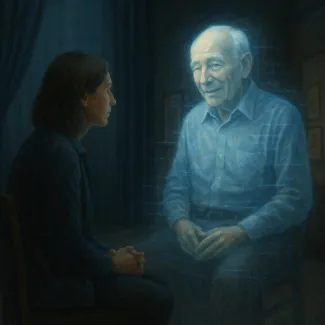
“Last May, I found myself in the basement of the Illinois Holocaust Museum and Education Center, speaking with the dead. I was sitting in the museum’s holographic theater, a sort of sanctuary room, facing a translucent screen in front of a curtained stage. Projected onto it was a life-size hologram of Sam, an elderly man dressed in khakis and a blue dress shirt. He was smiling and waiting patiently to speak with me.
…
Who among us hasn’t wished to speak with the dead?”
From Longreads, Uncanny Testimony
Across hospitals and museums alike, AI challenges us to decide how much of our humanity we are willing to delegate to machines. Only by keeping human meaning at the center of these advances can AI become a tool for care and conscience, rather than convenience alone.
Chuck Dinerstein, MD, MBA
Director of Medicine
Charles Dinerstein, MD, MBA, is the Medical Director of the American Council on Science and Health. A vascular surgeon with more than 25 years of clinical experience, he brings a physician's understanding of medical decision-making, an appreciation for scientific uncertainty, and a broader perspective on healthcare economics and policy to his writing.