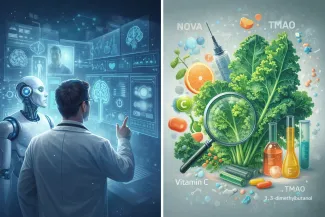
Kale is one of those plants that polarizes a crowd, with lovers and haters. But then there is this,
“Despite its onetime status as a superfood, kale isn’t all that it’s cracked up to be, nutritionally. It turns out that the carotenoids, vitamins C and E, and other phytonutrients that the green is bursting with are not very absorbable by the human body.”
There is a solution, but it requires an emulsifier, which, according to NOVA, makes it an ultraprocessed food. Damn! From Nautil.us, Kale Isn’t the Superfood You Thought
If it is true that you are what you eat, then we are all in for some awful news.
“Ten years ago, we started to look at nutritional databases like the USDA’s, and we were shocked to realize they only follow 150 molecules,” he said. “But we started digging further and realized we have absolutely no clue what’s in our food.”
For example, who could possibly want to ingest a chemical known as 3,3-dimethylbutanol – you do if you follow the Mediterranean Diet because it “prevents a group of gut bacteria from successfully [creating] an “atherotoxin” called trimethylamine N-oxide, or TMAO, which is elevated in the blood of patients suffering from cardiovascular disease.”
From Nautil.us, The Dark Matter of Food
Oliver Sacks embellished the truth and has joined a growing list of the “somewhat debunked.” Of course, Dr. Sachs may be forgiven because while much of his writing was about his chosen field of neurology, he was writing to a general audience and might not be fully bound by veracity, at least in the name of gathering our attention. Tyler Cowen, writing in The Free Press, builds on Dr. Sach’s fall to discuss how we might separate science fiction from fact.
“…trust literatures, not individual research studies. By a “literature,” I mean the collective work conducted by many researchers, acting in decentralized fashion, to publish and circulate the results that will best persuade other researchers.
Second, treat research articles, or their popular media coverage, as possibilities to put in your mental toolbox rather than settled truths.”
Charlotte Blease is a philosopher and associate professor of health informatics, tries to make a case for AI in medicine and begins by noting that physicians may not be the best at assessing AI’s role because we are enmeshed in the system. Point taken. Then she goes on,
“Exhaustion and overwork exacerbate mistakes, but the deeper truth is that human beings are limited creatures. We forget, misjudge, and grow overconfident; our moods, biases and blind spots shape what we see and what we judge to be the case. Burnout makes these weaknesses worse, but it does not create them. They are baked into the very psychology that once served us well in small ancestral groups, yet falters in the high-stakes, information-saturated, multitasking environment that is modern medicine. In other words, even at their best, doctors are human – and that means errors are inevitable.”
It is an interesting discussion throughout, and near the end, she states,
”What matters is not sentiment but whether care can be made more accurate, more timely and more humane.”
AI may enhance accuracy by recognizing patterns that are ill-formed for a physician’s typical concerns, potentially resulting in more timely care; however, chasing down diagnostic “wild geese” may make care less timely. But can AI make care more humane? We already see the human connection in medicine strained by the patient’s need for convenience and the physician's need for a work-life balance, as well as the technology and its latest corrections interposed into the physician-patient relationship. Surveys suggest that patients are beguiled by AI’s word choice, but will that simulacra of concern hold up when you have to discuss the hard choices of how and whether to treat a cancer?
From Aeon, Are doctors replaceable?
Chuck Dinerstein, MD, MBA
Director of Medicine
Charles Dinerstein, MD, MBA, is the Medical Director of the American Council on Science and Health. A vascular surgeon with more than 25 years of clinical experience, he brings a physician's understanding of medical decision-making, an appreciation for scientific uncertainty, and a broader perspective on healthcare economics and policy to his writing.