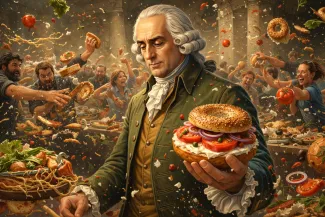
In the opening pages of The Wealth of Nations, Adam Smith invites us into a pin factory. A single laborer, attempting to fashion pins alone, might produce only a handful in a day. Yet when the work is divided—one man drawing out the wire, another straightening it, a third cutting it, a fourth sharpening the point, the output multiplies beyond measure. [1] From this, Smith derives an iconic economic insight: prosperity arises not from rustic self-sufficiency, but from specialization, exchange, and the intricate cooperation of strangers. That insight still shapes the way we understand modern abundance.
From Pins to Bagels
Consider, in a similar spirit, a breakfast icon, a delicious New York bagel, toasted, with a shmear of cream cheese, perhaps a slice of tomato or onion, crowned with lox.
The bagel itself is simple: flour, water, yeast, salt. Yet the flour is not merely ground grain. It is the product of mechanized planting, harvesting, milling, enrichment, testing, packaging, and distribution. The wheat may have been sown by GPS-guided tractors, the soil amended with precisely measured fertilizers. After harvest, it passes through grain elevators, rail networks, milling rollers, and enrichment facilities where iron and B vitamins are added in proportions determined by nutritional science. Each stage is overseen by workers who do not know the final consumer, yet whose specialized tasks render the bagel both affordable and nutritionally fortified.
The yeast is cultivated in industrial fermenters; the salt mined, purified, iodized, and transported across state lines. And the New York water, arguably the most critical component, arrives through municipal systems engineered, filtered, and regulated by a cadre of civil servants and technicians.
Now consider the cream cheese. Its smoothness may owe something to stabilizers like carob bean gum; its safety to pasteurization; its shelf life to preservatives. Milk must be collected from dairies, cooled, tested for pathogens, standardized for fat content, cultured, and blended. The dairy farmer, the truck driver, and the microbiologist all contribute in their own way.
Add to this the lox: salmon raised in aquaculture pens or caught in northern waters, cured with salt and time, sliced at Russ and Daughters with precision. The onion, perhaps grown in California or Georgia, is planted, irrigated, harvested, stored, sorted, and shipped. A January tomato, impossible in a preindustrial environment, likely originated in Florida or Mexico, grown in high-yield fields or greenhouses, its journey enabled by refrigerated trucks and cross-border trade agreements.
If one man were tasked with producing this entire meal, our breakfast would be long delayed, meager in quantity, and uncertain in safety. But through the division of labor, the bagel arrives warm at hand for a modest price. [2] It is, as a latter-day Adam Smith would point out, a small marvel of coordinated effort.
A Food System Under Suspicion
A recognition of abundance born from specialization lies at the heart of the recent New York Times article on America’s food environment. The article urges readers to reconsider the increasing reflexive suspicion regarding our food environment. Between social media and MAHA influencers exhorting us to “eat real food” and policy advocates decrying “ultra processing,” it is tempting to imagine that a retreat from scale and technology would restore health and virtue. However, the enrichment of flour and iodization of salt helped banish goiter, anemia, and rickets, and global supply chains make fresh fruits and vegetables available in winter, adding nutrition and variety to what would otherwise be a diet of root vegetables. The modern food environment, like Smith’s pin factory, multiplies output and distributes its benefits widely.
The article concedes the system’s excesses. The shelves that display yogurt and whole-grain bread also display sugary cereals and snacks engineered for hyperpalatability. Fast-food aisles crowd out fresh produce, and agricultural subsidies favor commodity crops that become added sugars - developments that many critics link to rising rates of obesity and metabolic disease.
MAHA’s contemporary advocates express concern over ultra-processed foods, chemical additives, industrial agriculture, and corporate influence; impulses not entirely at odds with those of the Times: the food landscape nudges us toward nutritional excess rather than nutritionally-guided health.
Reform or Retreat
Adam Smith did not propose dismantling the pin factory in favor of cottage craftsmanship, acknowledging that specialization increases wealth, and that the task of governance is to ensure its fruits are broadly shared and its abuses constrained. In the context of food, this suggests not the wholesale rejection of industrial systems, but their reform.
The Times and the MAHA moms both seek reform. The more “progressive” Times seeks to redirect the immense productive capacity of the existing system toward healthier ends through conventional levers such as taxation, government subsidies (SNAP and commodities), better labeling, and corporate regulation. Oddly, for a conservative political cause, the true MAHA activists seek to tear what exists down and rebuild. Their disagreement with Secretary Kennedy, whom critics accuse of merely “sniping around the edges” with symbolic changes such as redesigned food guides rather than structural reforms like ending sugar subsidies, reflects the divide over scale and strategy.
To demand that every citizen grind their own flour, cure their own fish, and tend their own garden would be to ignore the very system that has made nutrition more reliable and diverse than at any point in history. But to ignore the health and environmental costs embedded in the current configuration would be equally shortsighted.
The morning bagel with tomato or onion, lox, and cream cheese thus becomes more than breakfast. It is a testament to cooperation among strangers and to our society's capacity to transform dispersed effort into accessible nourishment. It is also a reminder that systems capable of abundance can, without wise policy, drift toward imbalance.
In Smith’s pin factory, productivity soared because each worker focused on a narrow task. In our food system, countless specialists perform analogous roles. The challenge for our time is not to undo that division of labor, but to align its incentives with public health and environmental stewardship. If MAHA voices the anxiety that something in our food environment has gone awry, the answer may lie not in dismantling the factory, but in adjusting its design. If we listen carefully to both sides, then perhaps we can find a better middle path.
[1] You can find a delightful dramatization of Smith’s pin factory here
[2] The use of the term modest may be hyperbole; the aforementioned lox and bagel is $17 at Russ and Daughters. The average price is roughly $7 to $8

Chuck Dinerstein, MD, MBA
Director of Medicine
Charles Dinerstein, MD, MBA, is the Medical Director of the American Council on Science and Health. A vascular surgeon with more than 25 years of clinical experience, he brings a physician's understanding of medical decision-making, an appreciation for scientific uncertainty, and a broader perspective on healthcare economics and policy to his writing.