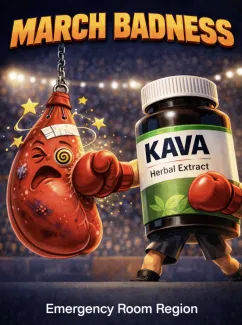
Welcome back to March Badness. In Part 1, we analyzed the contestants from the Placebo Region—supplements so implausible or diluted that they can't possibly work (or aren't even in the bottle). Now we move to the other side of the bracket, where the products actually do something – occasionally send people to the emergency room.
Or maybe a transplant center.
Grab a Bud Light. It's time for the tip-off!
The Placebo bracket has already been decided. Oscillococcinum (diluted duck guts) quacked its way to the finals and now awaits a challenger in the championship game.
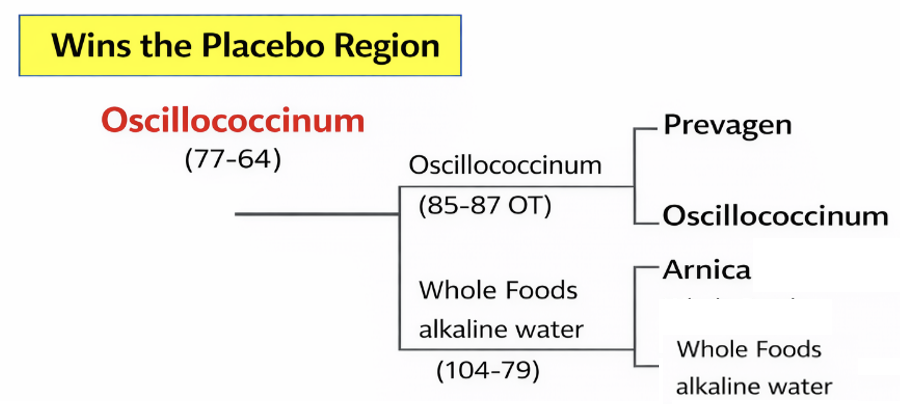
Who will it be? Talk about excitement! There wasn't a dry seat in the house.
Yohimbe (6th seed)
The Emergency Room Region features yohimbe, an herbal supplement marketed for sexual performance, bodybuilding, and occasionally anything else that might sell bottles. It comes from the bark of the African tree Pausinystalia yohimbe, which contains yohimbine, a rather toxic indole alkaloid compound that stimulates the nervous system.
This is not a trivial effect. Yohimbine can increase heart rate, blood pressure, and anxiety, and has been associated with seizures, heart rhythm disturbances, and emergency department visits. To make matters worse, analyses of yohimbe supplements have found that the amount of active compound in different products varies wildly, from almost none to doses that would make a cardiologist's eyes bug out of his head.
Unlike the supplements in the Placebo Region, yohimbe actually does something. Unfortunately, what it sometimes does is send people to the hospital. Yet, Amazon sells 80 different yohimbine products.
FanDuel odds – 5:1
Kava (8th Seed)
Next up is kava, a plant extract used for relaxation and anxiety relief. The roots of Piper methysticum have been used traditionally in Pacific Island cultures to prepare ceremonial beverages, but modern supplements often deliver the compounds in much more concentrated forms. This ain't good.
Kava can produce sedative effects, but it has also been linked to serious liver injury [1], including cases severe enough to require liver transplantation. Several countries restricted or temporarily banned kava products after reports of liver failure began to accumulate, but this hasn't stopped Amazon from selling more than 500 kava products.
In fairness, not every user develops liver damage. But when the potential side effects include organ failure, the risk–benefit calculation becomes a bit more complicated than the label suggests.
FanDuel odds – 1:1 (a strong favorite)
Green Tea Extract (2nd seed)
Green tea itself is harmless enough. Billions of people drink it every day. But concentrated green tea extract, commonly found in weight-loss supplements, is another story. These products deliver large doses of catechins—the main bioactive polyphenols in green tea—and Amazon alone lists more than 8,000 green tea extract products.
When consumed in large doses, the catechins in green tea extract have been linked to acute liver injury, including cases that required liver transplantation. The problem is not the tea—it's the massive doses delivered by concentrated extracts.
In other words, the same plant that produces a pleasant afternoon beverage can, when packaged as a supplement, occasionally produce a hepatology consult. Where the waiting room may or may not serve tea.
FanDuel odds – 6:1
DHEA (4th Seed)
Rounding out the Emergency Room Region is DHEA (dehydroepiandrosterone), a hormone normally produced by the adrenal glands but widely sold as an anti-aging and performance supplement.
Unlike most supplements, DHEA actually changes hormone levels because it is a sex hormone; the body converts it into testosterone and estrogen. That means it can cause acne, mood changes, menstrual disruption, and other endocrine effects. (This is a REAL endocrine disruptor, not your stupid frying pan.) There are also concerns that long-term use could stimulate hormone-sensitive cancers, though the evidence remains incomplete.
In other words, DHEA isn't just another herbal curiosity. It's from a factory, not an herb. It's a hormone, a real drug, that is sold in the supplement aisle for reasons I'll never understand. What in your diet is it supplementing?
FanDuel odds – 3:1
Emergency Room Region Quarterfinals
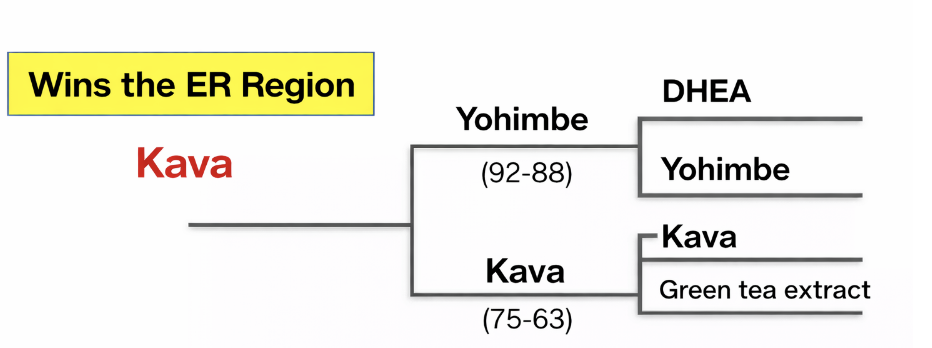
The thrilling tournament must have left many office pool novices bitterly disappointed as two underdogs, Kava (8th seed) and Yohimbe (6th seed), defied the bookmakers and left the favorites in the fairy dust.
In the first quarterfinal matchup, Yohimbe faced DHEA in what analysts predicted would be a close contest. DHEA opened strong with its vaunted Hormone Surge Offense, but Yohimbe persisted, raising blood pressure early and often. In the end, Yohimbe's sexual prowess offense proved too much to handle, and the supplement advanced to the semis, 92-88.
In the other quarterfinal, Green Tea Extract squared off against Kava. The tea came out aggressively with a strong liver attack, but Kava's sedating defense slowed the pace of the game to a crawl. In the end, Kava's liver toxicity proved decisive, and it pulled away late for a 75-63 victory, setting it up to face Yohimbe in the semis. Against all odds, it was Tea for Two. Minus the tea.
On to the Championship
Who is the March Badness Crappy Supplement Tournament for 2026?
That's not such an easy question.
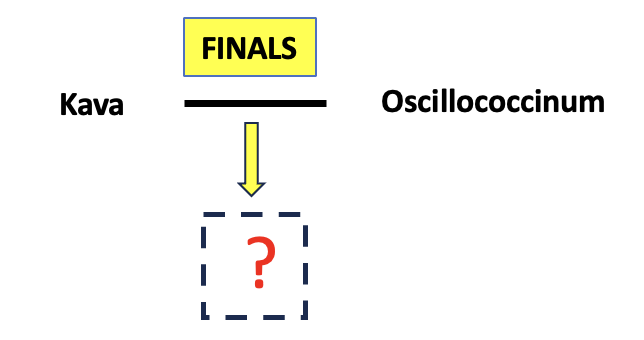
The final matchup pitted Oscillococcinum against Kava. One product contains essentially nothing. The other may contain enough to destroy an organ or two.
After reviewing the labels, tournament officials ruled the game a double forfeit.
Why?
Oscillococcinum was disqualified for having no active ingredients.
Kava was disqualified for having too many.
In the end, no champion was crowned.
The courtroom was adjourned. No verdict was returned.
–Don McLean, American Pie (1971)
Which, when you think about it, may be the most honest outcome ever produced by the supplement industry.
Even after laying 2.5 points with the book.
NOTE:
[1] CDC. Hepatic Toxicity Possibly Associated with Kava-Containing Products—United States, Germany, and Switzerland, 1999–2002.

Josh Bloom
Dr. Jonathan (Josh) Bloom, ACSH's Director of Chemical and Pharmaceutical Sciences, earned his Ph.D. at the University of Virginia and completed postdoctoral training at the University of Pennsylvania. During his 20-plus years in drug discovery at Wyeth, his research group discovered the antibiotic Tygacil®, approved in 2005. He holds 25 issued patents and has authored 35 academic papers. Since joining ACSH in 2010, he has written more than 2,000 articles and dozens of op-eds for major newspapers, including The Wall Street Journal and Chicago Tribune.