The “Gift” That Keeps on Giving
The first asbestos case, brought in 1929, was for a work-related disability. More lucrative personal injury lawsuits didn’t emerge until the 1960s, and the first successful mesothelioma suit arrived in 1973 with a landmark opinion that set toxic tort litigation afire as the Judge heralded the importance of warning of known risks.
By 2002, more than $70 billion had been spent on more than 730,000 asbestos claims, with lawsuits still being filed. Twenty-five years later, $30 billion still remains in trust funds created in the wake of multiple bankruptcies triggered by the mega-flux of lawsuits. Over the last half-century, the asbestos juggernaut exploded, bankrupting more than 130 companies.
Asbestos had many uses, from fireproofing and soundproofing to boiler insulation, even protecting rocket nose cones from space radiation during reentry. Over time, millions were exposed, creating a trove of potential plaintiffs who are still bringing cases – although the influx has plateaued.
The Forever Chemicals
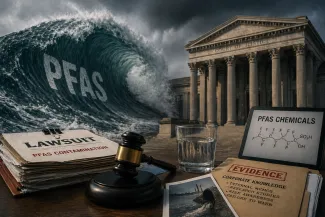
Like asbestos, per- and polyfluoroalkyl substances (PFAS), the “forever chemicals,” are ubiquitous and virtually indestructible. Although PFAS litigation is still in its infancy, cases are proliferating – and the types of claims brought eclipse those involving asbestos. Plaintiffs’ firms anticipate a similar trajectory and there are a lot of defendants with deep pockets, like 3M and DuPont which have already agreed to multi-billion-dollar settlements with public water systems.
PFAS exposures range from ingesting drinking water contaminated by industrial runoff to inhaling firefighting foam. Plaintiffs include state and municipal water systems, and consumers alleging personal injury, commonly consolidated in Multi-District Litigation (MDL). By April 2026, 15,222 PFAS personal injury lawsuits had been filed in the Aqueous Film-Forming Foams MDL, which accuses the defendants of failing to adequately warn the public about the harmful properties of these fluorochemical products, despite knowing their potential dangers.
Like asbestos, which primarily benefited the International Association of Heat and Frost Insulators and Allied Workers, creating an “industry-angel” that funded much of the epidemiology on which the plaintiffs’ cases rested, PFAS also has a target favored by plaintiffs’ firms: the International Association of Fire Fighters (IAFF) [1]
The Litigator Leaders
Concern over PFAS is only about 25 years old, compared with asbestos, which was a known risk, at least by some, for over a century, leaving less time for scientific and historical evidence of hazards to accrue. But the PFAS litigation playbook has already been crafted in the asbestos arena and is easily transmutable. Perhaps it’s no surprise that the firm Motley Rice, a prime player in PFAS litigation, was also a major mover in asbestos litigation, beginning circa 1978, when Ron Motley, one of the original asbestos plaintiffs’ attorneys, introduced corporate literature demonstrating corporate knowledge of asbestos-related harms dating back decades, awards proliferated and skyrocketed.
And yet, even without these smoking guns, the PFAS litigation is burgeoning.
The Asbestos Cover-up
Ron Motley’s use of these documents, demonstrating a corporate cover-up of knowledge of asbestos-related harms, surfaced in company documents or recalled by company employees, was chilling.
“Mr. Brown, do you mean to tell me you would let them work until they dropped dead?”
“Yes. We save a lot of money that way.” - Lewis Brown, President, Johns Manville, according to Charles Roemer, a Johns Manville employee
Since John Tyndall’s 1870 work, it was well known in scientific circles that dust can cause disease, a fact memorialized in “Dust is Dangerous.” Yet such knowledge was routinely disavowed by asbestos manufacturing executives, including Johns-Manville’s Medical Director, Dr. Paul Kotin. And if the companies didn’t know, they had no duty to warn, went the defense. At the outset of the litigation, this argument proved compelling to juries, and defendants scored early victories.
But years of diligent discovery produced strong evidence that, decades before the companies accepted Irving Selikoff’s 1964 epidemiological research—and admitted causation—they knew of asbestos’s dangers. That knowledge destroyed their defense, triggered the gargantuan verdicts, and fueled the seemingly immortal asbestos litigation, which continues unabated. No longer could companies hide in denial—they knew and acted as if workers’ lives were expendable. No smoking gun here—it was a grenade.
Does A PFAS Smoking Gun Exist?
For now, the PFAS litigation, still in its infancy, has no smoking gun. However, in a 2013 case, investigators suspected that DuPont was fully aware of the noxious properties of a PFAS subtype, Perfluorooctanoic acid (PFOA), known as C8, when it was allegedly disposed of, thereby poisoning the water of 80,000 West Virginia residents living near a Teflon manufacturing plant. To date, no court-worthy evidence has been found. Nevertheless, there are clues that it may exist. Documenting such knowledge would create a litigation launchpad, although to date, no court-worthy evidence has been found. Nevertheless, there are clues it may exist.
Finding such smoking guns presupposes that PFAS is dangerous, and as with all toxins, the dose makes the poison. In the asbestos cases, most plaintiffs were occupationally exposed to levels orders of magnitude higher than those experienced by the ordinary consumer. In the PFAS cases, most plaintiffs are experiencing environmental rather than occupational exposures. While many assert that these chemicals are not hazardous at lower levels, at least one troubling study suggests otherwise.
A little over a decade ago, in an agreement binding only in one West Virginia case, DuPont conceded ‘general causation’ between C-8 and six diseases, should a mutually agreed-upon epidemiological study establish an association among 3500 plaintiffs living near a Teflon plant for at least a year. It took seven years for the parties to agree on the scientists and the study design and to obtain the results.
A Treasury of Cancers
DuPont lost. The study established general causation, i.e., that the substance can, in theory, cause a disease. The three bellwether cases produced multi-million-dollar verdicts, and litigation was off and running.
“The Panel determined in 2012 there was a ‘probable link’ (i.e., more probable than not based on the weight of the available scientific evidence) between PFOA and high cholesterol, thyroid disease, kidney and testicular cancer, pregnancy-induced hypertension, and ulcerative colitis.”
Laws and Regulations
Another impact in the asbestos litigation bag was the proliferation of regulations, both occupational and environmental, that have surfaced since the 1970s, providing an additional tether for negligence cases. In the PFAS cases, the regulations are recent (enacted in 2024 and late 2023) and allegedly toothless, especially at the local level. The EPA regulations include safe drinking water standards setting enforceable maximum allowable limits, but some argue they are not strong or immediate enough, nor set appropriate penalties if the pollution continues.[2] Further, the regulations are too recent or anemic to bolster litigation akin to the asbestos cases, dampening the fulsomeness of any anticipated PFAS litigation wave.
Nevertheless, we are just at the starting gate, and more regulations are sure to emerge alongside additional cases. Whether these plaintiffs will succeed in proving causal harm remains to be seen, although I would have expected many more to have surfaced by now if another asbestos litigation wave were on its way. That leaves open the municipal drinking-water contamination suits. [3] And while those aren’t as dramatic as the personal injury case, current indications suggest they may be equally lucrative.
Whether PFAS becomes the next asbestos will hinge on science, discovery, and time. But the early signals are clear: the litigation wave is building, and should a smoking gun be found, it could reshape corporate risk just as dramatically as its infamous predecessor.
[1] Firefighting foam used in training exercises at U.S. military bases and commercial airports has been identified as a significant source of PFAS contamination in water systems. According to the DOD, approximately 600 military sites and their surrounding areas have been identified as having PFAS contamination in the water.
[2] EPA Scientifically-Challenged PFAS Numbers
[3] As of October 2021, there were 2,854 confirmed sites of PFAS contamination in water across the country.

Barbara Pfeffer Billauer JD MA (Occ. Health) PhD
Professor Barbara Pfeffer Billauer is an internationally recognized scholar of public health law, bioethics, and the laws of medical care, focusing on the integration of science and law and its impact on day-to-day policy and legal outcomes. She has lectured and published extensively, in scholarly journals and law reviews, and has written and edited seven books for lay and academic audiences.