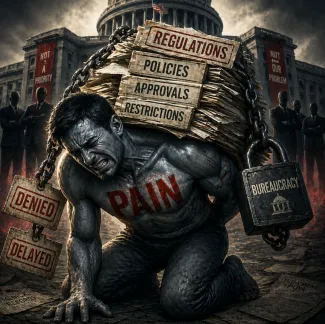
For a decade now, the so-called “opioid crisis” has been framed almost entirely in one narrative direction. We were made aware, and rightly so, of overdose deaths, pill mills, and other forms of reckless and irresponsible prescribing. However, another crisis was created in response, one that has received far less proportionate attention and moral seriousness: the abandonment and stigmatization of pain patients.
This crisis has an origin. The reality is that there were pill mills, and there were legitimate bad actors. To suggest otherwise, or to deny that there were prescribing environments bearing little resemblance to serious medicine, would be not only irresponsible but dishonest. The state of Florida became an unfortunate emblematic symbol of that breakdown, and efforts to deter bad actors and irresponsible prescribing cannot be dismissed out of hand. Anyone who attempts to do so risks ethical, moral, and rational incoherence.
However, this is not to suggest that the response was wise or proportionate. The central and most salient failure of the opioid panic was not genuine caution, but overgeneralization. A medical and political response arguably justified by an acute and statistically unusual series of events became, instead of caution, a hardened orthodoxy of broader cultural suspicion and stigma, one that flattened together the real and pronounced differences between criminal diversion, poor medical practice, addiction, and legitimate long-term pain care. Once this happened, pain patients were treated not as suffering people in need of care, but as metrics of risk, both to themselves and to providers.
This is where an essential distinction must be made. Science-based medicine is not merely the application of whatever evidence happens to be most administratively expedient or politically advantageous. Properly understood, it is broader and more foundational. It requires causal reasoning, mechanistic understanding, clinical judgment, and the capacity to interpret evidence proportionally in relation to the patient before you. It requires not only asking what trends in the general population may suggest, but more importantly, what those trends justify, and what they do not justify, in particular cases.
The fallout in pain medicine was not the triumph of science-based medicine, but the reduction of medicine into a bureaucratic and politically regressive form. Evidence, once detached from the deeper forges of scientific philosophy, can become not a guide but a warden, and when severed from humanity, a tyrant.
The first casualty of this tyranny is the very kind of thinking that gave rise to scientific inquiry in the first place. Population-level abstractions, further abstracted, begin to displace the doctor-patient relationship itself. What is then cited as caution becomes, instead, a capitulation before the admittedly difficult but necessary task of individualized care.
Once this paradigm shifts, the ramifications for pain patients are no longer accidental or incidental. They become structural.
Once this paradigm shifts, the ramifications for pain patients are no longer accidental or incidental. They become structural. The patient in severe pain is no longer seen first as a suffering person deserving of judgment, nuance, and, perhaps more importantly, science-based but humanly administered care. Instead, that patient is increasingly and disproportionately filtered through prior narratives of risk assessment, liability, and institutional fear. What should be a clinical relationship grounded in reciprocal humanity and understanding becomes morally and politically distorted in advance, and the pain patient is left to reckon with a medical system that fears its own tools more than it fears the suffering that betrays the profession itself.
The ramifications of this distortion have been neither abstract nor rare. Pain patients across this country have faced forced tapering, abrupt discontinuation, dismissal from care, worsening pain, loss of function, and profound psychological deterioration. Many have been treated as though continued need itself were evidence of moral or clinical pathology. Others have learned that stability on a long-term regimen offers little protection once a physician, clinic, or other institution becomes more afraid of scrutiny than of causing preventable suffering. In this environment, medicine does not merely fail to treat pain. It burdens an already vulnerable and stigmatized population with further alienation before a system that has already decided they are more dangerous to treat than deserving of care.
If any lesson has been learned over the past decade, it is that medicine cannot respond to one crisis by escalating another and then vicariously flattening that into the term “success.” A genuinely science-based medicine and ethic would have been capable of distinguishing abuse from care, panic from prudence, and population-level risk from the needs of the suffering person before it. Pain patients did not lose value because opioids became politically and narratively radioactive. They did not become invalid because fear and risk were flattened into a single governing logic. Nor did they deserve to be abandoned in the name of a hasty and histrionic response that more often than not confused bureaucratic defensiveness with moral seriousness. Pain patients, as with any other patient population, deserve far better than what they have received, and they still do.

BJ Saylor
L.B. Joshua Saylor holds a B.A. in Mathematics and is currently pursuing an M.S. in Mathematics. Writing as both an independent scholar and a chronic pain patient, BJ focuses on medicine, pain policy, scientific reasoning, and the critique of pseudoscientific and anti-scientific narratives that distort patient care.