
Much of our medical school education focuses on our underlying biochemistry, with rare exceptions, such as scattered discussions of orthopedics, where we consider biomechanics, forces, motion, and structure. However, the two are not separable, and biomechanics has much to teach us beyond muscle movement and strain.
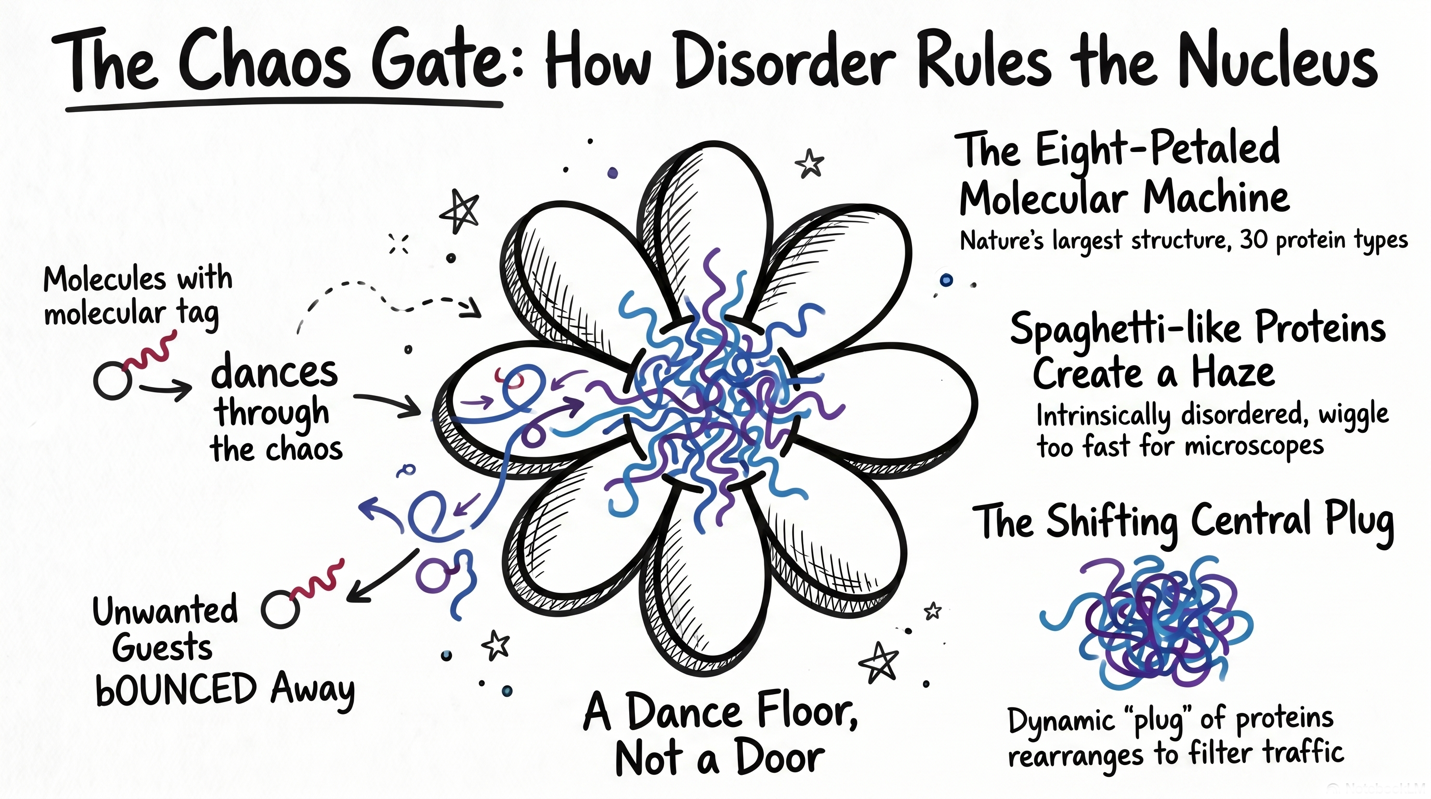
“The nuclear pore complex — a massive gate controlling traffic into the cell nucleus — works not with rigid parts but with a dynamic cloud of disordered proteins that selectively filter molecules.
“From the front, it looks like an eight-petaled flower; from the side, like a flying saucer. Its center opening spills over with spaghetti-like proteins tethered to the inner walls of the complex. ‘It’s a thing of enormous beauty,’ said Brian Chait.”
From Quanta, Disorder Drives One of Nature’s Most Complex Machines
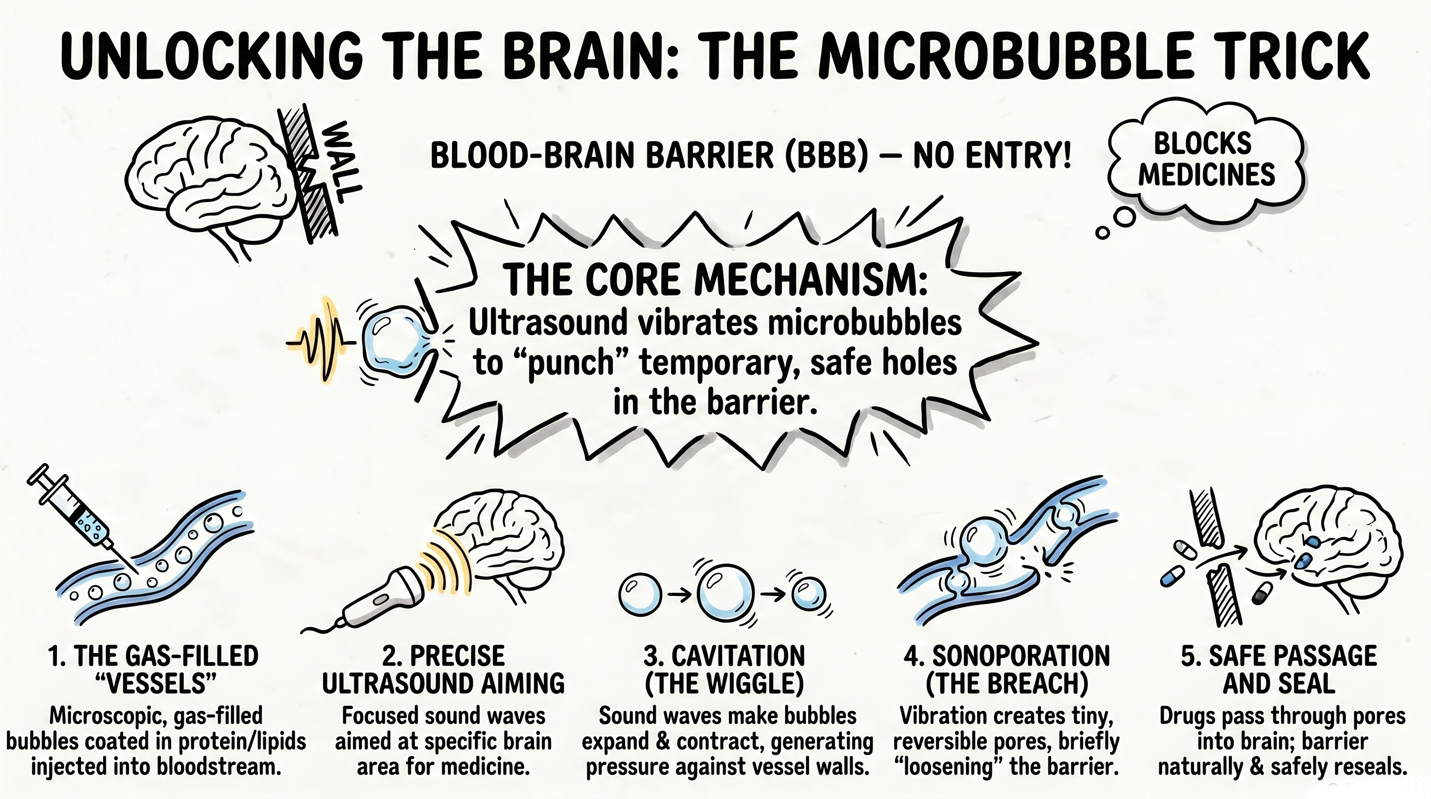
“One of the central problems in medicine is delivering drugs in the body, at the right time, place, and concentration. In many cases, less than one percent of an injected cancer drug dose actually reaches the tumor. The body is difficult terrain to navigate and unforgiving to outsiders. Some drugs need to evade immune cells, and many fail due to unsuccessful delivery. But the brain is even more forbidding. It has a defensive barrier that excludes nearly all large drugs, such as antibody therapies and nanoparticles, and most small molecule drugs, such as most chemotherapy drugs.”
Most of our approaches to crossing the blood-brain barrier have been chemical, but ultrasound, focused on microbubbles, creates enough of an “explosion” to temporarily loosen the blood-brain barrier’s physical connections, allowing medicines to reach previously guarded targets. From the Works in Progress newsletter, Microbubbles
The apocryphal story of Frankenstein’s origin is the work of a talented but bored foursome spending a stormy summer on the banks of Lake Como. It was here that Mary Shelley wrote Frankenstein on a dare to pass the time, as the unseasonable thunderstorms and lightning produced by the volcanic eruption of Mount Tabarra, and the recent work of Galvani in bringing a frog’s leg to life with electricity, were the talk of the town. However, as with all good stories, there are alternatives that are equally possible and fascinating.
“Mary Wollstonecraft Godwin Shelley began writing “Frankenstein; or, the Modern Prometheus” when she was eighteen years old, two years after she’d become pregnant with her first child, a baby she did not name. “Nurse the baby, read,” she had written in her diary, day after day, until the eleventh day: “I awoke in the night to give it suck it appeared to be sleeping so quietly that I would not awake it,” and then, in the morning, “Find my baby dead.” With grief at that loss came a fear of “a fever from the milk.” Her breasts were swollen, inflamed, unsucked; her sleep, too, grew fevered. “Dream that my little baby came to life again; that it had only been cold, and that we rubbed it before the fire, and it lived,” she wrote in her diary. “Awake and find no baby.”
Pregnant again only weeks later, she was likely still nursing her second baby when she started writing “Frankenstein,” and pregnant with her third by the time she finished.”
From the New Yorker, The Strange and Twisted Life of “Frankenstein

Chuck Dinerstein, MD, MBA
Director of Medicine
Charles Dinerstein, MD, MBA, is the Medical Director of the American Council on Science and Health. A vascular surgeon with more than 25 years of clinical experience, he brings a physician's understanding of medical decision-making, an appreciation for scientific uncertainty, and a broader perspective on healthcare economics and policy to his writing.