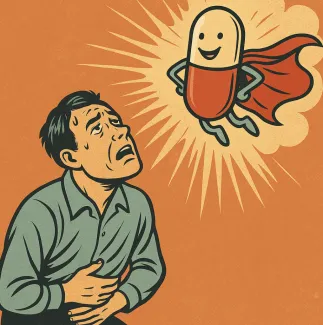
Once again, welcome to the town of Norovirus Hypeville. It's been a busy place over the past decade or so, and the residents have little to show for it.
Or maybe this is (finally) the real thing.
Wanna make (or more likely, lose) some fast money? Here's some mighty peppy PR courtesy of the Raging Bull website, reporting on a presentation at the 9th International Calicivirus [1] Conference in Banff, Alberta
"Buckle up, traders! As of this writing, Cocrystal Pharma, Inc. (Nasdaq: COCP) is stealing the spotlight, with its stock soaring over 60% today, and for good reason."
and...
"This news, hot off the press from September 12, 2025, is the rocket fuel behind today’s massive stock spike."
Is it a coincidence that the word "Bull" is the name of the site? Maybe, maybe not.
However, they do add the following disclaimer:
"Then there’s the clinical risk. While Phase 1 data [of its candidate CDI-988] looks promising, with no serious side effects and good tolerability, the upcoming Phase 1b study is a “human challenge” trial—meaning healthy volunteers will be deliberately infected with norovirus to test the drug. If the results don’t live up to the hype, the stock could take a hit."
Could take a hit? That's the understatement of the day. It's more like a walk-off grand slam in extra innings of game 7 of the World Series.
Still, most people who are not fond of spewing up half of their internal organs during a norovirus bout would welcome such a breakthrough. Does CDI-988 have what it takes to succeed where many others have failed?
Here are the key questions you should ask when they see hype from a biotech (especially a one-trick pony) [2] in order to determine if the discovery has a realistic chance of becoming a useful therapy.
- Is the hype based only upon a positive signal from cell-based assays?
- Has it shown efficacy in an animal model (if one exists)
- Has it progressed into human clinical trials?
- If so, at what stage?
For CDI-988, the answers are:
- No. The company is not relying solely on cellular experiments, but...
- No. Although there are a number of animal models of norovirus infection (none fully verified), I could not find any evidence that Cocrystal used any of them.
- Yes.
- Phase 1b* – no challenge trial yet, so we have no idea if it works.
- That's why the hype is...mostly hype.
*I cannot emphasize enough that a reduction in viral shedding or evidence of an immune response — results we’ve seen so far — is not nearly enough to make an effective drug or vaccine. In Phase 2 efficacy trials, we need to see people who are deliberately infected (I’ll sit this one out) actually become less sick. Without that, the results don’t mean much
Norovirus is especially challenging.
With norovirus therapies, there has been a big red stop sign between Phase 1 (primarily focused on safety) and FDA approval. No one has ever passed go (either vaccine or therapy) or even come close. Immunogenicity and even decreased shedding have been demonstrated in humans, but nothing has worked well enough in challenge trials to be considered as a therapy. [3]
Failures have included vaccine candidates from Ligocyte, HilleVax, Takeda, and Vaxart, the bomb I bought [4].
This isn’t to say antivirals don’t work — in fact, they’ve transformed the fight against many other viruses.
For the most part, modern antiviral research has been quite successful in preventing, treating, or even curing viral infections. Here are a few examples.
- Infections we’ve beaten or controlled (HIV, HCV, HBV, RSV, HPV, rotavirus, COVID)
- Infections still defiant (rhinovirus, herpes, norovirus)
Even if CDI-988 works, then what?
Given that scientists have learned how to design and develop antiviral drugs (based on the HIV/AIDS model), let's assume that CDI-988 is an effective inhibitor of norovirus replication. This is not far-fetched; mechanism-based inhibitors [5] have completely revolutionized the treatment of certain viral infections. This would be an enormous scientific accomplishment. But when would you take the pill? That's a big question here.
For example, Valtrex (herpes) is efficacious when taken at the first sign of a cold sore or in suppressing recurrent genital herpes outbreaks. Both Paxlovid (for COVID) and Tamiflu and similar drugs (for flu) must be taken early in the infection. AIDS and hepatitis C drugs can be taken at different stages of infection.
How would CDI-988 be used? This brings up some interesting questions. It might make sense to take a norovirus inhibitor prophylactically before a cruise. What about uninfected family members, again prophylactically, when a kid comes home sick with it? These seem like reasonable possibilities.
Here's an unreasonable possibility? Winter is the primary season for infection in the US; 20 million people (5% of the public) catch it per year, mainly in the winter. Having healthy people taking it all winter is crazy.
Another issue - timing
Norovirus hits fast and hard. Once nausea hits, vomiting usually follows shortly thereafter. Then it's too late. By then, the virus has infected your small intestine and created billions of progeny viruses, many of which are already in the toilet or on the floor. Even a drug with unmatched efficacy in preventing replication (how all antiviral drugs work) is going to be too late to the puke party.
Bottom line
If you take the Raging Bull's advice and buy the stock, you're betting that not only will the company have come up with the world's first and only anti-norovirus drug, but also figure out how to use it.
I wish them nothing but success, but I'm gonna sit this one out.
NOTES:
[1] Norovirus belongs to the Calicivirus family of viruses
[2] Let's call them a 1.5-trick pony. They have a flu drug in the pipeline.
[3] In some trials, a number of endpoints have been met, but none of the candidates have demonstrated any real efficacy.
[4] Disclaimer: Yes, I own some Vaxart stock. Last time I looked it was worth enough to buy 1.5 hotdogs and a small Coke.
[5] Successful antiviral drugs all work by a defined mechanism: they inhibit specific steps in the viral life cycle. Examples include polymerase inhibitors and protease inhibitors, which block essential enzymes. These inhibitors interact directly with the virus’s molecular machinery, a fit we can actually visualize using x-ray crystallography and molecular modeling. That’s why random repurposed drugs did not work against COVID-19. Without a validated viral target, they provide no clinical benefit . This is why ivermectin failed, and the rationally designed Paxlovid succeeded.