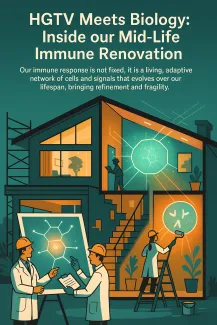
A new study explores this intricate journey, revealing that immune aging is not merely a process of decline but a complex recalibration that begins long before overt immune weakness appears. Just as a contractor inspects both the foundation and the framework, researchers examined how each layer of the immune system evolves with age.
Mapping the Midlife Makeover: Tracking Immunity in Transition
To study how the immune system changes at midlife, researchers compared adults aged 55–65 with those aged 25–35. Over nearly two years, they tracked more than 300 healthy participants—including through flu seasons—to map how immune responses evolve over time. Their analysis of the immune “proteome”—the full set of proteins linked to immune function (such as signaling molecules and antibodies) —identified 69 proteins that changed consistently with age.
Those shifts led researchers to the immune system’s command center—the T cells, where aging’s earliest blueprints begin to show.
The Control Room Rewired: T Cells Take Center Stage
Researchers found that most of the detectable shifts occurred within T cells, our immune system’s orchestrators and memory keepers. Other players, like B cells, natural killer cells, and monocytes, remained essentially unchanged. However, within the T cell family, three major subtypes were subtly transformed:
- Naive T cells, the “fresh recruits” that have never encountered an antigen, form the body’s reserve force, ready to respond to new infections. With age, these cells showed the greatest number of gene expression changes, suggesting that, even before their numbers decline, their molecular behavior begins to shift.
- Central memory T cells are the “strategists,” storing knowledge of past infections and coordinating rapid responses when familiar pathogens reappear. These cells also exhibited significant age-related transcriptional changes, suggesting that immune “memory” is recalibrated over time.
- Effector memory T cells are the rapid responders handling recurring threats. Their gene expression patterns changed too, but to a lesser degree, indicating that the most active defenders are somewhat more stable than the naive or central memory cells.
Silent Upgrades: Aging Without Inflammation
Notably, these molecular shifts unfolded without evidence of systemic inflammation. CMV is a chronic pathogen often associated with low-grade inflammation, and its impact on the immune proteome helped disentangle the effects of aging from those of chronic infection and inflammation. While there were highly targeted and stable alterations in specific immune cell populations, individuals in the study cohort who were CMV+ showed no elevation in inflammatory proteins or markers of aging, nor were immune cells more aged or “exhausted.” CMV reshapes specific cellular niches and leaves an enduring imprint, but it does not accelerate the molecular transformations that define natural immune aging.
The clearest test of this cellular remodeling came when the immune system was challenged in real time—with the seasonal flu vaccine.
Stress Test: What the Flu Vaccine Reveals About Immune Resilience
The response to influenza vaccination, which we know falters with age, necessitating “stronger” influenza vaccines for those over 65, provided a real-world measure of immune resilience. Here, the researchers shifted focus to our B cells, the antibody-producing cells, that are essential for remembering past infections and rapidly responding to new ones. While most influenza strains elicited similar antibody levels in young and older adults, one strain produced a weaker response in older adults before and after vaccination. A more detailed look found that while antibody levels lasted just as long, their initial strength was lower. That weakening traces back to how helper T cells “coach” B cells during vaccination—a dialogue that seems to falter with age, making B cell responses less efficient and less adaptable.
A particularly striking change involved the process by which B cells shift from producing early-response antibodies to more specialized forms, known as antibody class switching. Aging skews antibody production toward less potent forms, weakening vaccine protection even when antibody levels appear normal. The researchers traced this bias to age-related changes in helper T cells, which coordinate and “coach” B cells during vaccination.
As we age, the conversation between T cells and B cells begins to falter, and B cells become less able to fine-tune antibodies. Aging appears to reshape T cell identity and function from within, a cellular reprogramming that develops before advanced age and does so in the absence of systemic inflammation.
The Fading Conversation: When T Cells Stop Coaching B Cells
The research fundamentally supports the notion that the immune system doesn’t decline in a steady, predictable way; rather, its changes are shaped by a blend of internal programming (like genetic and cellular regulation) and external pressures (such as infections or vaccines). This study revealed that even before old age, the immune system undergoes a gradual yet profound shift, particularly within T cells, independent of chronic infection or inflammation. Aging rewires immune communication, changing how T and B cells “talk” to each other.
Renovation, Not Ruin: Rethinking the Story of Immune Aging
In the end, immune aging is less a story of deterioration than of resilient reorganization. Rather than collapsing, our immune system subtly restructures itself—adjusting how T cells and B cells communicate, recalibrating molecular pathways, and redefining what “immune balance” means with time. These shifts represent an adaptive reconfiguration, not a failure, as the immune system reprioritizes its responses and resources in later life.
Source: Multi-omic profiling reveals age-related immune dynamics in healthy adults Nature DOI: 10.1038/s41586-025-09686-5

Chuck Dinerstein, MD, MBA
Director of Medicine
Charles Dinerstein, MD, MBA, is the Medical Director of the American Council on Science and Health. A vascular surgeon with more than 25 years of clinical experience, he brings a physician's understanding of medical decision-making, an appreciation for scientific uncertainty, and a broader perspective on healthcare economics and policy to his writing.