
“I know it when I see it”
Those are the words Justice Potter Stewart used when struggling to define obscene pornography. Ultra-processed foods (UPFs) present a similar challenge: they feel intuitively recognizable, yet establishing clear boundaries around the concept is difficult. Any regulation targeting UPFs will need a precise definition to prevent endless loopholes for manufacturers, special interests, and attorneys. A recent opinion piece in Nature Medicine helps frame the debate and offers its own solution to the problem of definition.
What the science actually measures
There is no scientific consensus on how to define UPF. Most research uses the NOVA classification system, which categorizes foods partly by the presence of “cosmetic additives” and processing methods unlikely to happen in home kitchens. While NOVA accounts for industrial formulations and supports public health messages based on epidemiologic research, its inconsistent classification between processed and ultra-processed foods, along with its emphasis on processing instead of nutritional quality, limits its usefulness as a scientific measure of food quality and as a regulatory standard.
The authors argue that regulating foods solely by listing prohibited ingredients is always incomplete. Manufacturers can often replace one additive with another that serves a similar purpose. Further complicating matters, many additives have multiple functions. For instance, xanthan gum is a fermentation-derived polysaccharide ground into a powder that thickens liquids and stabilizes mixtures. Although it is often used to enhance texture and appearance, it can also slow physical deterioration and extend shelf life. In practice, the same ingredient may serve both as a cosmetic additive and a preservative.
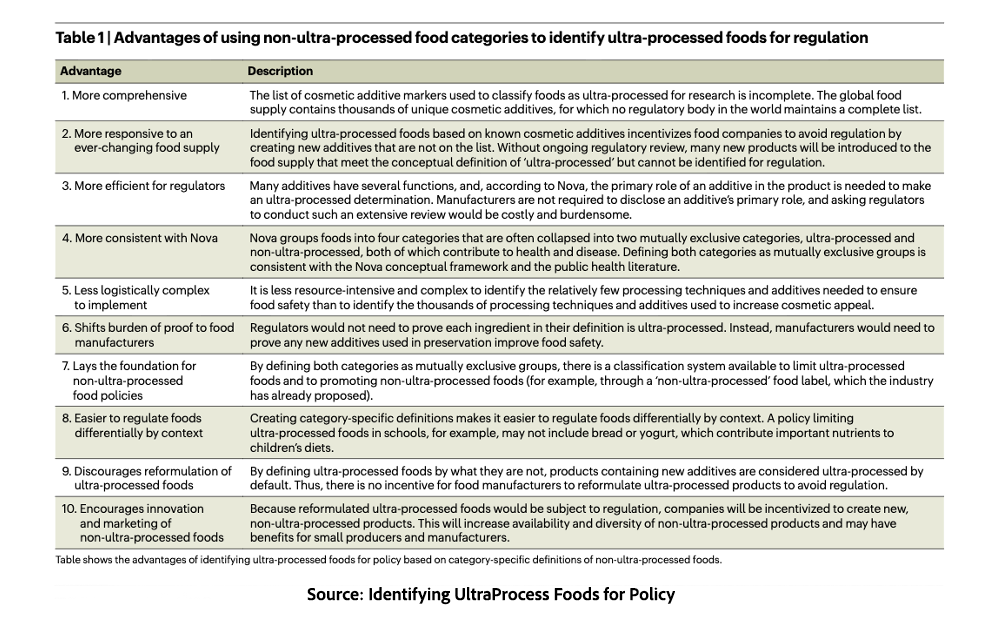
Because the NOVA classification, flawed or not, underpins most of our research on UPFs [1], the authors are hesitant to discard it completely. Instead, they suggest reversing the approach: rather than defining ultra-processed foods directly, policymakers could specify what does not qualify as a UPF.
Not-UPFs
They suggest that not- UPFs be defined by combining NOVA’s three other categories, unprocessed, ingredients, and processed, along with “technical expertise” on how it is produced and “what it must contain to meet biological safety and hygiene regulations.”
But invoking “technical expertise” inevitably introduces human judgment and potential bias. The authors offer yogurt as an example: milk, live cultures, and “ingredient” additions such as fruit, nuts, or honey would count as non-UPF. However, any other additive would automatically classify the product as ultra-processed. Even this rule has exceptions. Lactase enzymes, which are produced industrially and rarely used in home kitchens, might still be permitted because they “remove allergens rather than increase durability and cosmetic appeal."
By exempting lactase because it reduces allergens rather than enhancing “cosmetic appeal,” the authors unintentionally reveal a deeper challenge: that defining UPFs often depends less on the ingredient itself than on how and why it is used.
“We eat first with our eyes.” Additives, Shelf Life, and Consumer Perception
Long before refrigeration or microbiology, appearance offered a quick survival signal: mold meant danger, discoloration meant spoilage, and unusual textures suggested decay. We continue to make judgments about freshness and quality before the food even reaches our mouths. Bright greens in vegetables, golden browns in bread, or creamy whites in dairy products serve as evolutionary signals of freshness and quality. Dull produce, grayish meat, and separated yogurt all give the appearance of spoilage, even if they remain perfectly safe.
These instincts evolved in a world with short supply chains and quick consumption—conditions very different from modern food distribution.
Modern food production operates under very different conditions than traditional cooking. Today’s farm-to-table journey often spans long distances and several weeks. During this time, foods are exposed to temperature changes, oxygen, moisture variations, and physical movement, all of which can affect flavor, texture, and appearance.
The “chemical additions” used in modern foods balance three competing goals: safety, shelf life, and consumer perception. Critics of UPFs often see these additives as signs of industrial manipulation and potential health hazards. Manufacturers, on the other hand, view them as practical tools that help foods stay fresh through modern distribution systems without spoiling.
Bread made from flour, water, yeast, and salt will begin to develop mold within three to five days. If you are making it yourself or buying from a local bakery, this is manageable. However, national distribution, which benefits from economies of scale, i.e., lower prices, has a longer temporal chain. Calcium propionate slows mold growth, allowing bread to stay fresh for roughly a week or more. In this case, the additive helps extend microbial safety and reduces spoilage.
Other additives address what might be called cosmetic stability rather than microbial preservation. Fruit yogurt, for instance, often contains stabilizers like pectin that keep the fruit evenly distributed and prevent whey from separating. Without stabilizers, yogurt may develop a layer of liquid after several days. This separation is harmless, but many consumers interpret it as a sign of spoilage. Stabilizers help maintain the uniform texture people associate with freshness.
Research on food waste shows that consumers rely heavily on visual and sensory cues when deciding whether food is still acceptable to eat. Harmless physical changes often lead people to discard perfectly safe products. Individuals who prioritize appearance, smell, and taste tend to waste more food overall. Date labels add to the confusion, as many consumers interpret “best by” or “best before” as safety warnings rather than indicators of peak quality. Together, these behaviors help explain why additives are used not only to slow microbial spoilage but also to preserve the visual cues that signal freshness. In some cases, these additives may reduce food waste.
Cornflakes and the Ambiguity of Processing
Consider the cornflake, an invention by the brothers Kellogg. It resulted from a fortunate accident when boiled wheat went stale and was rolled into flakes. While one brother was excited about its nutritional value in a vegetarian diet, the more entrepreneurial brother realized that using corn provided a more “satisficing” crunch, and a light dusting of sugar enhanced both its flavor and sales. Today, grains such as wheat, corn, rice, or oats are processed by extruding them under high temperatures and pressures. Heating kills any bacteria, and extrusion creates a light, porous, low-moisture structure that offers crispness and hinders microbial growth.
Is this the kind of ultra-processing that should concern us, or simply a practical way to preserve food? In truth, it is both. High temperatures during extrusion produce toasted flavors and gelatinize starches, making them easier for digestive enzymes to break down. However, that same increase in digestibility can also raise the cereal’s glycemic response. Cornflakes can therefore seem both nutritionally beneficial and metabolically problematic, depending on which aspect we focus on.
When Definitions Become Policy
As nutrition policy researcher Alyssa Moran observes, “Once we’ve codified how those products are defined, it sets the groundwork for all kinds of policies to regulate their marketing and sale.” In other words, definitions quickly become policy tools.
The same consumer expectations that create skepticism toward additives also boost demand for the visual, textural, and flavor consistency these additives provide. Some additives clearly focus on safety and stability, while others mainly preserve sensory qualities like color, texture, and visual uniformity. Therefore, the presence or absence of additives doesn’t fully define what people fear when labeling something as a UPF. The challenge in defining UPFs lies in deciding whether the key feature is the ingredient itself, the role it plays, or the broader industrial process involved. Understanding the purpose behind these chemical additions is often complex and influenced by manufacturers, the MAHA moms, and regulatory agencies.
This tension reveals a broader problem: the concept of UPFs may be less a precise scientific category than a model of what we suspect is harmful in modern diets.
We are unlikely to arrive at a perfectly satisfying definition of UPFs because the term often serves as a model for what we see as harmful in modern food systems. Like all models, it simplifies reality. A regulatory definition might still be helpful, but it will function within a food environment shaped by decades of technological advances, economic incentives, and human preferences. What is produced, how it is distributed, and what ultimately appears on our tables are the results of long-evolving systems. Even the most carefully developed definition of UPFs will find it hard to change that built environment overnight. Therefore, such definitions may serve best as guiding tools rather than strict boundaries.
[1] The most important exception is the work of Kevin Hall
Source: Identifying UltraProcess Foods for Policy Nature Medicine DOI: 10/1038/s41591-025-04108-5

Chuck Dinerstein, MD, MBA
Director of Medicine
Dr. Charles Dinerstein, M.D., MBA, FACS is Director of Medicine at the American Council on Science and Health. He has over 25 years of experience as a vascular surgeon.