The Limits of Hedonic Eating
For decades, a prevailing narrative of the obesity epidemic has focused on the idea that modern food is simply too delicious for our self-control to handle, “hedonic eating.” Modern diets—full of rich, calorie-dense, highly palatable foods—overwhelm the body’s natural ability to regulate hunger. Pleasure wins, biology loses.
But what if that story is wrong? What if we’ve been focusing on the wrong signal?
Consider one of the most famous experiments in science, and a staple of Psychology 101: Pavlov’s dogs. Ring a bell, present food, repeat. Eventually, the dog salivates at the bell alone. The lesson was clear: behavior can be shaped by learned associations. But what if the bell isn’t outside the dog, but within?
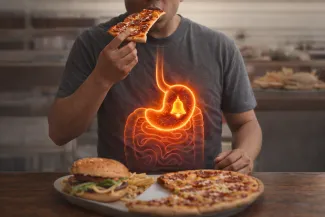
A growing body of research suggests that the real drivers of our eating may lie beneath our awareness. Instead of taste and pleasure calling the shots, unconscious physiological signals may be doing most of the work. Our brain may be listening less to the tongue and more to the gut.
Two Systems, One Appetite
This perspective reframes eating as the product of two parallel systems. One, the familiar conscious experience of flavor—taste, smell, texture, and all the expectations that come with them. The other is a hidden network that senses nutrients in the body and sends signals directly to the brain’s reward circuits. A “high road” of conscious perception and a “low road” of unconscious biology, with the low road often having the stronger pull.
Why “Liking” Doesn’t Predict Eating
One sticky assumption in nutrition science is that people with obesity are more sensitive to the pleasure of food. However, evidence is mixed. Some large-scale studies suggest that individuals with higher BMIs do not consistently report greater enjoyment of sweet or fatty foods than lean individuals. In fact, estimates from controlled studies suggest that palatability, the conscious enjoyment of a meal, may explain only a small fraction of the variation in how much people eat.
Pleasure isn’t just taste. It’s a blend of sensory input, expectations, memories, hunger, and even context. The same food can feel delicious or unappealing depending on how hungry you are, what you believe about it, or how it looks on the plate. What we mean by “liking” a food is just one piece of a much larger puzzle. In fact, what we choose, our preference, is not necessarily the same as what we like or find pleasurable. While taste can influence what we pick initially, it turns out to be a poor predictor of how much we ultimately consume.
Research suggests that individuals prone to weight gain often show stronger brain and behavioral responses to food-related cues. They may be more likely to eat when exposed to such cues, even in the absence of hunger. Notably, these responses do not always align with reported pleasure, highlighting a gap between subjective experience and behavior.
Learning to Crave Calories
To understand what’s going on, researchers turned to a process described as flavor-nutrient conditioning – a variant of Pavlov’s operant conditioning where your brain links a food’s flavor (palatability) with its calorie content. Your brain learns, “this taste gives me energy,” and the body teaches itself what is “valuable” without relying on conscious taste.
Classic flavor-nutrient conditioning experiments showed that animals regulate their intake based on calories rather than taste. Even when flavors are arbitrary or artificially assigned, animals quickly learn to prefer those associated with higher energy.
Humans show similar patterns. Brain imaging studies reveal that reward centers respond more strongly to calorie content than to reported liking. Our brain tracks energy, not enjoyment. Not convinced?
Consider the experience of eating cold, day-old pizza. You know it doesn’t taste as good as yesterday, but your unconscious continues to receive signals from the energy-providing fat and starch, allowing you to continue munching long after the initial pleasure has vanished.
If taste isn’t the main driver of reward, where is that signal coming from?
The Gut as a Hidden Sense Organ
The Pavlovian bell is the physiological response unfolding deep in your gut.
As food is digested, nutrients are detected by sensors in the gastrointestinal system. These signals are then transmitted to the brain via neural pathways involving the vagus nerve and metabolic processes such as glucose utilization. For a long time, gut-brain pathways, such as GLP-1 signaling, were thought to signal only fullness or discomfort. But new research shows something very different: some of these pathways act like reward circuits. The rewarding signal for fats comes primarily from vagal activity, while the sugar rewards relies on a "post-absorptive" metabolic signal that detects glucose as it enters the bloodstream.
All of this happens largely outside conscious awareness. The bell rings. You just don’t hear it.
When Pleasure Fades but Eating Continues
The brain’s drive for energy is so deep that flavor itself is dispensable. You may notice that the first bite of food is intensely satisfying, while later bites are less so. This shifting pleasure is known as alliesthesia: the idea that how good something feels depends on the body’s internal state.
If you repeatedly taste something sweet without swallowing it, it continues to taste good. But if you swallow it, its pleasantness gradually declines, as nutrients are absorbed. Our unconscious internal state, hunger, fullness, and metabolic signals actively reshape how food feels. The brain isn't just seeking flavor; it is seeking a metabolic result. As the physiologist Adolph noted in 1947: “Rats eat for calories.” Humans are no different
Two Minds at the Table
What emerges from all this is a picture of eating controlled by two overlapping systems.
One is conscious. It processes flavor, forms preferences, and gives rise to the experience of liking or disliking food. This is the system we trust, because we think it is in charge. The other operates below awareness, tracking nutrients, detecting energy, reinforcing behaviors that deliver calories. This system doesn’t care how food tastes. It cares what food does.
The key insight is that these systems are only partially connected. You can be pulled toward foods not because they taste good, but because your body has silently learned that they are energy-rich. In experiments, people are often poor at estimating the calorie content of foods. Yet their behavior responds accurately to actual energy density, as they are willing to work harder or pay more for foods with higher caloric value.
When Culture Aligns with Biology
The shift from a "hedonic" to an unconscious "metabolic" model of eating requires a rethinking of behavioral strategy towards obesity. If our choices are driven by the subliminal Low Road, we must look beyond the fragile conscious restraints of labeling, education, or willpower. The recent effectiveness of GLP-1–based drugs, which appear to reduce appetite and “food noise,” may reflect an intervention at this deeper physiological level.
Despite diets that seem indulgent on the surface, both countries show lower obesity rates than expected. Both cultures prioritize quality and taste while featuring energy-dense foods such as pasta, bread, cheese, and tempura. Both have structured eating patterns, a clear start and stop to eating, i.e., less snacking, smaller portion sizes, slower eating allowing for physiologic feedback to emerge, and a better alignment between flavor and nutrition where taste more reliably predicts caloric impact. Finally, both show stronger social norms towards eating, it is more social, less impulsive or isolate and “hara hachi bu” (腹八分), the Japanese eating principle to “Eat until you are about 80% full.”
In these cultures, the external signals of eating—flavor, portion size, meal timing, and social context—remain tightly synchronized with the internal physiological signals that follow digestion. The brain learns accurate associations between flavor and nourishment. Pleasure doesn’t override regulation because it is aligned with it.
In contrast, our modern ultra-processed food environments distort this system, altering flavor cues while providing calories in forms that bypass or confuse normal gut signaling. The result is misaligned conditioning.
The Bell Within
Pavlov’s dogs learned to salivate at the sound of a bell because it predicted food. For us, the bell is inside, ringing in our gut and bloodstream, in the chemistry of digestion. We don’t hear it, but our brain does. And over time, it learns to follow its sound.
Sources: Are ultra-processed foods too tasty? Toward a metabolic framework for diet and obesity PLOS Medicine DOI: 10.1371/journal.pmed.1005025
Rethinking Food Reward Annual review of Psychology, DOI: 10.1146/annurev-psych-122216-011643
Tastiness is not why people overeat STAT

Chuck Dinerstein, MD, MBA
Director of Medicine
Dr. Charles Dinerstein, M.D., MBA, FACS is Director of Medicine at the American Council on Science and Health. He has over 25 years of experience as a vascular surgeon.