For those who question Andrew Kolodny’s grasp of drugs and pharmacology, his latest op-ed, which somehow found its way into The Conversation, offers yet another opportunity to see just how tenuous that grasp really is. This time, he takes on kratom.
For years, Kolodny has been one of the most visible and relentless voices behind the effort to cast prescription opioids as an existential public health threat. The result has been widely criticized: millions of patients left undertreated, abruptly cut off, or with few viable options—and widespread suffering in its wake. Patients didn’t stop needing pain relief when prescriptions became harder to obtain—they looked elsewhere. Some found kratom.
Now he warns about it.
If you’re looking for irony, there’s plenty to go around.
Even his title, “Kratom poisonings surged 1,200% over the past decade, and regulators are struggling to keep up with the dangers,” sets the tone. It’s the first of many questionable or misleading claims. Let’s take a look.
“Kratom poisonings surged 1,200% over the past decade.”
Where’s the denominator? This number tells us essentially nothing. Did poisonings go from 1 million to 13 million, or from one to 13? Without absolute numbers, this is less a measure of risk than a way to make a small problem sound large.
"At legislative hearings, families share tragic stories of lives cut short by kratom overdoses and addiction."
Anecdotes are a great substitute for data—especially for the disingenuous. They make for powerful testimony, but they tell us nothing about how common these events are or what’s actually behind them. It's a splendid manipulative technique.
But how much harm does kratom really cause? According to Dr. Jeff Singer, my frequent writing partner and author of a recent Washington Examiner article, very little. The risks of kratom have been consistently overstated, often by treating rare, highly confounded cases as if they were representative of typical use.
"On the opposing side, lawmakers are also hearing from lobbyists representing the kratom industry..."
When in doubt, cry corruption. Kolodny has accused ACSH of being "industry supported," insinuating that we're being paid off for our positions. Don't believe me? Let's go back to 4/2/19.

(Now that the shoe is on the other foot, my former colleague Alex Berezow has taken a closer look at Kolodny’s finances. For example, in 2016 he earned $463,000 as chief medical officer of Phoenix House—separate from his academic salary at Brandeis University. And that was hardly the end of it. [1])

"Kratom has also been found to contain high levels of lead, which can damage the brain and other organs. For women of childbearing age, kratom may pose a risk to the fetus if pregnancy occurs. And using kratom during pregnancy may lead to infants experiencing opioid withdrawal at birth."
Please. This is three bad arguments pretending to be one. Lead contamination is a product quality problem, not an inherent property of kratom. “May pose a risk” to women of childbearing age could just as well be referring to alcohol, slipping on a banana peel, or being kicked by a horse. And neonatal withdrawal, if it occurs, reflects opioid-like dependence—not the dramatic revelation it’s being presented as.
Notably missing is the obvious: poor-quality, unregulated kratom is being used as a substitute for pharmaceutical-grade prescription opioids. The irony is almost perfect. In the push to reduce the risks of regulated drugs, we’ve made room for something far less regulated—and far less understood, as my colleague Dr. Jeff Singer and I have written about for years.
"Kratom supporters often point to personal stories from users who say it helps them. These experiences should not be dismissed, but personal stories are not the same as scientific evidence."
Well, I'll be damned.
Personal stories are not scientific evidence. Of course not. But that makes Kolodny's earlier reliance on “heartwrenching” stories at legislative hearings more than a little convenient. Anecdotes are dismissed when they contradict his position and showcased when they support it. That doesn't sound so fair, does it?
And it’s the same story throughout: numbers without context, anecdotes used when convenient, and conclusions that go way beyond the evidence.
Finally...
"Kratom’s rising use over the past decade coincided with the opioid crisis, as people searched for alternatives to prescription opioids."
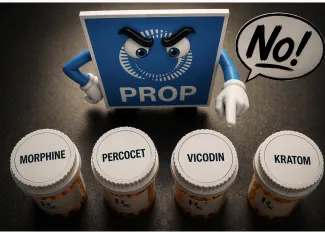
Could there be a better example of chutzpah—a child who murders both parents and then begs the court for mercy because he’s an orphan? Ask 1,000 pain patients who is most responsible for them being cut off from the painkillers that keep them functioning, and roughly 1,000 of them will name PROP (Physicians for Responsible Opioid Prescribing), an unelected anti-opioid cabal that has helped engineer the misery now faced by millions who, through no fault of their own, have been cut off from the analgesics they depend on.
And who has been the president of PROP for much of the group's long history? Why, Andrew Kolodny, of course.
I'm a little surprised The Conversation couldn't find someone better to converse with.
NOTE:
[1] According to an article in Pain News Network, Kolodny earned an estimated $500,000 (at $725 per hour) as an expert witness representing the state of Oklahoma. The article also discusses some tasty paydays for other members of PROP.

Josh Bloom
Dr. Jonathan (Josh) Bloom, ACSH's Director of Chemical and Pharmaceutical Sciences, earned his Ph.D. at the University of Virginia and completed postdoctoral training at the University of Pennsylvania. During his 20-plus years in drug discovery at Wyeth, his research group discovered the antibiotic Tygacil®, approved in 2005. He holds 25 issued patents and has authored 35 academic papers. Since joining ACSH in 2010, he has written more than 2,000 articles and dozens of op-eds for major newspapers, including The Wall Street Journal and Chicago Tribune.