In a recent Threads post, an expert pushed back against the unsolicited judgment often directed at women:
“There are some of y’all who are extremely committed to telling me, a surgical oncologist, that alcohol is a carcinogen when I claim it doesn’t cause breast cancer and only slightly raises the risk according to several studies. Can we please bring back critical thinking??”
To put critical thinking into practice, we must start with perspective. Breast cancer risk is driven primarily by factors we cannot change, such as age, genetic factors, family history, and breast density. These "heavy hitters" determine a woman’s baseline risk.
Lifestyle factors, such as alcohol, hormone therapy, and obesity, simply nudge that risk up or down. No level of alcohol consumption is completely risk-free, and the evidence consistently shows that breast cancer risk begins to rise even at low levels of consumption. But to understand alcohol’s true context, we need to set aside moral judgments, examine the underlying biology, and compare it directly with other common factors.
What Does an “Increased Risk” Actually Look Like?
You’ll often hear that alcohol raises breast cancer risk by around 10% per daily drink. That sounds significant—but it’s a relative increase, not an absolute one, and needs to be measured against a realistic baseline.
A major meta-analysis published in The Lancet estimated that the risk of being diagnosed with breast cancer between ages 50 and 69 is 6.3% (63 in 1,000) for average-weight women in developed countries who have never used hormone replacement therapy (HRT). The 50–69 age range is particularly useful for risk modeling because it captures the period when breast cancer is common and when the absolute effects of lifestyle factors such as alcohol, obesity, and HRT are most measurable.
The 6.3% figure is a population average that lumps women of differing risk profiles into the same statistical bucket. If we focus on the single largest baseline group of women (those with average breast density, without known genetic mutations, and no first-degree family history), the starting line drops further. For this specific group, the absolute baseline risk of developing breast cancer over those 20 years is typically 3% to 5% (30 to 50 cases per 1,000 women),
How Modifiable Factors Shift Risk
Using this real-world baseline as our benchmark and looking at modifiable factors side-by-side, a striking truth emerges: alcohol is not particularly perilous to this group and is similarly hazardous to other everyday factors we moralize over much less, like postmenopausal weight gain, or skipping regular exercise.
Here is how those individual choices shift the needle over a 20-year period:
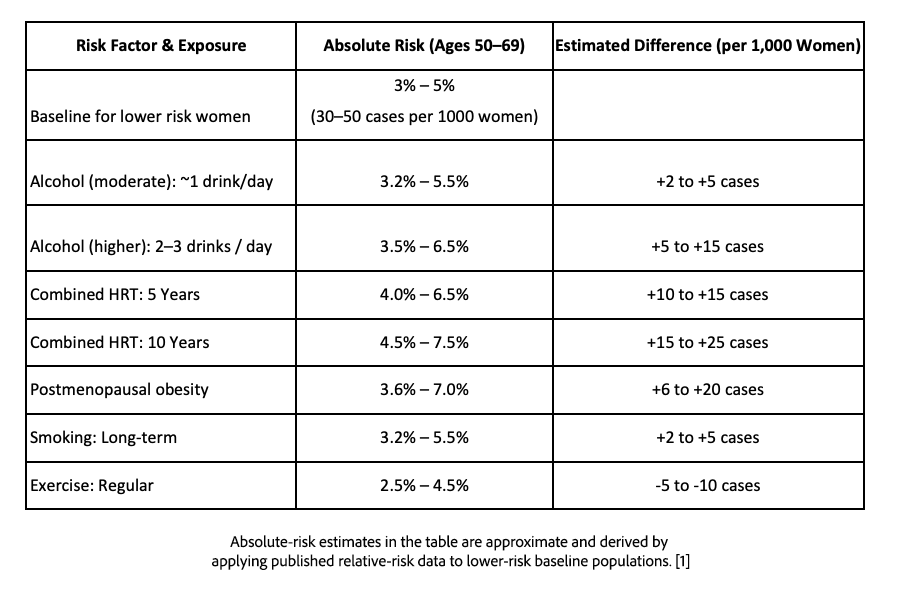
Risk factors are percentages, not fixed numbers. This means alcohol matters more if your baseline risk is already high. A 10% increase on a low baseline (30 per 1,000) adds only 3 cases; that same 10% increase on a higher baseline (80 per 1,000) adds 8 cases.
There is also a biological synergy at play: postmenopausal body fat acts as a 24/7 estrogen factory. Alcohol can increase circulating estrogen levels and may also contribute to oxidative stress and DNA damage. If baseline risk is already elevated due to weight, genetics, or breast density, alcohol may have a proportionally larger absolute effect.
The Biggest Drivers of Baseline Risk
While lifestyle gets the headlines, these non-modifiable factors are what truly move the needle between ages 50 and 69:
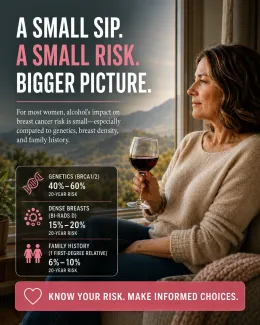
- Genetics (BRCA1/2): This is the single most significant driver of breast cancer. An alteration in the BRCA genes shifts the 20-year risk for women aged 50 and older from single digits to the 40% to 60% range, according to the American Cancer Society's data on inherited gene changes. This is why women with BRCA1 or BRCA2 alterations often consider prophylactic surgery; they aren't managing a "nudge," but a significant statistical probability of developing breast cancer over that 20-year period.
- Dense breasts: This is a double problem. First, dense tissue appears white on a mammogram and can physically mask a tumor. Second, denser breasts contain more glandular and connective tissue, creating a more biologically active environment in which cancer can develop. Women with extremely dense breasts (BI-RADS category D) have a four- to sixfold increased relative risk compared with women with fatty breasts (BI-RADS category A). In clinical risk models, this difference can translate into an absolute breast cancer risk of 15–20% between ages 50 and 70. Importantly, supplemental screening such as ultrasound or MRI can improve cancer detection in women with dense breasts.
- Family history multipliers: Having a mother, sister, or daughter with breast cancer roughly doubles a woman’s baseline risk. For a woman in the 50–69 age group who otherwise has low risk, American Cancer Society tracking data show this increases her risk from 3–5% to 6–10%. If you have two first-degree relatives with a history of breast cancer, that risk moves the line to 9–15%.
“No Safe Level”: True, but Not a Reason to Panic
The statement “there is no safe level of alcohol” is technically correct because risk begins to rise at the first sip. But in practical terms, “no safe level” does not mean “high risk.”
If you are at the lowest risk (3–5%) of being diagnosed with breast cancer over the next 20 years, a small glass of wine with dinner every night may increase that absolute risk by a percentage point. The psychological or social benefits of that nightly ritual may make you entirely comfortable accepting that tiny increase.
If, however, you have dense breasts and first-degree relatives with breast cancer, your baseline risk will be substantially higher before you even open the bottle. So a daily glass of wine may no longer add only a very small extra risk. For that woman, cutting back on alcohol becomes a much more meaningful lever to pull because her higher baseline risk amplifies the impact of each drink.
The bottom line on whether to go bottoms up is about personal choices and risk assessment. For most women, alcohol increases breast cancer risk by a relatively small absolute amount, and excessive worry about a nightly glass of wine should not distract from the bigger determinants of risk: knowing your family history, understanding your breast density,maintaining a healthy weight, and staying up to date with personalized screening.
[1] The Lancet (2019) – HRT and breast cancer risk meta-analysis
→ Source for modeled absolute-risk estimates and HRT-associated increases in breast cancer risk.
World Cancer Research Fund – Preventing breast cancer
→ Evidence summaries on alcohol, body weight, and physical activity as breast cancer risk modifiers.
Cancer Research UK – Breast cancer risk factors
→ Population-level breast cancer incidence data and contextual risk comparisons, including alcohol, obesity, HRT, smoking, and exercise.

Angela Dowden
Angela Dowden is a British health journalist, author, and Registered Nutritionist. She has nearly 30 years’ experience bringing food, nutrition, and health science to life for international audiences through her print and online work.