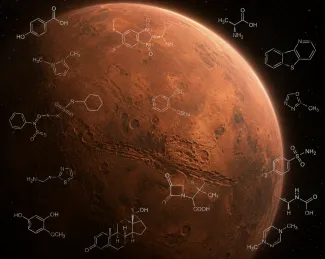
Scientists claim to have detected a bizarre collection of organic molecules in ancient Martian rocks, including compounds better known to petroleum chemists than planetary scientists. Some of the findings are probably real, some are probably artifacts, and all of them required an insane feat of analytical chemistry carried out millions of miles away on Mars.
Rebaccca Trager over at Chemistry World posted something that appears, at first glance, to be a silly April Fools’ joke. Trager’s summary of a Nature Communications paper reports on some odd chemicals that appear to have been detected on Mars. So odd, in fact, that it's worth questioning if they're really there.
Using gas chromatography and mass spectrometry aboard NASA’s Curiosity rover, scientists detected a strange assortment of organic chemicals (those that contain carbon, not the worthless Whole Foods definition) [1]. Among the reported compounds were naphthalene, benzothiophene, methylnaphthalene, and methyl benzoate—molecules more familiar to petroleum chemists than planetary scientists. Organic chemicals are the chemicals of life, and it’s mighty hard to look at this collection (many of which I’ve used in the lab) and not wonder whether Marvin the Martian was onto something.

Marvin the Martian is in a pissy mood. Image: Wikimedia Commons
Before asking whether these molecules were really present on Mars, perhaps the more germane question is how scientists can measure and identify such chemical structures in the first place. Fortunately, we have instruments on this planet called mass spectrometers. These instruments identify molecules by breaking them into charged fragments with highly characteristic patterns. Here’s (more or less) what they look like (Figure 1).
Stay curious. Stay informed. Free, independent writing delivered weekly
— no ads, no sponsored fluff.
Join Now
Donate
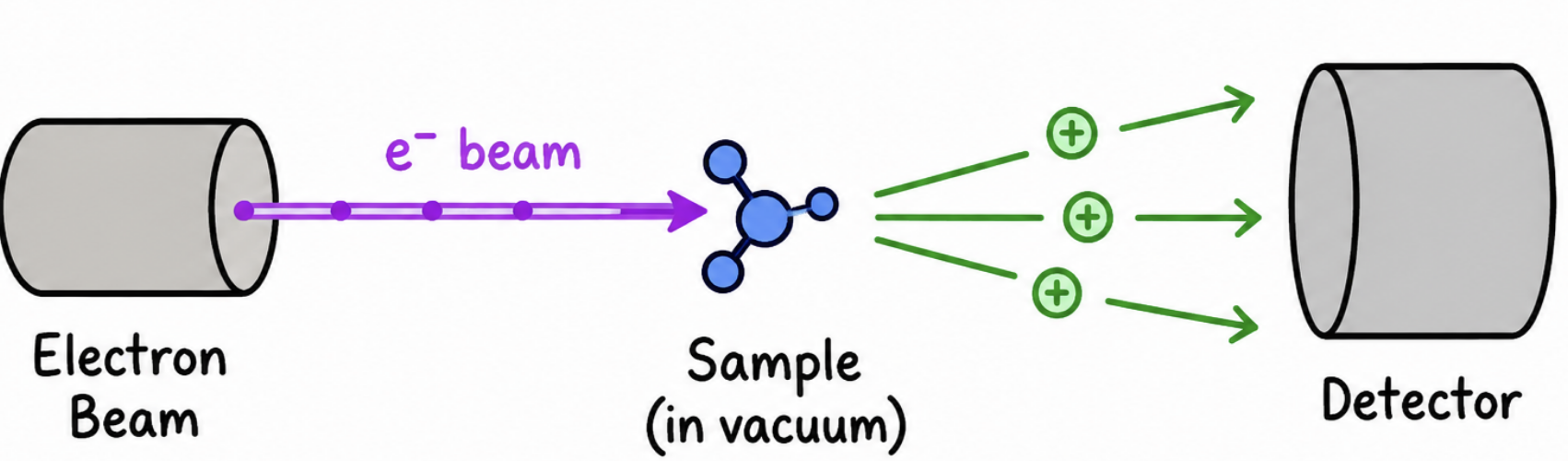
Figure 1. A high-energy electron beam ionizes vaporized molecules, producing charged fragments that are separated and detected by the mass spectrometer. The peak with the highest mass often corresponds to the molecular weight.
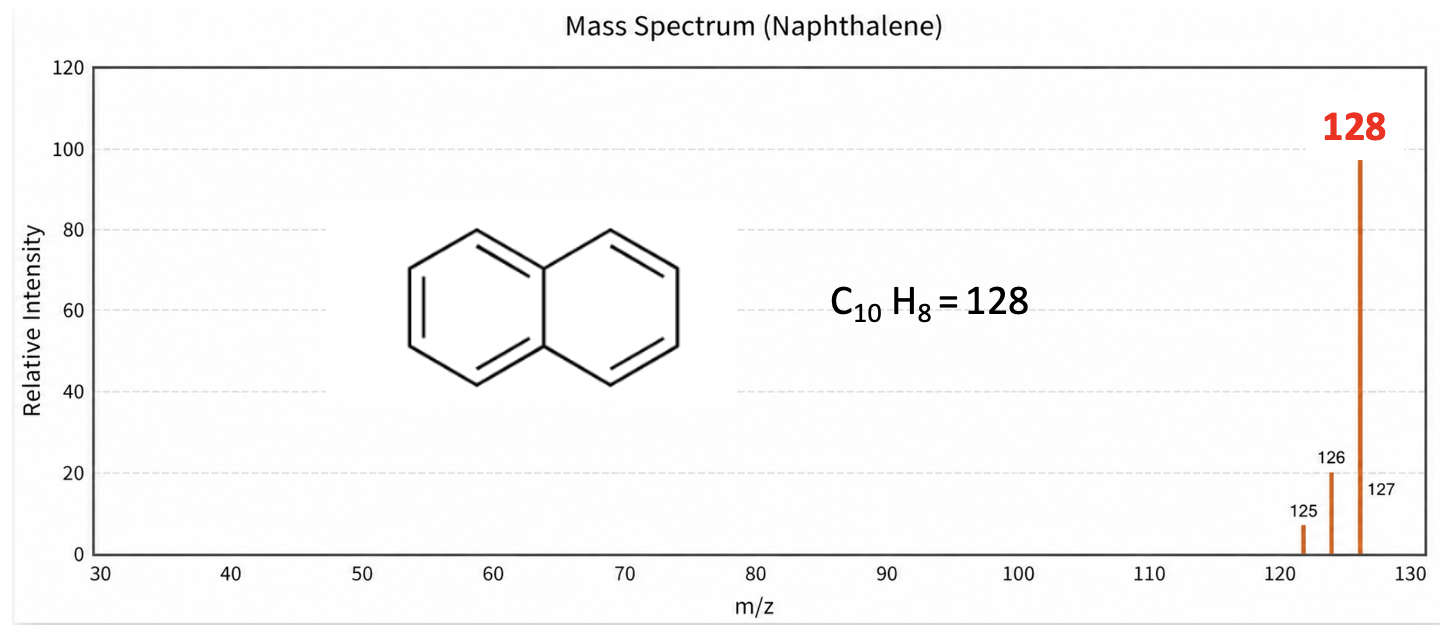
The mass spectrum of naphthalene, one of the detected chemicals, shows a molecular mass of 128 Daltons (atomic mass units).
(Some of) the Suspects
Analyzing and determining the chemical structure of something in a laboratory can be challenging enough on Earth. So how can this possibly be done on another planet?
Because you never know when you might need one, the Mars rover Curiosity carries a miniature chemistry laboratory called SAM (Sample Analysis at Mars), which heats powdered rock samples, separates the released molecules using gas chromatography, and identifies them by mass spectrometry. The experiment also used a reagent called tetramethylammonium hydroxide (TMAH) to help liberate organic compounds from the rocks and make them easier to analyze by gas chromatography, but it could also create new methylated compounds during the analysis itself.
Comparing the results with Earth-based standards is key. A mass peak alone cannot identify a molecule because countless different compounds can share the same molecular weight (for example, isomers). Gas chromatography helps solve this problem by passing molecules through a long coated column, where different compounds travel at different speeds and therefore emerge at different times (“retention times”). When both the mass spectrum and retention time match those of a known standard, confidence in the identification is high.
What else was on Mars?
Aside from naphthalene—which, for a number of reasons, is likely to be a genuine result—the group identified six other compounds (out of more than 20 detected signals), some of which may represent authentic Martian organic material and some of which almost certainly do not. But this raises two separate questions: 1) Were these compounds actually present in the Martian rocks, and 2) Were they identified correctly?
Probably real:
- Naphthalene
- DIhydronaphthalene
- Benzothiophene
These compounds are probably “real” because they are chemically stable aromatic molecules with highly characteristic mass spectra and gas chromatographic retention times, making them easier to identify with confidence than many of the other detected compounds. They are also plausible breakdown products of ancient macromolecular carbon and have previously been found in meteorites and other extraterrestrial material.
Maybe:
- Methylnaphthalene
- Trimethylbenzene
- Tetramethylbenzene
By contrast, methylnaphthalene, trimethylbenzene, and tetramethylbenzene are chemically ambiguous because heating large carbon-rich molecules in the presence of tetramethylammonium hydroxide (TMAH) can generate methylated aromatic compounds as secondary reaction products. In other words, some or all of the methyl groups attached to these molecules may have originated from the TMAH reagent itself rather than from the Martian rocks.
No way:
Unlike the other compounds, methyl benzoate stands out chemically because it is exactly the type of molecule expected to form during the experiment itself rather than in the rocks. Benzoic acid—which has previously been found in meteorites and other extraterrestrial material—readily reacts with TMAH under the sample-preparation conditions used in the experiment to form methyl benzoate.
In other words, the detection of methyl benzoate may say less about what was originally present on Mars than about what happened after the sample was cooked inside Curiosity’s onboard chemistry laboratory.
Personally speaking, there is no way on Earth that methyl benzoate, the methyl ester of benzoic acid, is gonna be found on Mars. Just saying.
Bottom line
I don’t know how people pulled this stuff off. It’s pretty amazing. Whether some of these molecules were really sitting in Martian rocks for billions of years—or were partly created during the analysis itself—the chemistry and engineering behind the experiment are astonishing. More importantly, the findings suggest that ancient Martian rocks contain complex organic carbon hydrocarbons that survived for billions of years, making Mars chemically far more interesting than we once thought.
NOTE
[1] There are a few exceptions to this. For the purposes of this article, they don’t matter.