Single-Use Plastics, Friend or Foe?

By Chuck Dinerstein, MD, MBA — Oct 27, 2020
There's growing concern about plastics' ultimate fate, as that kind of waste continues to fill our oceans, landfills, and ourselves. It seems logical that banning single-use plastics would help stem the tide. But a new review finds that to be not quite as true, as advocates argue.

There's growing concern about plastics' ultimate fate, as that kind of waste continues to fill our oceans, landfills, and ourselves. It seems logical that banning single-use plastics would help stem the tide. But a new review finds that to be not quite as true, as advocates argue.

COVID: Europe's Second Wave Soars Past America's Third Wave

By Alex Berezow, PhD — Oct 27, 2020
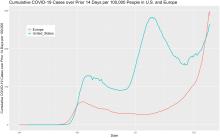
Europe is in worse shape than the U.S. when it comes to new infections, at least for the time being. Without a change in strategy -- and hoping for a vaccine is not a strategy -- going back into lockdown is pointless, as a third (or fourth) wave will emerge when society reopens.

Europe is in worse shape than the U.S. when it comes to new infections, at least for the time being. Without a change in strategy -- and hoping for a vaccine is not a strategy -- going back into lockdown is pointless, as a third (or fourth) wave will emerge when society reopens.

Thinking Aloud: Direct Contact

By Chuck Dinerstein, MD, MBA — Oct 26, 2020
This week, the CDC modified its definition of direct contact for COVID-19 from 15 continuous minutes to 15 accumulated minutes within a distance of six feet or less. Should we consider this change in definition as flip-flopping, "moving the goalposts,” or something else?

This week, the CDC modified its definition of direct contact for COVID-19 from 15 continuous minutes to 15 accumulated minutes within a distance of six feet or less. Should we consider this change in definition as flip-flopping, "moving the goalposts,” or something else?

Do You Have 'Pandemic Stomach?' An Interview With Gastroenterologist Dr. Michael Glick

By Josh Bloom — Oct 25, 2020
How's your stomach lately? If it's not so good, you have plenty of company. New York gastroenterologist Dr. Michael Glick explains how the stress and anxiety caused by the COVID pandemic is screwing up America's collective stomachs. And lungs, too.

How's your stomach lately? If it's not so good, you have plenty of company. New York gastroenterologist Dr. Michael Glick explains how the stress and anxiety caused by the COVID pandemic is screwing up America's collective stomachs. And lungs, too.

Do Eyeglasses Protect You From COVID-19?

By Chuck Dinerstein, MD, MBA — Oct 23, 2020
A new study in JAMA Ophthalmology considers whether eyeglasses confer protection from COVID-19. What it really demonstrates is how a variable -- in this case, eyeglasses -- can point in so many directions as to be useless. (But it will get you published in a peer-reviewed journal.)

A new study in JAMA Ophthalmology considers whether eyeglasses confer protection from COVID-19. What it really demonstrates is how a variable -- in this case, eyeglasses -- can point in so many directions as to be useless. (But it will get you published in a peer-reviewed journal.)

Havana Syndrome: Were Our Diplomats Attacked with Microwave Weapons?

By Alex Berezow, PhD — Oct 23, 2020
We know that in the 1970s the Soviets used microwave weapons against American diplomats. Maybe with the cooperation of other countries, Putin's Russia is doing it again.

We know that in the 1970s the Soviets used microwave weapons against American diplomats. Maybe with the cooperation of other countries, Putin's Russia is doing it again.

Drs. Bloom and Seley-Radtke in the Baltimore Sun: 'Herd Immunity' is a Bad Idea.

By Josh Bloom — Oct 22, 2020
Herd immunity as a way to fight COVID-19 is a hot topic these days -- but for all the wrong reasons. In an opinion column published in the Baltimore Sun, Dr. Katherine Seley-Radtke, and ACSH's Dr. Josh Bloom argue that it's dangerous and simply won't work.

Herd immunity as a way to fight COVID-19 is a hot topic these days -- but for all the wrong reasons. In an opinion column published in the Baltimore Sun, Dr. Katherine Seley-Radtke, and ACSH's Dr. Josh Bloom argue that it's dangerous and simply won't work.

What I am Reading October 22nd

By Chuck Dinerstein, MD, MBA — Oct 22, 2020
What do the firebombing of Dresden and the fires on the West Coast have in common? Embedded science, the Fall as a tonic, and a different history of packing the Supreme Court

What do the firebombing of Dresden and the fires on the West Coast have in common? Embedded science, the Fall as a tonic, and a different history of packing the Supreme Court

Opioid Crisis: Purdue Pharma Got What It Deserved

By Alex Berezow, PhD — Oct 22, 2020
Purdue Pharma will pay an $8 billion fine and shut down. Finally, justice has been served, though far too late for the thousands of addicted or dead Americans whose problems began with OxyContin.

Purdue Pharma will pay an $8 billion fine and shut down. Finally, justice has been served, though far too late for the thousands of addicted or dead Americans whose problems began with OxyContin.

Happy Endings, While Dining Out & in Our Heads

By Chuck Dinerstein, MD, MBA — Oct 21, 2020
I have long been a fan of Danny Meyer's restaurants, including Shake Shack and the Union Square Café. He's a man who understands food, organization, and hospitality. One of the great lessons the restauranteur teaches involves “service recovery” – fixing mistakes with food and food service. The take-away message remains that a customer's bad experience is often corrected and rewarded by how things conclude; in other words, the end counts more than the blip in the middle. And, turns out, that Meyer's observations reflect the way our brain is wired.

I have long been a fan of Danny Meyer's restaurants, including Shake Shack and the Union Square Café. He's a man who understands food, organization, and hospitality. One of the great lessons the restauranteur teaches involves “service recovery” – fixing mistakes with food and food service. The take-away message remains that a customer's bad experience is often corrected and rewarded by how things conclude; in other words, the end counts more than the blip in the middle. And, turns out, that Meyer's observations reflect the way our brain is wired.