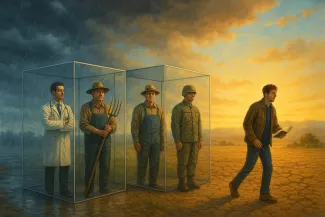
At last, I found an article that provides an explanation for why our experts led us astray during the days of COVID. It seems, if you are to think past purported “intent,” that it is the unease of uncertainty that drives physician behavior.
“As John D. Halamka and Paul Cerrato, digital healthcare experts at the Mayo Clinic in Minnesota, write in their book Transform: Mayo Clinic Platform and the Digital Future of Health (2025), doctors tend to operate by following ‘disease scripts’ based on recognisable symptom clusters. This habit-driven way of thinking, known as routine expertise, is useful for carrying out standard procedures on limited time. However, physicians falter when confronted with patients whose symptoms don’t fall within the boundaries of existing medical knowledge.”
From Aeon, Learning to Not-Know
What we eat is tied to what we grow. Today, we are a net food IMPORTER. Our reliance on corporate monoculture farming has made us vulnerable in a way that makes our concerns about AI chips trivial.
“But no one is talking about the larger food crisis our addiction to excessive corn-soy production implies, and our resulting loss of sovereignty. The variety of crops we produce is in free fall. For instance, in Florida, since the late 1990s, orange production has dropped by 95% because of a single disease. That’s remarkable, and in virtually every other era of American politics would be considered dangerous and notable. Imagine that happening to corn or soy. And with China eliminating the number one export market for soybeans, few are willing to admit what such an event truly implies about the amount of risk we are bearing with our move away from traditional flexible family farms.”
From Matt Stoller’s Big, Soy Boy America
“Last Monday at Quantico, it was little noticed by the legacy media or, indeed, by the President, that THE COMBATANT COMMANDERS DID NOT BRING BODYGUARDS BUT LAWYERS TO QUANTICO, THEIR JUDGE ADVOCATE GENERALS (JAG). …The lawyers were present, recording every word and preparing their notes to use in briefs and the options they will supply to their Commanders …
As an example of the existence of this bulwark Secretary Hegseth did attempt something stupid right after Quantico. He ordered the 5,000 man Ready Brigade of the 82nd Airborne Division that is our emergency force that can be deployed and have boots on the ground anywhere in the world in 48 hours, ready to fight, to deploy. He attempted to deploy them to of all places peaceful Portland. The 82nd is an elite emergency force of great lethal power. It’s designed and equipped to land, tactically disburse and engage and destroy an enemy force. It’s not a police force; not by any stretch of the imagination . It’s interesting that Hegseth’s order was quickly cancelled. Reason: the JAG officers said absolutely not. It violates the Posse Comitatus Act. That was the internal verdict of the Army’s professional lawyers and Hegseth was smart enough not to contest them.”
For those of us who listened to Secretary Hegseth and President Trump at Quantico, Terrence Goggin, the West Point History Professor, offers us an important lesson about our military’s history.
I am lucky enough to live in a part of New York that has its own Tractor Supply Co. Why TCS, because they have Carhartt working clothes, which I like to believe I’ve “earned working in my woodshop.
“Dave has done a whole lot in eleven years as Carhartt archivist. The curation of human stories that he has built the archive around is what’s most impressive. When an archivist encounters an object, a sign, questions have to be asked. Curiosity is the most powerful vector when seeking meaning. Channels of communication must be open in order for the object’s history to be understood. Why did someone keep this jacket for so long? Why did someone put up an American flag on their porch? It’s not that there are right answers. It’s that to eradicate space for discussion is to erase people’s stories.”
From Articles of Interest, The Meaning of Carhartt
Chuck Dinerstein, MD, MBA
Director of Medicine
Dr. Charles Dinerstein, M.D., MBA, FACS is Director of Medicine at the American Council on Science and Health. He has over 25 years of experience as a vascular surgeon.