For years, we’ve been told a simple story about the “opioid epidemic”: first, doctors prescribed too many pills, then reformulated OxyContin “drove” people to heroin, then fentanyl arrived, and now a wave of ultra-potent synthetics is killing “naïve” users in record numbers. Four neat phases, one neat villain: prescription opioids.
It’s a compelling narrative. It’s also deeply misleading.
A new multi-part investigation by journalist Amy Bianco at The PAIN GAME—“A Tale of Two Graphs (and More)” is, in my view, the clearest and most honest dismantling of that four-phase storyline that anyone has published to date.
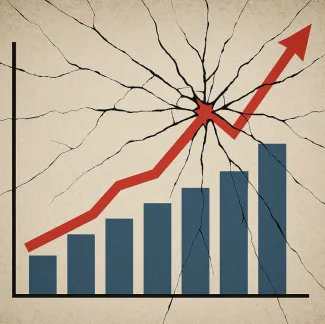
Instead of starting with slogans or cherry-picked timelines, the author goes back to the graphs that shaped public policy: the classic CDC figure showing prescription opioid sales rising in lockstep with “prescription opioid deaths,” and the less famous but far more important Jalal/Burke graph showing that overall overdose deaths have risen on a smooth exponential curve since the late 1970s, across all drugs, long before OxyContin ever appeared.
Once you put those two graphs side by side, the four-phase myth starts to unravel.
What this series does differently
Most commentary treats “Phase One” as a morality play: greedy companies, gullible doctors, and passive patients whose prescriptions inevitably turned into addiction and death. This series refuses that caricature.
It shows how the modern pain movement began in oncology and AIDS care. This was a good-faith effort by clinicians who had seen opioids transform the lives of people in terrible pain, and who reasonably believed that carefully monitored use could help a wider group of patients. It traces how that model depended on time, expertise, and multidisciplinary care—psychology, physical therapy, and careful follow-up—not just a prescription pad.
Then it documents how the insurance industry quietly dismantled those comprehensive pain programs, reimbursing the cheapest elements and starving the rest. By 2015, the number of collaborative pain clinics in the U.S. had collapsed from roughly 1,000 to under 100 outside the VA. What survived in most communities was a 15-minute visit and a bottle of pills—not because physicians were lazy or corrupt, but because the system made everything else nearly impossible.
The piece also exposes something almost no one outside this world has seen: how overdose is coded and counted. “Prescription opioid deaths” on a CDC graph are usually multi-drug deaths where an opioid was present, not the proven cause. When a doctor is under investigation, the pressure on medical examiners to label a death as a “prescription overdose” can be intense—even when the patient had advanced heart disease, cancer, infection or, in one jaw-dropping example, died in a car crash.
Once you understand how messy the “opioid deaths” line really is, the simple Phase One story—“doctor prescribes → patient becomes addicted → patient overdoses”—looks much less like science and much more like a convenient political script.
Beyond four phases: waves, scams, and a rigged ecosystem
One of the most powerful sections comes from a methadone nurse in Maine who describes three overlapping waves of patients she saw between the late 1990s and early 2000s:
• long-time heroin users trying to stabilize
• abandoned chronic pain patients whose doctors cut them off
• young people getting hooked on diverted pills from medicine cabinets and the street
Those three waves alone blow up the idea that Phase One was mostly about “innocent patients turned into addicts by their prescriptions.” The reality was a tangled ecosystem where licit and illicit markets bled into each other, where diversion happened in countless small ways, and where the same pill could mean stability for one person and chaos for another.
The series goes further, tracing what it calls a “hierarchy of scams”: scammers who lied to doctors to get pills; law-enforcement strategies that turned those scammers into witnesses against high-volume prescribers; prosecutors who built careers by portraying pain specialists as kingpins; and insurers and government programs quietly saving money when those practices were shut down and complex patients scattered. All of this was then wrapped in the rhetoric of a new front in the War on Drugs: the “War on Prescription Drug Abuse.”
Meanwhile, as opioid prescriptions have fallen sharply since 2012, deaths from illicit fentanyl and its analogues have exploded. The second CDC graph of the article makes this brutally clear: prescribing plummets while the line of synthetic opioid deaths rockets upward. If pills were truly the singular engine of the crisis, those trends should move together. They don’t.
Why this matters now
If you live with pain, treat people in pain, or care about overdose policy, you already know something is off in the dominant story. Pain patients are being forcibly tapered or abruptly cut off. Clinicians are leaving the field in fear. Yet overdose deaths keep rising, driven by a volatile illicit market that our policies helped create.
Bianco’s series gives you the missing context and language to explain why.
It challenges the “magic molecule” theory which is the idea that a brief encounter with an opioid dooms a large share of people to lifelong addiction. If that were true, routine post-surgical prescribing over the last 50 years would have produced apocalyptic levels of opioid use disorder. It didn’t. The reality is far more nuanced, and far more tied to social conditions, trauma, and long-running failures of the War on Drugs than to any single product or prescription.
Most importantly, Bianco’s pieces insist on telling the story in all its messy, human detail: the patients who did everything “right” and were still treated as suspects; the young people who started using pills as teenagers because they were everywhere and life was hard; and the clinicians and law-enforcement officers who tried to do the right thing inside systems that rewarded spectacle over truth.
An invitation
If you’re tired of being told that the crisis can be explained in four tidy phases and one villain, I’d encourage you to read “A Tale of Two Graphs (and More)” and share it widely.
It doesn’t deny the harms of opioids or the responsibility of industry. It does something braver; it shows how partial truths, weaponized graphs, and a half-century of bad drug policy have combined to produce the catastrophe we’re in, and it explains why doubling down on the same narrative will only make things worse.
If we want policies that save lives and protect people in pain, we have to start by telling the story honestly. This series is a major step in that direction.
Lynn R. Webster, MD, is a pain and addiction medicine specialist and serves as Executive Vice President of Scientific Affairs at Dr. Vince Clinical Research, where he consults with pharmaceutical companies. He is also Senior Fellow, Center for U.S. Policy
Dr. Webster is the author of the forthcoming book, Deconstructing Toxic Narratives—Data, Disparities, and a New Path Forward in the Opioid Crisis, to be published by Springer Nature. He is not a member of any political or religious organization

Lynn Webster, MD
Lynn R. Webster, MD, is a physician, researcher, and author specializing in pain and addiction medicine. He is a Senior Fellow at the Center for U.S. Policy and co-author of Deconstructing Toxic Narratives: Data, Disparities, and a New Path Forward in the Opioid Crisis.