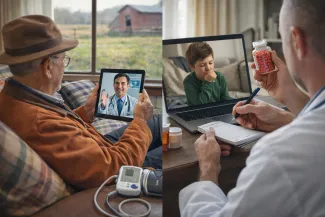
Five years after the pandemic drove medicine online, the evaluation of telehealth is more nuanced than either its supporters or critics acknowledge. Online consultations are a tool, not a revolution. Like any tool, their value depends on who uses them, why they are used, and who they are used on.
What the Evidence Gets Right
The numbers are striking. Before COVID-19, telehealth made up about 0.2% of U.S. health insurance claims. By April 2020, it had increased to 78 times that amount. Today, it accounts for roughly 4% to 6% of outpatient visits—much higher than before the pandemic but still below the peak. Patients appreciate it: 94% of those who had a virtual visit in 2024 said they would do it again. They save about 51 minutes of travel time per appointment, and a typical virtual visit costs $40 to $50, compared to $176 for an in-person visit. Globally, India’s government-run eSanjeevani platform has provided over 160 million consultations, and the UK’s NHS App recorded 62 million sessions in a single month. The infrastructure is in place. The question remains: does telehealth improve the quality of care, or just enhance convenience?
Regarding mental health, the evidence is compelling. A meta-analysis of 56 studies in Clinical Psychology Review found that video psychotherapy produces results nearly identical to in-person therapy. A 2023 review in JMIR Mental Health reported comparable effectiveness for post-traumatic stress, mood disorders, and anxiety. These findings are not just academic. A 2025 study in JAMA Network Open, which tracked over 5,000 Medicaid patients at a Montana telepsychiatry clinic, found 38% fewer hospitalizations and nearly 18% fewer emergency room visits compared with matched controls. Psychiatry now has the highest telehealth adoption of any specialty—about 50%—and for good reason. Whether you are a veteran in rural Wyoming or a single parent unable to take three hours off work for therapy, a video session isn’t second-best—it may be the only option, and the data demonstrate that it is effective.
Chronic disease management shows similar promise. A 2025 systematic review of 40 randomized controlled trials found that remote patient monitoring reduced hospitalizations by 14%. The U.S. Department of Veterans Affairs telehealth program served 2.4 million veterans through 11.6 million encounters in 2023 and reported a 41% reduction in hospital admissions among remote-monitoring enrollees. For homebound patients, a 2025 meta-analysis found that telehealth reduced emergency room visits, improved quality of life, and lessened depression. These are measurable gains for populations that the traditional healthcare model has chronically underserved.
Where Virtual Care Falls Short
Telehealth faces a prescribing challenge. Children received antibiotic prescriptions during 52 % of telemedicine visits compared to 31 % at primary care offices. National claims data show that telehealth’s antibiotic overprescribing rate for upper respiratory infections is nearly three times that of emergency departments. The reason is clear: when clinicians cannot look in a child’s ear or listen to their lungs, diagnostic uncertainty leads them to prescribe antibiotics more often. Amid an antimicrobial resistance crisis, this is a serious concern.
Misdiagnosis remains a significant concern. Analyses of telehealth malpractice claims reveal that 66% to 70% involve diagnostic errors, compared to about 47% for in-person care. The Institute for Healthcare Improvement has warned that the diagnostic safety risks already present in outpatient care are increased by virtual formats. A camera can show a rash, but it cannot palpate an abdomen, listen to a heart murmur, or capture the subtle clinical gestalt that decades of training convey. There is insight a physician gains from being in the same room with a patient that no camera can replicate.
Access Isn’t Equal
Then there is the digital divide—the uncomfortable truth behind telehealth’s promise of accessibility. About 41% of Medicare's homebound beneficiaries lack the internet connection or devices needed for video visits. Only 27.5% of adults in rural areas used telemedicine in 2021, compared to more than 40% in urban areas. Adults over age 50 report 50% more difficulty with virtual visits than younger patients. Those most in need of better access—the elderly, rural residents, and the economically disadvantaged—are the least equipped to use the technology. A tool that widens the gap it aims to close warrants scrutiny.
The Cost and Limits of Convenience
There is also the issue of cost. A RAND Corporation study found that only 12% of direct-to-consumer telehealth visits replaced visits to other providers; the remaining 88% were entirely new uses—people seeking care they would not have otherwise sought. Net spending on acute respiratory illnesses actually increased by $45 per telehealth user. In some cases, telehealth does not replace existing care; it creates additional low-acuity demand.
Finally, the idea of “without borders” does not match reality. In the United States, the Interstate Medical Licensure Compact covers 44 jurisdictions, but California, Florida, and New York are not part of it. The European Union’s European Health Data Space started in 2025, but cross-border data exchange won't be required until 2029. India’s telemedicine guidelines do not include rules for cross-border consultations. Regulatory fragmentation remains common rather than rare.
A Tool, Not a Transformation
None of this implies that telehealth lacks value. For the right patient, under the right conditions, and with the proper infrastructure, platforms offering verified doctor consultations and medical notes online can achieve results comparable to in-person care. However, the notion that virtual medicine eliminates all barriers to healthcare access is, at best, premature. As the Society of General Internal Medicine noted in 2023: when supported properly, telemedicine can improve outcomes and equity; when implemented poorly, it can lead to unsafe care, increase disparities, and waste resources. The key difference between these two outcomes isn't more technology; it's a greater honesty about what the technology can and cannot do.

Viktor Simunović
Dr. Viktor Simunović, M.D., is a distinguished physician and healthcare technology innovator with over a decade of experience in clinical practice and digital health. As the Co-Founder and Lead General Physician of Sicknote.com, he pioneers multilingual telemedicine solutions and legally compliant medical certification across Ireland and the EU. His work focuses on integrating general medicine and dermatology with cutting-edge technology to make high-quality care more accessible and efficient.