I’ve recently written about nitazenes (here and here), a class of deadly synthetic opioids that began showing up in the street drug supply in the past few years. Just what we don’t need. These bad boys are extraordinarily potent—often more so than fentanyl—and easy to make using common laboratory chemicals. In other words, another nightmare street drug.
And the band played on
More recently, Jeff Singer and I wrote about another chemical misanthrope: cychlorphine. Different structure, same pattern—more dangerous. Yet another opioid that can be synthesized from a new set of precursors, sidestepping the controls that had finally begun to catch up with fentanyl.
None of this was surprising. It’s the same cycle we’ve seen for decades. Crack down on one drug, and another—stronger, cheaper, and often more dangerous—takes its place. Prescription opioids gave way to heroin. Heroin gave way to fentanyl. Fentanyl gave way to nitazenes. Now something else is already waiting in the wings.
Call it the iron law of prohibition: the harder the enforcement, the harder the drug.
But every so often, there’s a pleasant surprise around the corner.
In this case, it’s an opioid that—at least in early studies—treats pain without some of the baggage of other powerful opioids. And I’ll be damned if it isn’t a nitazene analog.
It may even represent a rare case of evading the iron law of prohibition, thanks to a 36-page opus in Nature—a nearly superhuman effort by 44 (!) scientists across multiple research centers, clocking in at more than 30,000 words (! again)—a task I’d cheerfully assign to someone else.
Here we identify a novel MOR agonist with supramaximal intrinsic efficacy and a unique pharmacological profile that produced effective analgesia in rodents with minimal adverse effects
Gomez, J.L., Ventriglia, E.N., Frangos, Z.J. et al. A µ-opioid receptor superagonist analgesic with minimal adverse effects. Nature (2026). https://doi.org/10.1038/s41586-026-10299-9
Same Target, More or Less
The more important compound is called DFNZ (N-desethyl-fluornitazene), a derivative of the nitazene class (Figure 1). Intuitively, there’s nothing reassuring about that—quite the opposite. Nitazenes are among the most potent opioids known and began showing up in the U.S. illicit drug supply around 2020, with entirely predictable consequences.
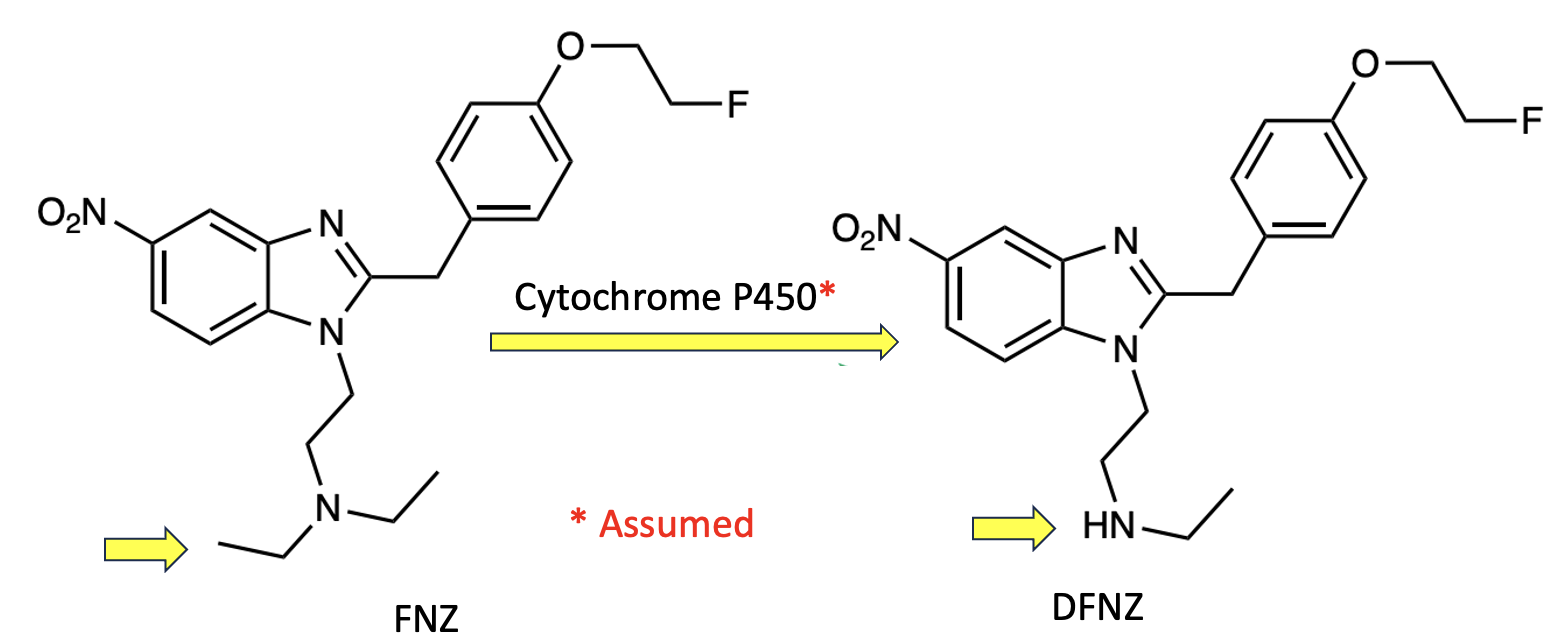
Figure 1. N-Desethyl-fluornitrazene (DFNZ), the active metabolite formed by oxidative deethylation of fluornitrazene (FNZ), presumably by one of the CYP enzymes in the liver. The yellow arrows denote the site of metabolism.
DFNZ hits the same target as morphine and fentanyl—the µ-opioid receptor. In laboratory assays, it behaves as a “superagonist,” meaning it can activate the receptor even more strongly than standard opioids (Table 1).
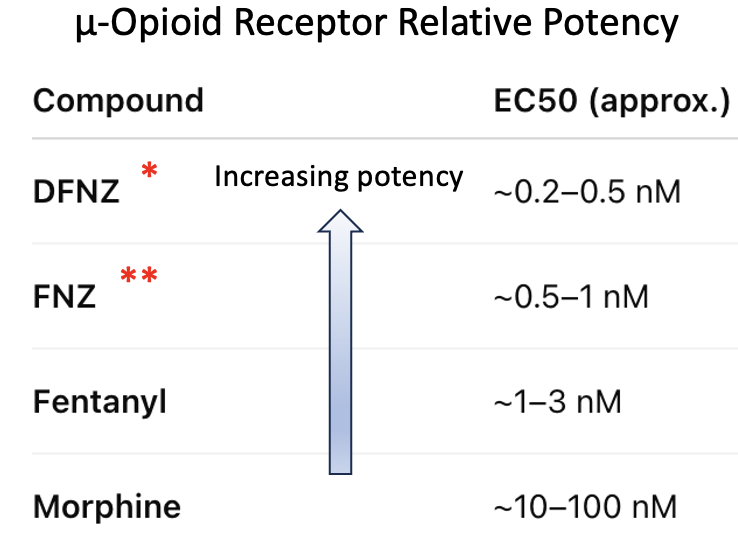
Table 1. Relative potency of selected opioids. Both nitazines are potent mu-agonists. *FNZ, the drug that is administered, has a short half-life. ** DFNZ, the active metabolite of FNZ, does the "work."
So Far, Nothing New, But...
Binding is just the starting point. What matters is what happens next. That’s where DFNZ starts to show its superpowers.
It relieves pain—without the usual baggage [1].
At least in mouse studies.
Now Things Get Weird. Good Weird.
The parent compound (FNZ) barely sticks around. PET imaging shows it’s in the brain for only a few minutes. That should be the end of the story.
It isn’t. The pain relief lasts for hours. With opioids, the rule is simple: drug in the brain, effect. Drug gone, effect gone. Not here.
What’s happening is that FNZ is quickly converted into something else—DFNZ. And DFNZ sticks around long enough to do the real work.
In other words, the drug the mice are given isn’t the drug that matters.
Opioids, Dopamine, and Other Assorted Suspects
If opioids have a signature liability beyond respiratory depression, it’s addiction—and that largely runs through dopamine. Most addictive drugs trigger sharp, rapid bursts of dopamine in the brain’s reward circuitry. These spikes act as a kind of teaching signal: this matters, do it again.
DFNZ doesn’t do that—at least not in the same way. It still increases dopamine, but more slowly and less dramatically. Instead of sharp spikes, the signal is flatter and more sustained. That difference shows up in behavior. Animals will take the drug, but when it’s removed, they stop. There’s little evidence of persistent drug-seeking—the kind you almost always see with traditional opioids. Without those fast dopamine spikes, the brain doesn’t seem to get the same reinforcement signal. This isn’t a weaker reward signal. It’s a different one.
Bottom Line. Maybe.
What makes this paper interesting and potentially groundbreaking [3] is not just the compound. It’s what it suggests.
For a long time, the assumption has been that if you strongly activate the µ-opioid receptor, you get the whole package: pain relief, euphoria, respiratory depression, and addiction. You can tweak around the edges, but you can’t really separate them.
DFNZ suggests that this might be wrong, at least in "rodent world."
Perhaps pain could be addressed not by abandoning opioids, but by using different ones.
That’s a big idea. It’s also a long way from proven. Everything here is in rodents, but this is still a very potent opioid with properties that defy previous opioid research. This is hardly something to take lightly.
If these findings hold up—still a big if—they point to something we haven’t seen before: an opioid that relieves pain without fully triggering the biological machinery that makes opioids so dangerous.
That would really be something. But, for now, keep your paws crossed. This discovery may just be too good to be true. Time (and mice) will tell.
Finally, let's close with some wisdom from my frequent writing partner, Dr. Singer. What would have happened had the DEA made nitazines Schedule I drugs?
Fortunately, regulators didn’t panic and slap nitazenes into Schedule I when they appeared in 2019. That left room for research—and even the discovery of potentially beneficial compounds. We’ve seen what happens otherwise: Schedule I buried psychedelic research for fifty years, and we’re only now uncovering its therapeutic potential.”
He has a point.
NOTES:
[1] “Baggage” includes respiratory depression, tolerance, dependence, withdrawal, and the reinforcement of drug-seeking behavior.
[2] The fluorine atom isn’t just decorative—it allows the compound to be labeled with fluorine-18 for PET imaging, so researchers can track where it goes in the brain in real time.
[3] I have omitted much. Given the length and complexity of this paper, I really had no choice.