Serendipity, luck for the prepared mind.
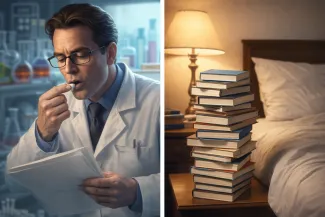
“While testing compounds for this medication, he licked a white powder off of his finger as he picked up a piece of paper—a blatant violation of work safety regulations. He noticed that this powder had a “surprisingly potent sweet taste,” and decided to develop it into an artificial sweetener. Schlatter eventually applied for a patent, which was granted on this day in 1970.”
The white powder was aspartame, 200 times sweeter than sugar and calorie-free. Read the entire story from Nautil.us, How Aspartame Came from a Work Safety Violation. And you can read more about the science behind the concern on the ACSH website,
I read a lot, for pleasure and work. And while most of my current reading is digital, I still maintain a growing pile of books on the nightstand. Of course, the Japanese have a word for that, tsundoku – the acquisition of books, letting them pile up without reading them. Jono Hey of Sketchplanations gets into the details here. I will leave it to Mr. Hey and another of my favorites, Austin Kleon, quoting Carl Sagan.
“What an astonishing thing a book is. It’s a flat object made from a tree with flexible parts on which are imprinted lots of funny dark squiggles.
But one glance at it and you’re inside the mind of another person, maybe somebody dead for thousands of years.
Across the millennia, an author is speaking clearly and silently inside your head, directly to you. Writing is perhaps the greatest of human inventions, binding together people who never knew each other, citizens of distant epochs.
Books break the shackles of time. A book is proof that humans are capable of working magic.”
Remember the church choir that represented the first superspreader event of the pandemic? Turns out that singing is not a necessary condition. Scientists have been at work identifying superspreaders (beyond the obvious germ vectors we call our toddlers and young children).
“virologists have long known that a small proportion of people play an outsized role in driving pretty much any outbreak of a respiratory pathogen – be it Covid-19, flu, respiratory syncytial virus (RSV), tuberculosis, or even measles.”
The BBC provides a science review, Some people have 10 million times more virus than others': Are you a flu superspreader?
I am not alone in recognizing that generate AI uses a lot of em dashes, those – found sprinkled throughout its responses. I was never a fan, but perhaps failing to understand its history has left me biased and punctuation-wise poorer.
“While punctuation crept into writing systems around the third century BCE, the rules that governed them remained both complex and inconsistent well into the eleventh and twelfth centuries. It was around that time that an Italian scholar decided to leave his mark on the world of punctuation. His name was Boncompagno Da Signa.”
As it turns out, the em dash has been used by hacks like Willie Shakespeare, Charlie Dickens, Hermie Melville, and, evidently, the OG Queen of the em dash, Emily Dickinson. For the lowdown on a punctuation mark that is coming back to us, and why AI has been its greatest advocate, from 99% Invisible, a podcast, The Em Dash

Chuck Dinerstein, MD, MBA
Director of Medicine
Charles Dinerstein, MD, MBA, is the Medical Director of the American Council on Science and Health. A vascular surgeon with more than 25 years of clinical experience, he brings a physician's understanding of medical decision-making, an appreciation for scientific uncertainty, and a broader perspective on healthcare economics and policy to his writing.