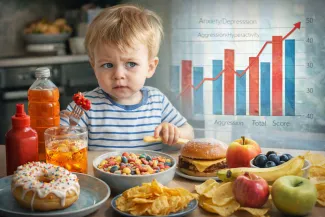
Here is how STAT’s Morning Rounds newsletter summarized the study:
“The more ultra-processed food a 3-year-old eats, the worse behavioral and emotional symptoms they’ll show at age 5, according to a Canadian cohort study published yesterday in JAMA Network Open. … 10% increase in energy from ultra-processed foods was associated with more inward-focused behavioral issues like anxiety and depression, as well as externalizing issues like aggression and hyperactivity.”
The summary is accurate. Unfortunately, it merely echoes the misleading findings of the research’s authors. Do we owe our readers more?
Looking Past the Headline
The study published in JAMA Network Open examines a cohort of approximately 2000 Canadian children. Parents completed a food-frequency questionnaire when their children were three years old, and later filled out a standardized behavioral assessment when the children turned five.
- Higher intake of ultra-processed foods (UPFs) was linked to higher scores on the Child Behavior Checklist (CBCL), which measures “internalizing” emotional symptoms, like anxiety, outward “externalizing” behavioral issues, like aggression, and overall behavior scores.
- When researchers simulated replacing ultra-processed foods with minimally processed foods, behavior scores improved across all categories, indicating potential benefits from dietary changes.
- The relationship persisted even after adjusting for several potential confounding factors, such as family background, maternal diet, breastfeeding, income, physical activity, and body weight.
The researchers end on this note:
“In this prospective Canadian cohort study of young children, higher UPF intake at age 3 years was associated with adverse behavioral and emotional symptoms at age 5 years. Modeling substitution of UPF for MPF was associated with lower CBCL scores, suggesting that efforts encouraging MPF in place of UPF may help to support child behavioral, emotional, and mental health development.” [emphasis added]
Context Matters: Interpreting the Behavior Scores
Given the stereotype of Canadian soft-spoken civility, can this be true? To explore this, we look at the CBCL scores of those 5-year-olds. At age 5, the cohort’s average internalizing score was 44.6, externalizing score was 39.6, and the total score was 41. The CBCL is standardized with a mean of 50; scores of 70 or higher indicate significant problems. These scores indicate that parents did not see a notable or concerning level of behavioral or emotional issues.
The next question is whether specific types of ultra-processed foods were more strongly associated with behavioral scores. To answer that, we need to look more closely at how the researchers analyzed the data.
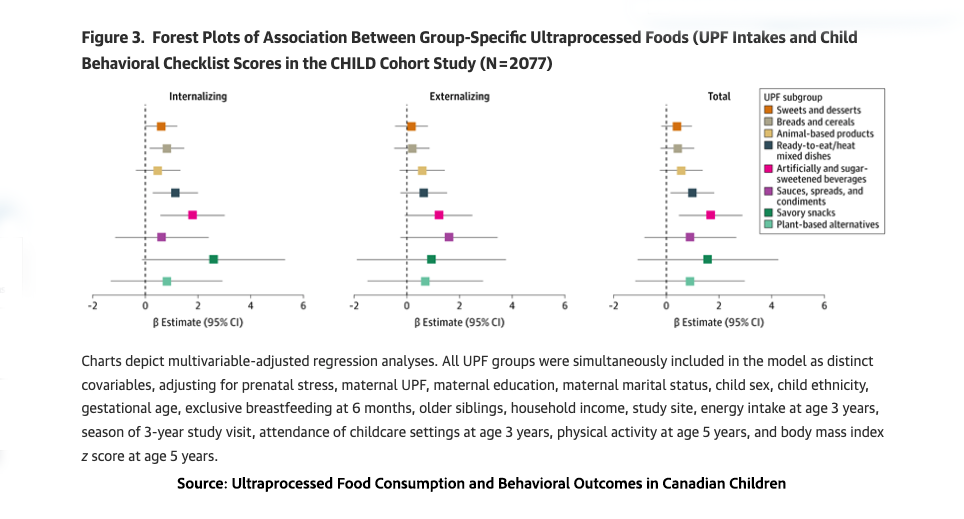
The β coefficient indicates the strength of the relationship between UPFs, the predictor variable, and the CBCL score, where positive values signify higher scores. The graph displays the research findings, and I want to remind readers that confidence intervals touching the zero line are statistically insignificant. For concerned parents, among all the UPF subgroups, only ready-to-eat, “grab-and-go" foods and artificially and sugar-sweetened beverages had any impact.
Speaking of parents, how twisted was the diet these Canadians served up to their children? Of the roughly 1500 calories each kid consumed, 45% came from UPFs. For comparison, US children ages one to six get about 56% of their calories from such foods. [1]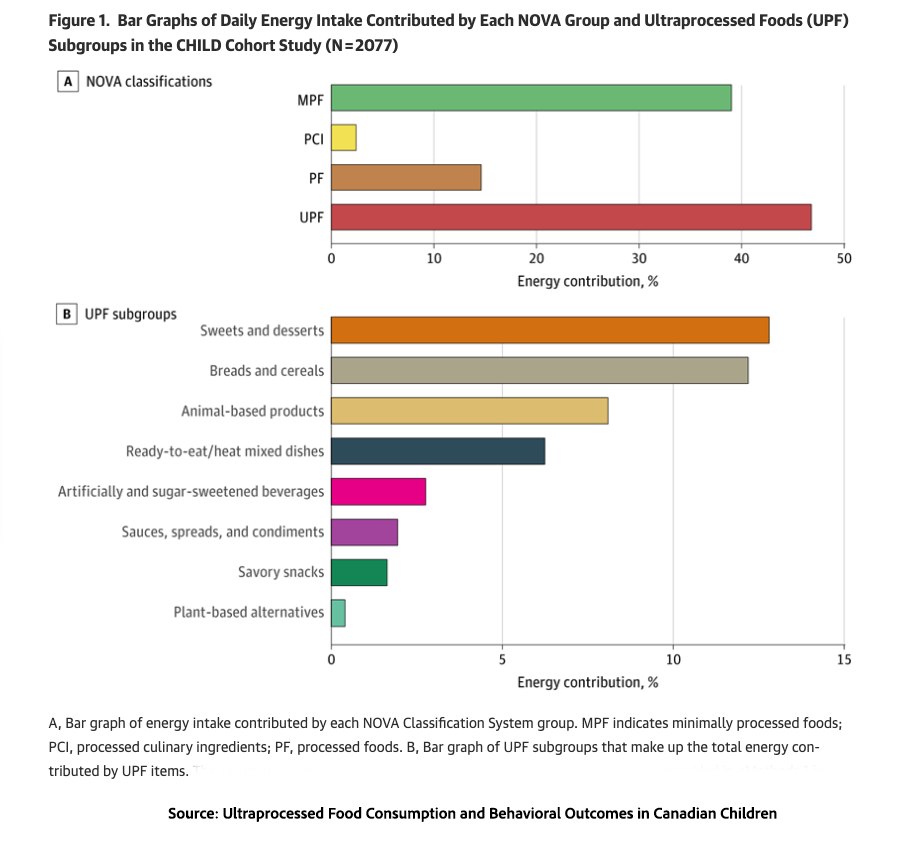
Notably, the two categories linked to behavioral scores—ready-to-eat foods and sweetened beverages—accounted for only about 6% and 3% of total calories, respectively. [2]
The researchers point out that the biological mechanisms linking ultra-processed food consumption to children’s behavioral and emotional development remain unclear. Ultra-processed foods, which are typically low in fiber and micronutrients but high in saturated fat, sugar, sodium, and calories, are associated with plausible neurobiological processes. Although they do not directly measure these “nutrients of concern,” they acknowledge that "nutrients of concern do not explain the observed associations.”
From Statistical Signal to Public Narrative
To return to my original question, do we owe our readers more? I believe the answer is yes.
What did the study actually reveal? Children who ate more ultra-processed foods at age three had slightly higher behavioral scores two years later. However, the differences were small, the scores stayed well within the normal range, and most types of ultra-processed foods showed no significant link to behavior.
In other words, the study raises an interesting hypothesis about diet and child development, but it does not demonstrate that ultra-processed foods cause behavioral problems, nor does it suggest that Canadian preschoolers are experiencing widespread emotional or behavioral difficulties. What it really shows is how easy it is for a nuanced observational finding to be compressed into a headline that implies far more than the evidence supports.
Science deserves better than that, and so do readers.
Whether the reporting is AI-assisted, careless, a gist, or “promoting the narrative,” is a rabbit hole I prefer not to explore. The responsibility does not lie only with researchers or journalists—it lies with all of us who consume science news. We should expect reporting that tells the whole story, not just the most clickable sentence. Findings should be placed in context, their limitations acknowledged, and their real-world meaning explained.
If we want a public conversation about science that informs rather than inflames, we must hold what we read accountable—not simply for being correct, but for being complete.
[1] Based on the researchers' findings, that would boost CBCL scores to the standardized average.
[2] Fun fact – those artificial food dyes now being removed from our diet are most often found in sweets and desserts, UPFs that are not linked to any behavioral impact. They are present in sports drinks, but how many parents are giving toddlers and preschoolers Gatorade?
Source: Ultraprocessed Food Consumption and Behavioral Outcomes in Canadian Children JAMA Network Open DOI: 10.1001/jamanetworkopen.2026.0434

Chuck Dinerstein, MD, MBA
Director of Medicine
Charles Dinerstein, MD, MBA, is the Medical Director of the American Council on Science and Health. A vascular surgeon with more than 25 years of clinical experience, he brings a physician's understanding of medical decision-making, an appreciation for scientific uncertainty, and a broader perspective on healthcare economics and policy to his writing.