Introduction
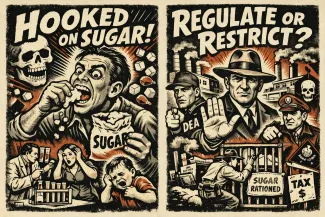
A recent thought piece from Harvard asked the deceptively simple question: is sugar addictive?
Sugar triggers cravings, compulsive behavior, and withdrawal-like symptoms, all hallmarks of addiction. However, sugar is fundamentally different from drugs; it is part of an essential diet, and moderate consumption is normal and not harmful.
Sugar is a boundary object, acquiring different meanings depending on the observer. From a regulatory perspective, the FDA views it as an ingredient, while the USDA considers it a commodity. However, when considering the litany of federal regulators, sugar could also be seen as a pollutant, a controlled substance, and a contributor to chronic illness.
Current Status
The FDA treats sugar a food ingredient, specifically falling under the category of “generally recognized as safe” (GRAS) for its intended use. Even amid growing concerns about obesity and diabetes, the FDA’s approach remains limited: it highlights sugar through labels, specifies how it can be described, and aligns with public health guidance, but it ultimately leaves the decision to consume sugar up to individuals rather than regulating it as a controlled substance.
The USDA views sugar from a different perspective, focusing on agriculture, markets, and nutrition programs, and regulates how sugar is produced, priced, and incorporated into federal food policies.
The primary role of the USDA is through a long-standing system aimed at stabilizing the domestic sugar industry by implementing production controls, import quotas, price supports, and loans to growers.
The USDA’s second major role, along with the Department of Health and Human Services, is nutritional: issuing the Dietary Guidelines for Americans. Although these guidelines do not have the force of law, they influence a wide range of federal programs, such as SNAP and school meals, by indirectly regulating sugar consumption through standards for which foods are eligible or reimbursable in these programs.
Each classification of sugar has its own specific regulatory logic—varying assumptions about harm, responsibility, and the government's role.
But what if sugar were an addictive substance?
What Happens If Sugar Isn’t GRAS Anymore?
Sugar’s GRAS designation is crucial; without it, sugar would likely be regulated as a food additive, a much more rigorous process. Manufacturers couldn’t simply add sugar to products based on longstanding use. They would need to petition the FDA for approval beforehand, providing scientific evidence that sugar is safe under its intended conditions of use. This includes data on toxicity, metabolic effects, and potential long-term health risks. The FDA would then assess whether sugar is both generally safe and safe at specific levels in specific foods.
That shift would allow the FDA to do something it mostly avoids with sugar now: setting clear limits. The agency could set maximum levels in certain products, ban its use in others, or add warnings if risks are found.
Sugar sits at the crossroads of the USDA’s duties to promote agricultural markets and improve public health through diet. Nutritionally, the USDA has enormous leverage because it can alter what millions of Americans encounter via federally supported food systems. The Dietary Guidelines could become more stringent, particularly for children, moving beyond "limit added sugars to less than 10% of calories." School meals might implement tighter limits on added sugars, and WIC and SNAP packages could be redesigned to prioritize lower-sugar options through subsidies or disincentives.
More controversially, pressure could build on the agricultural sector. While the USDA cannot easily dismantle the sugar program overnight, a rising consumer movement might push to loosen or eliminate price supports and quotas, redirect subsidies toward alternative, “healthier” food production, and reframe sugar not as a strategic commodity but as a product with downstream health costs.
One might expect the usual counterarguments from manufacturers and growers.
- Sugar producers would emphasize that their crop is legal, widely used, and safe in moderation, and that overconsumption is a behavioral and dietary pattern issue, not a failure of agricultural policy.
- Second, they would raise economic concerns, noting the loss of thousands of jobs in farming, processing, and related industries, potentially hollowing out domestic production and increasing reliance on foreign suppliers.
- Third, there would be pushback on what would be seen as selective targeting. Treating sugar as the key contributor and oversimplifying complex health problems.
- Finally, there’s a political argument: that using governmental regulation crosses a line from guidance into paternalism, particularly for lower-income populations who rely on those programs.
If sugar were broadly recognized as addictive in a pharmacological sense and associated with significant, widespread health risks, then the regulatory landscape would shift dramatically.
Sugar as a Controlled Substance
If sugar were considered addictive, the DEA would treat it as a controlled substance to limit abuse and dependence. Scheduling is central to DEA authority. Due to sugar’s widespread presence and low immediate toxicity, it would probably be placed near the less restrictive end of the Schedule, recognizing some dependence risk but not classifying sugar like opioids or stimulants. Although strict drug-style controls would be impractical, there would be strict oversight of bulk and industrial production and distribution. Retail restrictions, such as placing sugar behind the counter or requiring age verification, might occur, but enforcement would likely focus upstream where the largest quantities are handled.
Controlled substances are not freely marketed, so we would see strict limits on advertising, especially to children, restrictions on branding, sponsorships, and product placement, along with mandatory warnings about dependence and health risks. Perhaps the most significant change is that violations become criminal offenses, particularly for unlicensed large-scale distribution or diversion outside regulated channels.
Sugar as an Environmental Pollutant
If sugar were considered a pollutant in the food environment, it would become an exposure problem, not a dietary choice — something widespread in the environment with dose-dependent harm. The EPA’s regulatory focus would shift from “How do we inform consumers?” to “How do we reduce population exposure?", emphasizing changing the available food options rather than just telling people to eat differently. This would reorient policy from personal responsibility to environmental management, controlling how much sugar enters the food system, where it appears, and how much people are exposed.
Sugar would serve as an exposure metric, requiring exposure limits, such as a maximum population exposure level, with regulatory action triggered if exceeded. These limits would be, like the DEA’s, set at the source of exposure—where sugar enters the food system. A hallmark of EPA regulation is technology-forcing standards—rules that compel industries to innovate. Applied here, the agency could require manufacturers to meet progressively stricter sugar thresholds, effectively mandating reformulation. Over time, the baseline level of sweetness in the food environment would decrease, just as emissions standards have reduced pollutants in air and water. The EPA maintains a strong enforcement stance, imposing fines, penalties, mandatory reformulations, and restrictions on the distribution of non-compliant products.
- EPA-style communication focuses explicitly on hazard and risk. Nutritional labels would be replaced with Prop. 65 warning-style labels that frame sugar not just as “unhealthy,” but as a risk factor to be minimized.
- A key aspect of EPA policy is addressing unequal exposure. If sugar is considered a pollutant, dietary disparities based on income, geography, or access become “environmental justice issues.” In addition to stricter standards for foods sold in schools, there could be incentives to lower sugar levels in “over-served” areas.
Sugar as a Dose-Dependent Risk, like Radiation
As a nuclear regulator, the Nuclear Regulatory Commission (NRC) begins with a different premise: while some exposure may be unavoidable, all exposure carries risk and must therefore be minimized, monitored, and justified. Instead of asking, “How much sugar is in this product?” the governing question becomes: “Is this level of exposure necessary—and can it be reduced?”
- Radiation regulation is based on the principle that “the dose makes the poison,” although there’s no clear line between safe and unsafe, only an increasing likelihood of harm. A nuclear-style framework would define acceptable daily intake ranges and lifetime exposure limits, with stricter limits for more sensitive individuals, such as children. The key shift is precision: sugar consumption becomes something to quantify and manage, not just “watch.”
- One of radiation protection’s core principles is to keep exposure as low as reasonably achievable (ALARA), even below official limits. In the context of sugar, this means not just staying under a recommended cap but actively reducing added sugar wherever possible.
- In radiation protection, any exposure must be justified by a benefit. You don’t expose people unless there is a valid reason. Under this approach, using sugar as a preservative could be justified, but adding it solely for taste or market appeal would be examined closely.
Like with the EPA, labeling would shift from providing information to communicating risks, signaling exposure, and manufacturers and food providers would be expected to design products and environments that minimize exposure by default.
Sugar as a Healthcare Cost Driver
The Centers for Medicare & Medicaid Services (CMS) would assess sugar use in the context of chronic disease and healthcare costs, aiming to reduce downstream medical expenses. Their main strategies involve providing financial incentives to providers who lower the burden of diet-related diseases in their patients by increasing coverage for nutritional counseling and metabolic screening. Alternatively, they incorporate sugar-related metrics into value-based care frameworks that consider high sugar intake as a modifiable clinical risk factor, like smoking.
Sugar as a Taxable Risk
Like CMS, the policy levers involve fiscal policy, in which sugar is priced rather than prohibited, thereby influencing behavior through economic incentives. This includes excise taxes on sugary products, raising prices to discourage consumption, and possibly subsidizing lower-sugar alternatives. The revenue generated would typically support public health programs or nutrition initiatives.
Competing Visions of Control and Choice
One perspective, supported by public health advocates including the MAHA moms, argues that the current system underestimates both the extent of harm and the limits of individual choice. Sugar is not just an ingredient, but a pervasive exposure embedded in the modern food environment; its consumption is influenced by availability, formulation, and marketing, not just knowledge. This approach implicitly draws lessons from other areas: when risk is chronic, cumulative, and affects entire populations, relying solely on individual behavior change often falls short. However, this approach also has trade-offs. It risks paternalism when interventions limit choices or disproportionately impact lower-income populations. Importantly, it can also lead to pushing policies forward before science is fully settled.
The countervailing view begins with the premise that sugar is a lawful, functional part of the food supply, and that the issue lies in consumption patterns, not the substance itself. This view highlights consumer choice, the technological role of sugar in food (preservation, texture, taste), and the significance of a stable domestic agricultural industry. It also reflects a broader economic reality: sugar is part of a system in which benefits are concentrated among producers, while costs are spread among consumers, making the policy framework politically resilient to change.
And underlying it all is a fundamental mismatch: the long-term, possible harms of sugar stand in contrast to its immediate benefits—taste, cost, convenience—making aggressive regulation both harder to justify and to sustain politically.
At its core, the conflict revolves around where responsibility should rest. The FDA model primarily places it on the individual. The public health model shifts responsibility toward the system. The USDA aims to balance both, supporting production while promoting consumption. For decades, that uneasy middle ground that encourages moderation and protects agriculture has been politically sustainable. The real question is how long that middle ground can endure. Because once the framing changes, the policy response rarely remains incremental—and what was once a matter of personal choice can quickly become a matter of public control.

Chuck Dinerstein, MD, MBA
Director of Medicine
Charles Dinerstein, MD, MBA, is the Medical Director of the American Council on Science and Health. A vascular surgeon with more than 25 years of clinical experience, he brings a physician's understanding of medical decision-making, an appreciation for scientific uncertainty, and a broader perspective on healthcare economics and policy to his writing.