One of TikTok’s seemingly endless stupid “challenges” has resurfaced after six years in hiding. The Benadryl challenge encourages teens to take large doses to hallucinate and has already led to multiple overdoses and at least one reported death, according to an article in today's New York Post.
Idiocy like this has been going on for years. Viral “challenges” involving ingestion or toxic exposure have sent tens of thousands of teenagers to emergency rooms—including more than 35,000 ER visits linked to the Tide Pod challenge alone between 2016 and 2020—and, in some cases, have proved fatal.
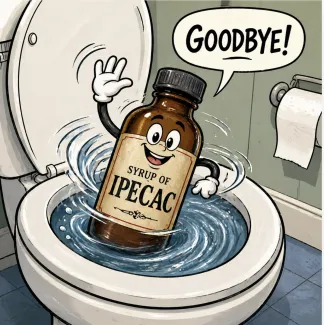
Less than a decade before the launch of TikTok, syrup of ipecac, a drug that parents once kept on hand in case of poisoning, became unavailable in the US. [1] And Benadryl, once the go-to antihistamine, began to fall out of favor about the same time. [2] In a sense, this is a tale of two old drugs and their changing role in medicine.
The first of those drugs, syrup of ipecac, was once a staple of American medicine cabinets. The second, Benadryl, is becoming less so—it is no longer the first-line antihistamine.
Whatever happened to ipecac?
Syrup of ipecac wasn’t banned or recalled. Instead, it quietly disappeared from pharmacy shelves as evidence accumulated that it didn’t work as well as anyone had assumed—and could sometimes do more harm than good. The problem wasn’t that ipecac failed to induce vomiting—something known for more than five centuries, dating back to its use in South America. Instead, by the time vomiting occurred, some of the substance was often already in the bloodstream, and the process itself carried risks, including aspiration and delayed treatment. Case reports describe prolonged vomiting lasting hours or even days, sometimes leading to dehydration, aspiration, and other complications, with rare cases of serious injury or death.
By the early 2000s, poison control centers and medical organizations had largely reversed course. Safer and more effective approaches like activated charcoal replaced ipecac, and demand for the drug simply evaporated. What had once been standard advice faded away—not because of regulation, but because the evidence no longer supported it.
How does ipecac work?
The two primary alkaloids [3] in ipecac are closely related chemicals called emetine and cephaeline. While the latter gives no obvious clue about its function, the first does and not so subtly.
Both compounds are emetogenic—that is, they induce vomiting—and act on both the stomach (by irritation) and the brain (via the chemoreceptor trigger zone), effectively giving you two spews for the price of one. [4]
Bottom line
There isn't really anything new here. Newer drugs have been replacing older ones forever. It turns out that inducing vomiting is not the best way to handle most poisonings. And if this changes, just look in the vegetable crisper. That's where kale is stored.
NOTES:
[1] Ipecac was not banned; it simply fell out of favor.
[2] Benadryl is gradually being replaced by newer antihistamines like Claritin and Zyrtec.
[3] Alkaloids are nitrogen-containing compounds derived from plants. Many are toxic.
[4] A deranged pharmacologic paradox: What would happen if someone who overdosed on Zofran was given ipecac? Quiz: Why would I even ask this?

Josh Bloom
Dr. Jonathan (Josh) Bloom, ACSH's Director of Chemical and Pharmaceutical Sciences, earned his Ph.D. at the University of Virginia and completed postdoctoral training at the University of Pennsylvania. During his 20-plus years in drug discovery at Wyeth, his research group discovered the antibiotic Tygacil®, approved in 2005. He holds 25 issued patents and has authored 35 academic papers. Since joining ACSH in 2010, he has written more than 2,000 articles and dozens of op-eds for major newspapers, including The Wall Street Journal and Chicago Tribune.