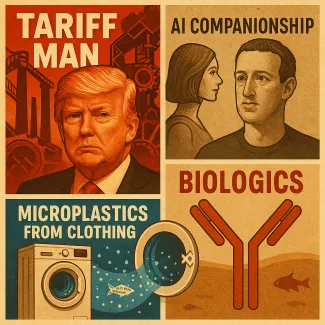
President Trump has declared himself a “Tariff Man,” channeling the thoughts of President McKinley. If you are like me, your knowledge is limited to McKinley's untimely death at the hands of an assassin aided by his physicians. The New Yorker takes a deeper dive into Presidents Trump and McKinley.
“Trump’s knowledge is thin, but his instincts are sharp, and if he picked the wrong individual, he nevertheless picked the right era. McKinley sprang from an age when the United States’ relationship to the world was fundamentally different. It was a time of trade barriers and colonial wars, a time before what political scientists call the “liberal international order.” Trump grew up in the shadow of that order and came to resent it enormously. His attraction to the nineteenth century seems to derive from his desire to be free of liberal internationalism. But, in reaching back to that past, what sort of future is he steering toward?”
Why Donald Trump Is Obsessed with a President from the Gilded Age
By now, you have likely heard that we consume a credit card-sized amount of microplastics every week, and plastic bag bans have been implemented to reduce plastic pollution. But the fault lies not in our plastic bags, but in our clothes.
“People are becoming more aware of microplastic pollution,” Pennington says, but fewer people know “that our clothing and our washing machines are the number one source of them.” Synthetic fibers now make up more than two-thirds of all fabrics produced each year, and as many as 1.5 million fibers can be released from a single synthetic garment during a wash cycle.
…
Yet one thing is clear: All that pollution is no match for traditional washing machine filters, or for wastewater treatment facilities that clean water before returning it to streams and rivers.”
From Anthropocene, Engineers turn fish biology into a breakthrough microplastic laundry filter
Mark Zuckerberg has a “thing” about connecting us. Remember, Facebook was first a way for college students to meet and greet. But today he has higher aspirations.
“Silicon Valley wants to make you new friends—or at least program them. “The average American has fewer than three friends,” Mark Zuckerberg said on a podcast in April. “The reality is that people just don’t have as much connection as they want. They feel more alone a lot of the time than they would like.”
Of course, as a techie, he is offering up AI companionship. A great piece by The Atlantic’s Yair Rosenberg, who asks the question, instead of selling water purifiers, Have You Considered Not Polluting the Water?
Medicine, especially our pharmacologic weapons, grows in increments. Serums were replaced by antibiotics, which in turn have been supplanted by more specific, concentrated serums that we refer to as “biologicals.”
“In the early days, serum was mass-produced in sheep, and then horses, which had greater blood volume (35–40 liters vs under five). Serum therapy was applied to many diseases, including pneumococcal bacterial infections (the most common cause of pneumonia), for which it was the only effective treatment before penicillin became widely available in 1945.”
But biologicals are almost impossible to produce synthetically, so we have harnessed others to do the heavy lifting. From Works in Progress, How to make an antibody

Chuck Dinerstein, MD, MBA
Director of Medicine
Dr. Charles Dinerstein, M.D., MBA, FACS is Director of Medicine at the American Council on Science and Health. He has over 25 years of experience as a vascular surgeon.