After the holiday season, many nutritionists face the recurring question: “I overdid it with food and want to lose weight fast — what do I do?” The answer is simple: after a few days of festive indulgence, return to your routine, adjust your meals, and move a bit more.
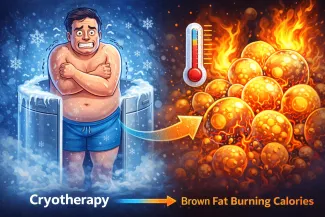
Still, impatience drives many toward unusual practices that promise fast, painless weight loss. Cryotherapy, a procedure that uses extreme cold via liquids, cryoprobes, or ice, offers a hint of biological plausibility. Proponents claim that a three-minute session can burn up to 800 calories, mainly through thermal effects: extreme cold forces the body to expend calories to maintain core temperature; a temporary increase in norepinephrine, linked to a “fight or flight” response to extreme cold, is also cited.
Underlying these claims is a basic physiological distinction between adipose tissue types, which is essential to understanding the proposed mechanism. Most body fat consists of white adipose tissue, which plays primary roles in energy storage and distribution, hormone production, and the regulation of feeding behavior. Brown adipose tissue, in contrast, primarily regulates body temperature and body mass through adaptive thermogenesis.
Under certain conditions, some white fat may acquire thermogenic characteristics, often referred to as beige fat. In this context, the proposed mechanism is non-shivering thermogenesis — heat production triggered by cold without muscle shivering. In theory, repeated exposure could convert white fat into beige [1] or brown fat, which dissipates energy as heat. Two widely cited studies are interesting, but a key question remains: do they support the manufacturer’s bold claims, or are they stretched to fit a marketing narrative? A closer look suggests the evidence is limited, inconsistent, and well below the advertised 800 calories. [2]
The Scientific Basis
In Mechanism Underlying Tissue Cryotherapy to Combat Obesity/Overweight: Triggering Thermogenesis, the authors conducted a retrospective analysis to evaluate changes in markers of inflammation and estimates of energy expenditure after single or multiple local applications of tissue cryotherapy. They analyzed two groups: 18 participants received three applications, and 7 received six. In the latter group, total body scans assessed fat and muscle mass.
Key findings:
- Analyses of inflammatory and lipid mobilization markers revealed no relevant changes, suggesting no systemic inflammation or fat cell destruction (adipocyte lysis).
Three hours after a single application, waist circumference decreased by an average of 3.0%, with no significant changes in thigh circumference, body weight, or BMI. One week later, the waist reduction was no longer statistically significant. - Multiple applications led to reductions in waist circumference (2.8 cm), body weight (0.53 kg), and BMI.
- DEXA scans after three and six sessions showed significant decreases in fat mass, dropping ~3.8%, and BMI also declined after six sessions.
Despite an optimistic spin, the study was limited by its small size, lack of blinding and randomization, and an absence of controls. The persistence of effects over time remains unclear, raising questions about whether these changes reflect actual changes to brown fat or merely transient effects.
Most concerning, it is reasonable to assume that the absence of a limitations section was not a methodological oversight. One of the authors serves as the medical director of a clinic offering tissue cryotherapy for obesity, a clear conflict of interest.
Turning to “Cold Acclimation Recruits Human Brown Fat and Increases Non-shivering Thermogenesis,” a better-designed, more methodologically robust study, it, too, remains inconclusive. The researchers began with a well-established observation: animals not acclimated to cold initially respond with shivering thermogenesis, increasing energy expenditure through muscle contractions. With prolonged exposure, shivering diminishes, but energy expenditure remains elevated, suggesting increased “non-shivering” thermogenesis. This phenomenon, in humans, is associated with brown adipose tissue. The study examined the effects of cold acclimation on non-shivering thermogenesis and on the presence and activity of this tissue.
For ten consecutive days, 17 healthy adults were exposed to 15–16 °C (roughly 60 °F) for six hours daily.
Before acclimation, participants had an average resting metabolic rate of ~1,625 calories, with lower values in women (1,418 calories) and higher values in men (1,816 calories).
After cold exposure:
- Energy expenditure increased modestly: by 231 calories in women and 215 calories in men.
- Non-shivering thermogenesis rose from 10.8% to 17.8%, while resting metabolism remained largely unchanged.
- Brown adipose tissue was present in 94% of participants before acclimation and 100% afterward.
Despite the increased energy expenditure, participants showed no changes in body weight or composition, leading the researchers to hypothesize that the effect may have been offset by increased food intake or reduced physical activity.
Even when accounting for the study’s limitations — small sample size and a lack of rigorous control over diet, physical activity, and other confounding factors — the main interpretation remains: biologically, cryotherapy reflects a cold-acclimation model rather than the destruction of fat cells as it is currently marketed.
New studies?
Both studies predate 2019, leaving open the possibility of more recent, methodologically robust evidence.
A 2022 scoping review in the Journal of Thermal Biology synthesized evidence on whole-body cryotherapy in overweight and obese adults. Of 879 studies identified, only eight met the inclusion criteria, representing 189 participants, most of whom were overweight or obese. Study quality was moderate, and interventions varied widely, including ice immersion, cold exposure, and cryogenic chamber temperatures.
Most studies reported heterogeneous reductions in fat mass and body circumference, likely influenced by concurrent diet and exercise and the absence of adequate controls. One finding suggested that higher subcutaneous fat in obese individuals delays heat loss and increases metabolic rate. Metabolic effects included potential increases in energy expenditure, muscle tremor, and glucose uptake, while effects on leptin, which suppresses appetite and increases thermogenesis, were inconsistent. Adipokines, signaling proteins secreted by adipose tissue, responded differently depending on baseline fitness and adiposity: lower-fitness, higher-adiposity individuals showed increased cellular signaling, whereas fitter obese individuals showed decreased signaling.
Cryotherapy’s appeal lies in its potential anti-inflammatory and metabolic effects, which partially mimic those of exercise, especially in low-fit individuals. However, the review highlighted major limitations: a lack of investigation into molecular mechanisms; absence of standardized protocols (temperature, session number, exposure time, and timing); few randomized trials; no stratification by obesity severity; lack of blinding; inadequate controls; and confounding from diet and physical activity.
The authors concluded that current data were insufficient to support cryotherapy as an effective adjunctive treatment for obesity.
Three years later, a clinical trial published in Obesity tested whether adding cryotherapy to conventional management would enhance weight loss, improve body composition, or affect metabolic responses. The results were underwhelming.
The 12-month trial included 20 adults, allocated to either conventional management plus cryotherapy (CRYO) or conventional management alone. The intervention consisted of 28 sessions over 16 weeks, followed by monthly maintenance sessions. Energy intake and physical activity were carefully monitored throughout the study.
Both groups reduced caloric intake by approximately 750 kcal/day and increased physical activity, with partial persistence until 12 months.
- Weight loss was significant but similar between groups: CRYO lost 11.9 kg at five months and 9.9 kg at 12 months, while the control lost 11.2 kg and 7.8 kg
- Changes in fat mass, lean mass, and waist circumference did not differ between groups.
- Temporary reductions in LDL and fasting glucose in the CRYO group were not sustained.
- No increase in brown adipose tissue activity was observed.
Any metabolic benefits observed were modest and transient, leading the authors to conclude that combining whole-body cryotherapy with conventional obesity management was not superior to conventional management alone. In addition to the litany of limitations, several authors had ties to the pharmaceutical industry, including Novo Nordisk, a producer of GLP-1–based medications. For the conspiratorial and misguided, it seems cryotherapy is being suppressed by “Big Pharma” to protect sales; the evidence does not support this idea.
Given the extremely weak evidence, cryotherapy may transiently increase calories expended to restore core body temperature. However, this effect appears small, inconsistent, and far below the 800 kcal frequently advertised. It is insufficient to meaningfully affect total energy expenditure or promote significant weight loss.
What the evidence does show is that a well-managed hypocaloric diet, combined with increased physical activity and, when indicated, psychological or pharmacological support, remains the most effective strategy for managing obesity. Outside of this framework, other approaches tend to follow the same pattern observed in pseudoscientific practices: many promises with minimal supporting evidence.
[1] a type of fat that shares characteristics of both white (WAT) and brown (BAT) adipose tissue in morphology and function.
[2] For comparison, an 80-kg person running six miles in an hour burns roughly 880 kcal, and vigorous weight training rarely exceeds 480 kcal.
Sources:
Mechanism Underlying Tissue Cryotherapy to Combat Obesity/Overweight: Triggering Thermogenesis. Journal of Obesity. DOI: 10.1155/2018/5789647
Cold acclimation recruits human brown fat and increases non-shivering thermogenesis. The Journal of Clinical Investigation. DOI: 10.1172/JCI68993.
Whole-body cryostimulation in obesity. A scoping review. Journal of Thermal Biology. DOI: 10.1016/j.jtherbio.2022.103250.
Effects of Whole-Body Cryotherapy Combined With Conventional Obesity Management Versus Obesity Management Alone: A Clinical Trial. Obesity. DOI: 10.1002/oby.70019.

Mauro Proença
Mauro Proença is a nutrition graduate student with a postgraduate degree in Clinical Nutrition from the University of São Paulo (USP), Brazil.