
Every parent cringes when they hear that dreaded phrase: “I’m bored!” It always strikes at the most inopportune time—while you're trying to cook dinner or finally starting to fold that mountain of laundry you've been putting off for days.
Part of that anxiety stems from our long-held assumptions about boredom. Boredom is commonly defined as “the aversive experience of wanting, but being unable, to engage in satisfying activity,” and it’s a feeling most of us view negatively and usually try to avoid—for ourselves and our children.
How kids handle boredom has shifted with societal changes over the decades. Children of the ’90s usually lacked constant access to technology; they chased away boredom with diverse activities, many of them outdoors. Modern children and teens face a different reality: parents are more likely to allow device access and less likely to encourage outdoor time.
This contrast helps illustrate why boredom isn’t the villain many of us assumed it to be. Instead of viewing this unsettling feeling as a discomfort to avoid, we should use it as a tool to cultivate creativity and problem-solving in our children.
Boredom: avoid it at your own risk
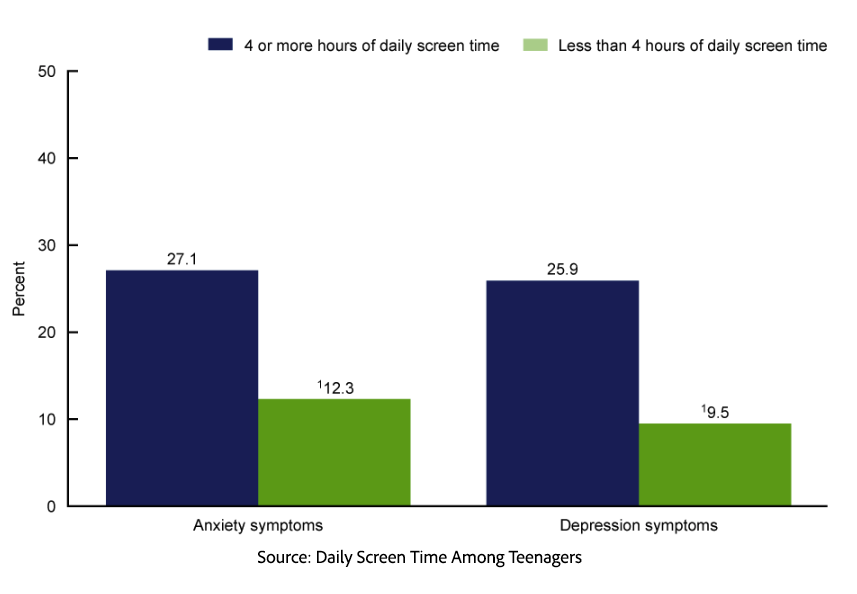
According to a 2024 CDC data brief, about half of teens (50.4%) spend four or more hours daily on screens. That equates to four hours not spent on activities that build physical or mental skills—the brain and body go relatively unchallenged in meaningful ways. Just as important, the CDC reports:
“The percentage of teenagers who had symptoms of anxiety or depression in the past 2 weeks was higher among those with 4 hours or more of daily screen time.”
The ditch on the other side of the road is the widespread belief that children must always be busy, with parents constantly facilitating their entertainment. We see this in families juggling multiple after-school activities each week, in parents investing hours in “perfect” sensory bins, and in the “quick and easy” activities—actually requiring 15 different items and 20 minutes of setup—promoted by parenting influencers, all of which raise the already elevated bar for moms and dads.
The benefits of boredom
What many parents don’t realize is that there is a scientific advantage to letting kids experience boredom. As a pair of University of Tokyo researchers noted in a 2024 perspective, “Boredom can drive one to seek fulfilling activities and the acquisition of skills to better enjoy life.” In other words, the absence of structured activity encourages children to explore their surroundings more creatively and develop problem-solving skills that may not emerge as readily in parent-directed settings.
Evidence supporting this perspective goes back many years. For instance, a 2014 study by Sandi Mann and Rebekah Cadman from the University of Central Lancashire tested whether boredom boosts creativity. Participants completed a boring task—copying phone numbers from a phone book for 15 minutes—then tackled a creative challenge: generating as many uses as possible for a pair of polystyrene cups.
Those who had been bored produced more creative uses than those who had not. The researchers replicated the experiment with other boring tasks and found that boredom led to both more ideas and higher-quality ideas. Although the study had limitations, as all research does, the authors’ takeaway was striking:
“Until recently, boredom has been viewed as a negative emotion with only negative outcomes, but the current study adds weight to the evidence that suggests that boredom can sometimes be a force for good … [I]t might be a worthwhile enterprise to allow or even embrace boredom in work, education and leisure."
Stepping back to allow boredom benefits parents too by reducing mental load and relieving stress. Not only does this help you handle other inevitable challenges of parenthood (e.g., stressful bedtime routines, doctor visits), but it also improves your overall quality of life. A little time to yourself isn’t a bad thing.
Anything worth doing is hard
However, the transition isn’t seamless. Children may initially push back, expecting parents to “fix” their boredom before gradually learning self-management. Since we once defaulted to TV for quiet moments in our house, we facilitated the change by offering a variety of activities and refusing to intervene when complaints of boredom arose.
At first, there was plenty of whining. Over time, though, our kids found ways to stay occupied. The shift was gradual, but they now play more independently and creatively.
Conclusion
Do yourself a favor. The next time your children whine, “I’m bored,” resist the urge to entertain them. Research indicates that boredom, in moderation, supports creativity, problem-solving, and self-reliance. Step back and let them reap those benefits.

Desiree English
Desiree English is a high school science teacher with eight years of classroom experience. She holds a B.S. in Kinesiology and brings a unique blend of academic expertise and real-life “in-the-trenches” parenting to family and children’s content.