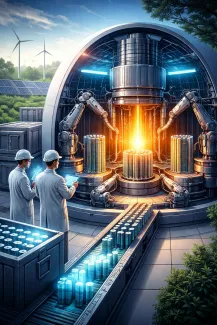
With winter here, I can’t help thinking about sitting around the fireplace when I was a kid, warming my back while we watched TV or played board games. The only thing about the fireplace I didn’t like was having to occasionally clean out the ashes, wondering why there wasn’t a way to simply burn the ashes away. Our society has a similar relationship with nuclear energy – the energy is nice, but we’re not very fond of the waste. Unlike my childhood fireplace, though, nuclear engineers might have figured out how to get nuclear fuel “ash” to “burn” itself using a reactor currently working its way through the licensing process – Oklo Inc’s new Aurora reactor plant.
According to the Department of Energy, the US has generated about 90,000 metric tons of spent reactor fuel since the 1950s, virtually all of which remains in storage awaiting permanent disposal. There are several categories of radionuclides within spent fuel
- Unused U-235 and U-238 and “transuranics,” formed when uranium atoms capture neutrons during reactor operations. These are the “waste” materials that will remain radioactive for centuries and longer.
- Fission products are produced during reactor operations. Virtually all short-lived fission products will decay to stability in years to decades.
Aurora will derive its energy from the uranium extracted from the spent fuel.
Uranium comes in two main varieties – U-235 and U-238 – of which U-235 “fissions” easily in the chain reaction that generates heat, and powers most of our nuclear reactors. About 0.72% of natural uranium consists of U-235, a fraction too low to sustain fission in a reactor using normal water for cooling; enriching U-235 to about 5% of the uranium can be used in the fuel for most commercial reactors. Any enrichment of U-235 above 20% is considered highly enriched uranium and can be produced only by a handful of nations, of which the US is one. The region between 5% and 20% U-235 is called high-assay low-enriched uranium (HALEU), and that’s what Aurora uses.
Running a reactor on 20% enriched fuel isn’t a new idea – research reactors and reactors used to produce isotopes for use in medicine, research, and industry have been running on 20% or higher enrichment for decades. But its use in power reactors is relatively new, and many of the small advanced power reactors in the design pipeline today are banking on its availability; the HALEU fuel for Aurora is a proof-of-concept project to show that spent high-assay fuel (enriched to more than 20% U-235), now considered a “waste product” to be stored away for centuries, can be blended with less-enriched uranium and made into HALEU fuel. The advantage of HALEU over lower enrichments is that its higher concentration of fissionable U-235 produces more power and can operate longer without refueling [1]. A long refueling cycle reduces the time and cost of supplying nuclear energy.
Over the years, the US has designed many nuclear reactors. One of these designs, the Experimental Breeder Reactor (EBR), used 67% enriched U-235; it was built at the Idaho National Laboratory (INL), located in a desert in the southeast corner of the state. The uranium concentrations in the EBR failed to meet the reactor’s goals; however, by down-blending the 67% enriched uranium with natural or less-enriched uranium, the uranium can be extracted and used to make HALEU fuel to power Aurora. There’s enough spent EBR fuel for INL to produce about 10 tons of HALEU fuel, and about 10 tons of additional uranium fission products that won’t need to be stored while awaiting disposal.
Aurora isn’t going to make much of a dent in the 90,000 metric tons of spent fuel backlog; in fact, the single reactor can’t even keep up with the 2000 tons of spent fuel we produce annually. It’s also worth noting that the vast majority of our spent fuel backlog, and the spent fuel being generated from commercial reactors today, is in the form of low-enriched fuel that can’t be downblended to produce HALEU. But that’s OK – Aurora is as much a test platform as anything.
If Aurora is successful, the design can be rolled out across the country, burning up a little more of the spent, difficult-to-dispose-of, high-assay reactor fuel with every new operating reactor. Even better, Aurora will use liquid sodium as coolant; reactors that can derive energy from U-238 as well as U-235, letting them utilize and “dispose of” even more of our spent fuel, possibly including spent fuel from commercial reactors.
To be clear, Aurora isn’t a magic eraser for all nuclear waste, and it won’t make a meaningful dent in the nation’s 90,000-metric-ton spent-fuel inventory overnight, especially since most commercial spent fuel can’t simply be down-blended into HALEU. But that’s not the real point. Aurora is a proof-of-concept for something far more important: a practical pathway to extract value from high-assay “waste,” shrink the amount of long-lived uranium requiring storage, and demonstrate advanced reactor operation that could scale up. If it works, each new reactor becomes not just a power plant, but a small, steady step toward reducing the burden of the hardest-to-manage spent fuels—turning today’s radioactive leftovers into tomorrow’s electricity.
[1] Today’s nuclear naval reactors, for example, use highly enriched uranium and are designed to last for 30 years or longer.