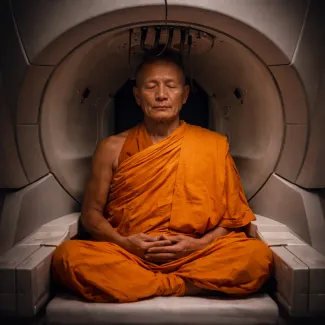
From Experience to Measurement
Many contemplative (Eastern) traditions emphasize direct experience, while modern science emphasizes systematic observation and measurement. In practice, both approaches seek reliable knowledge using different tools. The difficulty of experiential knowledge lies in translating what is often implicit and personally understood into concepts that can be shared and measured. Meditation, often grouped under the umbrella of “mindfulness,” sits at this intersection. Beginners are typically instructed either to focus attention on a single object, such as the breath, or to observe thoughts and sensations as they arise and pass without clinging—two complementary approaches rooted in longstanding traditions.
Samatha, still the waters of your mind, letting a turbulent lake become still. Attention rests on a single object, and as distractions quiet, awareness becomes steady and unified. In psychological terms, this form of meditation emphasizes sustained attention, stability, and deliberate regulation of thought.
Vipassana, by contrast, focuses on observing the water itself—its ripples, currents, and shifting reflections. Rather than focusing on one object, practitioners notice thoughts, emotions, and sensations as they arise and pass. In cognitive terms, this style emphasizes flexibility, responsiveness, and dynamic balance in mental activity.
If these practices cultivate different modes of awareness, do those differences leave measurable traces in the brain? In recent decades, neuroscience has turned its tools toward meditation, using brain-imaging techniques to quantify electrical activity across time and space. To understand what researchers measure, two concepts are especially important.
Complexity and Criticality in the Brain
In everyday language, complexity refers to a system’s “richness,” “detail,” or “many interacting parts.” Higher complexity implies a broader range of possible states the system can explore. Scientifically, it describes systems whose behavior emerges from interactions across multiple scales of time and space, and cannot be predicted from their components alone. Weather patterns, ecosystems, and human physiology are all examples of complex systems. In cognitive brain science, complexity has been linked to richer patterns of information processing and flexible behavior.
Criticality is a concept in physics that describes the point at which a system balances between order and disorder, e.g., water at the brink of boiling, poised between liquid and vapor. Near this transition, systems become especially sensitive to inputs and capable of rapid reorganization. Some neuroscientists hypothesize that the brain operates near such a critical “Goldilocks spot,” balancing stability with flexibility. This balance may support attention, memory, and adaptive thinking, balancing both integration and differentiation of information —though the idea remains an active area of research.
Inside the Experiment
Twelve highly trained Theravada Buddhist monks participated in a magnetoencephalography (MEG) brain-imaging experiment. This noninvasive technique records the tiny magnetic fields produced by electrical activity in the brain with millisecond precision. While in the MEG scanner, the monks practiced the two distinct meditation styles, Samatha and Vipassana. These meditation periods were alternated with an eyes-closed resting state. Each meditation block lasted six minutes and was repeated across multiple sessions.
To quantify complexity and criticality, researchers analyzed several biomarkers, including oscillatory power (the strength of rhythmic brain activity), long-range temporal correlations (how strongly present activity depends on past activity), signal complexity (the diversity and distribution of patterns in the signal), the 1/f slope (a feature linked to the balance of a network’s excitation to inhibition), and a deviation-from-criticality coefficient measuring how far neural activity strayed from a theoretical critical state.
Two Paths, Two Neural Signatures
The results revealed distinct shifts in neural dynamics during meditation. Signal complexity increased, suggesting that brain activity became less repetitive and more diverse. Rather than simply “quieting” the brain, meditation appeared to enrich its dynamic repertoire.
Long-range temporal correlations decreased, meaning neural activity became less tethered to its immediate past. In practical terms, the brain’s signals showed less persistence, consistent with reduced tendency to remain locked in extended patterns, potentially reflecting greater moment-to-moment flexibility.
The 1/f slope flattened during meditation; a change interpreted as reflecting shifts in excitation–inhibition balance, altering large-scale network responsiveness.
Vipassana, with its open monitoring style, appeared to shift neural activity closer to theoretical criticality, emphasizing responsiveness and scale-free dynamics. Samatha increased complexity while maintaining greater overall order, aligning with sustained attentional stability rather than maximal sensitivity. Together, they illustrate that meditation is not a single neural state but two complementary ways of operating near complexity’s boundary; tuning the brain toward flexible, stable, and adaptive responsiveness.
While the body may remain still, meditation is not solely “relaxation.” It is a dynamic regulation of complexity. It reduces excessive persistence, loosens rumination, and increases informational richness. It modulates the excitation–inhibition balance and adjusts the brain’s proximity to the critical point.
Bridging Inner and Outer Worlds
Meditation is often spoken about in poetic or spiritual language. Yet, it also offers a remarkable opportunity for science: the chance to observe how deliberate shifts in awareness reshape the brain’s activity. Practices that seem simple, such as focusing on the breath or watching thoughts arise, may correspond to measurable changes in neural dynamics.
By examining Samatha’s stabilizing focus and Vipassana’s open monitoring through the lens of complexity and criticality, neuroscience offers one way of translating inner experience into shared, observable terms. This translation does not replace lived understanding, nor does it claim to exhaust it. Rather, it suggests that subjective practice and objective measurement can illuminate different facets of the same human capacity. In that sense, meditation becomes not a proof of one tradition over another, but a meeting point between ways of knowing. Ironically, it describes “the middle way.”
Source: —Meditation induces shifts in neural oscillations, brain complexity, and critical dynamics Neuroscience of Consciousness DOI: 10.1093/nc/niaf047

Chuck Dinerstein, MD, MBA
Director of Medicine
Charles Dinerstein, MD, MBA, is the Medical Director of the American Council on Science and Health. A vascular surgeon with more than 25 years of clinical experience, he brings a physician's understanding of medical decision-making, an appreciation for scientific uncertainty, and a broader perspective on healthcare economics and policy to his writing.