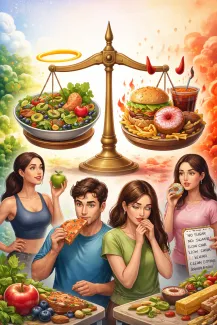
This moral turn didn’t happen overnight. It has been fuelled by overlapping trends: heightened concern about obesity and chronic disease, growing anxiety about ultra-processed foods, social-media amplification of dietary extremes, and rising scepticism toward public-health messaging and dietary guidelines.
The result is a food culture in which people don’t just worry about whether what they’re eating supports their health— they worry about what it says about them.
How food became a measure of virtue
Moral pressure shows up through language, framing, and implication. When foods are described as “clean,” others become implicitly dirty. When short ingredient lists are treated as shorthand for virtue, complexity becomes suspect. Being vegan, carnivore, sugar-free, or low carb becomes a test of character rather than a set of choices shaped by biology, culture, pleasure, habit, and constraint. These dynamics are most clearly documented in clinical and high-risk populations, particularly among those vulnerable to disordered eating.
Moralisation creates food guilt—and it helps nobody
Rigid, rule-based approaches, e.g., no-added-sugar mandates, clean-ingredient lists, time-restricted eating windows, and calorie counting, are associated with greater guilt, shame, and internal conflict around eating. When foods are categorised as off-limits or morally suspect, people crave these “guilty pleasures” more. Cue a cycle of deprivation, heightened craving, and eventual overindulgence—often accompanied by guilt or stress that perpetuates restriction and overconsumption, with consequences for both psychological well-being and metabolic regulation.
The downstream risk isn’t just hypothetical. Clinical accounts increasingly describe orthorexia nervosa: a pattern in which the pursuit of “healthy eating” becomes rigid, obsessive, and impairing. In this scenario, fixation on dietary “purity” can escalate into malnutrition, anxiety, shame, and disruption to daily life.
When “ideal” diets quietly become moral standards
Nutrition advice doesn’t have to sound moralistic to carry moral weight. Often, it does so by quietly assuming an idealised—and privileged—version of daily life. Much of today’s dietary guidance emphasises whole foods, home cooking, and meals prepared largely from scratch. At a broad, population level, this logic holds: diets built around minimally processed foods tend to be associated with better health outcomes.
The problem arises when these ideals are presented without any real acknowledgment of time, money, cooking ability, caregiving responsibilities, or access. In that context, guidance quietly turns into a standard of virtue. The unspoken message is this: if you rely on cheap, ultra-processed, or convenience foods, you have failed in some personal way.
Regularly cooking whole-food meals is not a neutral lifestyle choice. It’s a logistical challenge shaped by income, work schedules, physical exhaustion, kitchen resources, and mental bandwidth. Time is a special form of privilege, and not everyone has the same access to it.
When the bar for “doing it right” is set unrealistically high, the result is not better diets. It is more guilt, more confusion, and often less progress.
When simplification turns into distortion
One of the clearest modern expressions of nutrition moralisation is the fixation on simplicity: fewer ingredients, “real” food, and the avoidance of anything deemed ultra-processed, chemical, or industrial.
In this framing, ingredient count becomes a proxy for health, even though it tells us very little about nutritional quality. Parents may feel judged for giving their children a cereal with a longer, more “processed” ingredient list, even when that cereal, fortified with added iron and B vitamins, offers greater public health benefits than a one- or two-ingredient alternative.
Similarly, people may be made to feel bad for choosing foods that contain preservatives or emulsifiers, even though those products are often safer, longer-lasting, and more affordable.
This kind of oversimplification tends to disproportionately fuel the more extreme claims and nutrition misinformation, such as the idea that sugar must be eliminated entirely or that seed oils are “toxic.” Failure to comply is then framed as a “lack of discipline,” despite these purity-based claims being unsupported by the weight of scientific evidence.
Bottom line: Treating processing and additives as morally suspect shifts attention away from what matters most: overall dietary patterns, nutrient adequacy, access, and sustainability.
Who pays the highest price when nutrition turns moral?
When nutrition advice becomes moralised, some people pay a higher price than others.
Those with the time, money, and cultural capital to pursue “perfect” diets often accrue social credibility, not necessarily better health. Individuals with fewer resources are more likely to feel judged for relying on affordable, convenient foods. Those managing chronic illness, body-weight stigma, or a history of disordered eating may experience heightened anxiety about “getting it wrong.” And for many older adults and caregivers, prioritising practicality over ideals can come with an added sense of blame.
This is not a failure of personal responsibility. It is a failure of framing.
A better model: pragmatic, not purist
None of this is an argument against whole foods, cooking skills, or improving diet quality. It is an argument against turning those goals into moral benchmarks.
When excessive moralisation of food has led to a disordered relationship with food, one promising alternative framework for healing is intuitive eating, which explicitly pushes back against “good/bad” food binaries, grants unconditional permission to eat, and emphasises internal cues and flexibility. A systematic review of studies in adult women found intuitive eating to be consistently linked with
- less disordered eating
- more positive body image
- better emotional functioning
While the evidence cannot confirm cause and effect, it suggests that moving away from rigid, moralised food rules may support psychological well-being and merits further investigation.
Ultimately, effective nutrition guidance is pragmatic, recognising trade-offs and allowing for balance and moderation. It distinguishes between everyday foods and occasional foods without attaching shame. It acknowledges that enjoyment and social meaning are part of eating, not obstacles to be eliminated.
Most importantly, it accepts that “better” need not mean “perfect” and that sustainable change matters more than ideological consistency. Because when nutrition advice turns moral, everyone loses.

Angela Dowden
Angela Dowden is a British health journalist, author, and Registered Nutritionist. She has nearly 30 years’ experience bringing food, nutrition, and health science to life for international audiences through her print and online work.