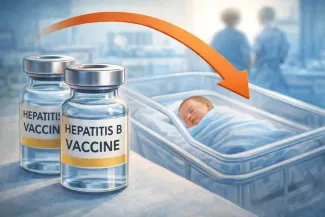
A Sudden Reversal
A new research letter in JAMA reports a sharp decline in newborn hepatitis B vaccination rates in the United States between 2023 and 2025. After years of steady growth, immunization levels peaked at 83.5% before falling to roughly 73%—a drop that diverged markedly from projections based on prior trends. Because hepatitis B acquired at birth carries a high risk of lifelong chronic infection, even modest shifts in coverage can have long-term public health consequences.
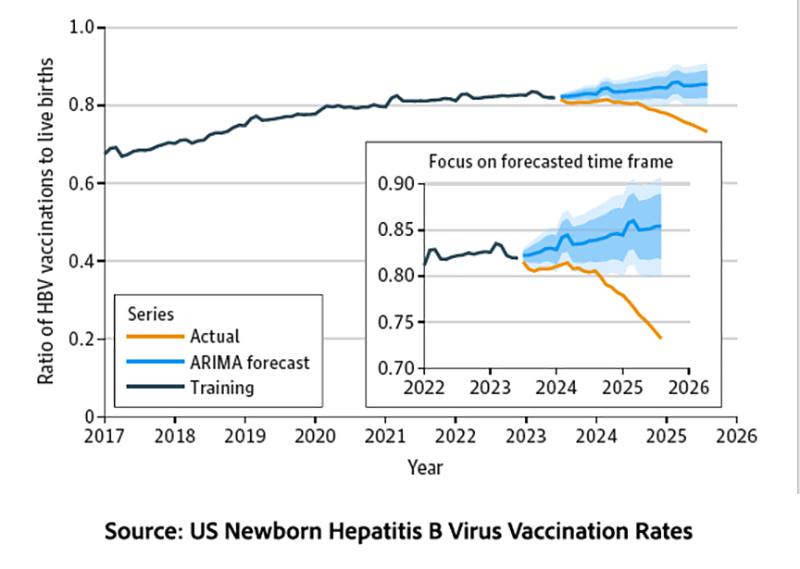
The analysis draws on electronic health records from roughly 1,800 hospitals participating in Epic’s Cosmos database [1], tracking monthly hepatitis B vaccinations per live birth. In the figure, the blue line represents forecasted rates based on prior trends, while the yellow line shows observed vaccinations. The divergence begins in the summer of 2023.
That timing coincides with widely circulated comments by then–presidential candidate, now HHS Secretary, Robert F. Kennedy Jr., spoke with Joe Rogan, and questioned whether universal newborn vaccination is necessary if pregnant women are screened for hepatitis B infection [2].
Why the Birth Dose Exists
Although most pregnant women are tested, screening does not identify every case. 12-16% of infections are missed, and hospital systems do not successfully flag all births to infected mothers. Because infants infected at birth face up to a 90% risk of developing chronic hepatitis B, public health officials adopted universal birth-dose vaccination as a safety net to prevent missed transmissions.
But the Epic findings tell only part of the story. Here is the CDC data on those same vaccination rates based on their dataset.
Two Datasets, Different Signals
The Centers for Disease Control and Prevention (CDC) tracks the same vaccination measure using its own national reporting systems, which rely on provider reports and survey-based estimates rather than a single electronic health record platform.
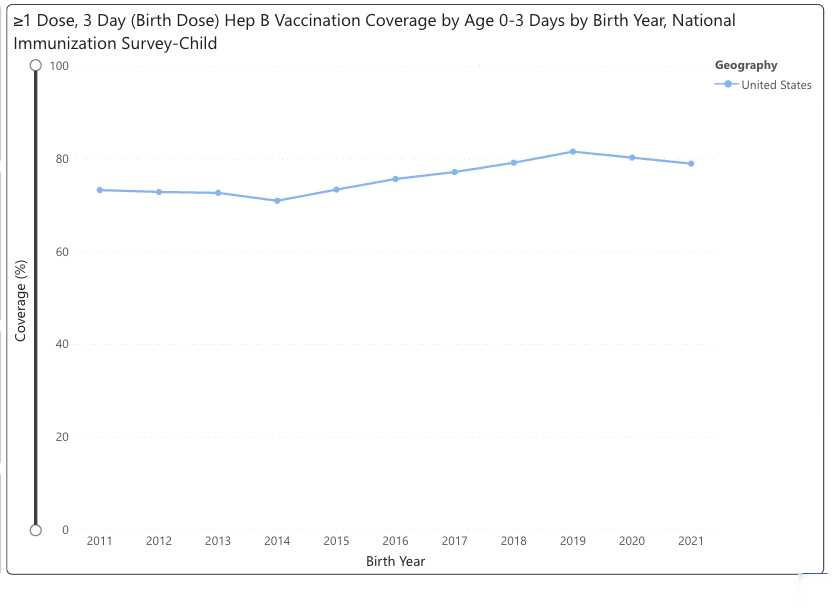 The Epic data, meant to fill the gap, creates an “apples to oranges” problem. The CDC puts vaccination coverage at about 78%, Epic 80%. But, more importantly, the CDC data pushes declining vaccination rates back to just after 2019, when COVID and its fallout in terms of trust in public healthcare were coming into full effect.
Regardless of the exact starting point, both datasets indicate downward movement. Because the systems differ, the precise magnitude of the decline remains uncertain. The study authors caution against attributing the change to any single cause, noting that it coincides with a period of intensified public debate over vaccines, prominent media coverage, and policy discussions that may have shaped parental and clinician decision-making.
To understand why even small percentage changes matter, it helps to recall what hepatitis B looked like before routine immunization.
Before Vaccination: A Different Landscape of Disease and Trust
Prior to the institution of immunization, we had roughly 24 cases per 100,000 children under age 10, about 16,000 cases. With immunization, as late as 2022, the effective rate was 0; 20 cases were identified nationwide.
“Those who cannot remember the past are condemned to repeat it” - George Santayana
The historical decline in cases illustrates how quickly the collective memory of once-common diseases can fade.
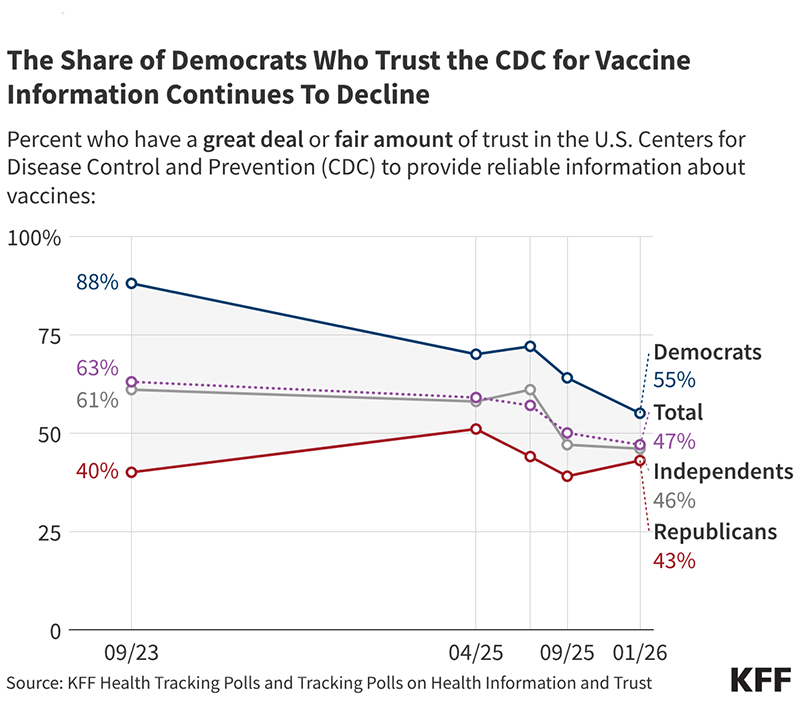
Republicans, already less confident, show little change as Democrats’ confidence plunges. While Secretary Kennedy and his allies at the Children’s Health Defense continue to sow doubt, their role in our mistrust is not nearly as concerning as the trust broken with our public health officials.
What the Next Few Years Will Reveal
Prevention comes in many forms. Secretary Kennedy would have us believe that our diet is powerful in our health. While chicken soup may be good for the soul, it is an underperformer in treating sepsis. Vaccination has increased our immunologic memory for some diseases, including measles, polio, and hepatitis B, but at the same time, it has reduced our living memory of their devastating impacts.
Public health rarely turns on a single speech, a single dataset, or a single political moment. It moves incrementally, shaped by trust, perception, and evidence accumulated over years. The decline in newborn hepatitis B immunization may ultimately prove modest, reversible, or consequential—but that determination will come not from rhetoric, but from surveillance data, clinical outcomes, and transparent analysis.
If case counts remain low, confidence in more individualized decision-making may grow. If infections begin to rise, the consequences will not be abstract; they will appear in pediatric clinics and, decades later, in liver disease and deaths. The real test is not ideological consistency, but whether the next generation is as protected as the last.
[1] The Epic data is not necessarily nationally representative and has shifted geographically over the study time frame.
[2] He went on to make claims about the vaccine causing autism as well as Big Pharma’s focus on children to keep its supply chain open and generating revenue.
Source: US Newborn Hepatitis B Virus Vaccination Rates JAMA DOI: 10.1001/jama.2026.0866

Chuck Dinerstein, MD, MBA
Director of Medicine
Charles Dinerstein, MD, MBA, is the Medical Director of the American Council on Science and Health. A vascular surgeon with more than 25 years of clinical experience, he brings a physician's understanding of medical decision-making, an appreciation for scientific uncertainty, and a broader perspective on healthcare economics and policy to his writing.