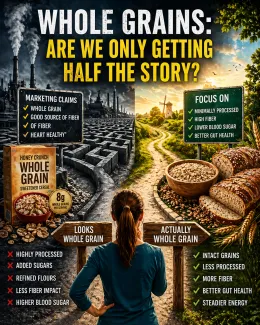
That message, repeated everywhere from official recommendations to cereal-box packaging, is that whole grains are a straightforward upgrade over refined grains: slower to digest, gentler on blood sugar, and protective against chronic disease.
It is not entirely wrong, but that message often becomes more disingenuous. “Whole grain” has become a loosely defined marketing term slapped on products that behave very differently in the body than the minimally processed grains that underpin most of the science.
Food companies have every incentive to push the whole-grain angle. The US dietary guidelines have encouraged swapping refined grains for whole grains since the early 2000s, typically recommending that at least half of all grains consumed be whole.
The latest 2025–2030 guidelines haven’t abandoned whole grains either. Despite visual summaries relegating them to the apex of an inverted triangle, Americans are still advised to consume 2–4 servings per day, depending on calorie needs. But the emphasis has sharpened: they call for prioritizing fiber-rich whole grains and explicitly identify “highly processed, refined carbohydrates, such as white bread, ready-to-eat or packaged breakfast options, flour tortillas, and crackers” as foods to “significantly reduce”.
Yet the labeling system consumers rely on has not kept pace. Products can still carry prominent “whole grain” claims under relatively permissive and inconsistent standards. As a result, many of the very foods the new guidelines urge us to cut back on—highly processed carbohydrate products—remain the most aggressively marketed as “whole grain.”
A Definition That Doesn’t Define Enough
At first glance, the concept of a whole grain seems straightforward. In its natural state, a grain kernel—like wheat or oats—contains three components: the fibrous bran, the starchy endosperm, and the nutrient-rich germ. Refined grains remove the bran and germ, leaving mostly starch behind. Whole grains, by contrast, retain all three.
But once that tidy biological definition meets modern food manufacturing, the problems begin. Many commercial “whole grain” products start with whole kernels that are ground, flaked, or finely milled into flour, or even separated into bran, germ, and endosperm, then recombined in proportions that may not match the original kernel.
The result can still qualify as “whole grain” on paper, yet the original physical structure—the dense matrix that slows digestion—is largely destroyed. This matters because, broadly speaking, the more a grain is broken down through milling, grinding, or flaking, the faster its starch is released, regardless of whether it is whole grain. Studies confirm this: finely milled whole grains like wheat and rye can have a glycemic impact almost identical to refined grains.
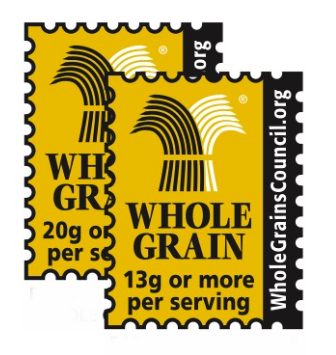 Permissive labeling rules only compound the issue. The FDA allows whole-grain health claims when a product contains just 51% whole-grain ingredients by weight of the grain portion. And the industry-backed Whole Grains Council awards its popular stamp to products with as little as 8 grams of whole grains per serving overall, with no limits on added sugars or the degree of processing. Thousands of items now carry these signals—from oats and brown rice to sweetened cereals, chips, and granola bars—yet they vary dramatically in processing level, fiber quality, and metabolic impact.
Large cohort studies looking at health impacts reflect this messiness: for example, oatmeal and some intact grains such as brown rice show more consistent protective links with coronary heart disease, whereas popcorn—often loaded with salt, sugar, or toffee coatings—shows weaker or more neutral associations, particularly depending on intake levels. However, it’s not entirely down to added ingredients or degree of processing: whole grain breakfast cereals, which are often ultra-processed and relatively high in sugar, can still show protective associations—highlighting how strongly these patterns depend on overall dietary context and how such foods are consumed.
Microbiome Effects
Processing whole grains can also change and boost the fiber profile of foods, affecting gut health, not always for the better.
When minimally processed or left intact, a portion of the starch in grains resists digestion in the small intestine and reaches the colon, where, together with fiber, it serves as fuel for beneficial bacteria. But when grains are finely milled, much of that resistant starch is broken down, so far less fermentable material reaches the colon.
Inulin is sometimes added during bread production to improve texture and moisture retention, which can help extend shelf life. While this rapidly fermented fiber can have physiological benefits for some, it can cause considerable discomfort for others, particularly people with irritable bowel syndrome.
A Corrective, Not a Rejection
None of this means the decades of research linking whole grains to better health should be discarded. Large meta-analyses have consistently associated higher whole-grain intake to lower risks of major chronic diseases and premature death. Taken together with the broader fiber literature, which often shows similar or even stronger associations across a wider range of foods, the benefits appear to stem largely from less-processed, more fiber-rich diets overall, with whole grains as one important part.
But as we have seen, those benefits are unevenly distributed—so how do you navigate the whole grain maze and land on the right products for your health?
How to Navigate Whole Grain Foods
One approach is to shift attention from whole-grain claims to properties that more directly reflect metabolic effects. For example, the ratio of total carbohydrates to fiber can serve as a rough proxy for carbohydrate quality and for how much of the grain’s natural structure and fiber matrix remain intact. Products with no more than about 10 grams of carbohydrate for every 1 gram of fiber (a ≤10:1 ratio) tend to be digested more slowly and are associated with better overall nutritional profiles. You can find these figures on the Nutrition Facts panel on the label.
Physical form also offers useful clues. Foods that retain visible grain structure—such as steel-cut oats, farro, or barley kernels—tend to digest more slowly and are generally better choices. A simple rule of thumb is whether a grain-based food would still look recognizably intact after sitting in water, rather than quickly breaking down into a paste.
Variety matters, too. Different whole grains provide different types of fiber and nutrients, so relying on just one or two sources may limit potential benefits.
The bottom line? Whole grains are not a myth—but the way we define and market them often is. The evidence supports diets rich in fiber and minimally processed foods, including intact or lightly processed grains. What it does not support is the idea that any product labeled “whole grain” will deliver those benefits.

Angela Dowden
Angela Dowden is a British health journalist, author, and Registered Nutritionist. She has nearly 30 years’ experience bringing food, nutrition, and health science to life for international audiences through her print and online work.