A recent piece in the New York Times detailed the panorama if bioweapons conceived by AI. What the piece doesn’t detail are the myriad factors to be considered in designing the perfect super-weapon. Here are some parameters that would vex a human bioweapon engineer; little wonder that constructing an effective bio-weapon lends itself to AI’s ingenuity.
Picking a Pathogen
The art of choosing or crafting a prospective bioweapon depends on how likely the microbe is to be transmitted and deposited at the target organ, how easily it can be vanquished along the transmission route, and how long it can barricade itself during a siege, only to appear when circumstances for infection become more favorable. A lethal microbe with measles-like transmission, or a nickel’s worth of smallpox, theoretically, will harm many, constituting a grave hazard, but unless your target population is properly exposed, nothing will happen. A virus in the vial can’t execute unless it reaches the target organ of the human or animal.
Surviving Deployment (Delivery)
Once the pathogen is picked, the next step is selecting the deployment method. A missile might carry the rogue microbe from a terrorist lab to NYC, but the intense heat and pressure of detonation will kill the payload, and detonating at high altitudes likely won’t deliver the pathogen into someone’s lungs. The hazard, its potential to cause harm, is large, but the risk, the likelihood of harm, is small. If it’s rainy or windy, weather currents will wash or blow the pathogen away, further dampening its effect. Once again, large hazard, small risk.
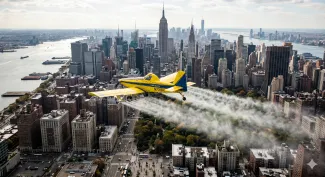
These constraints explain why Homeland Security scenarios postulate delivery vectors using crop dusters or drones - no explosives required, and the exposure is closer to the population’s breathing zone. (Can you imagine what people would do if they saw a crop duster bobbing and weaving through the NYC skyline 42 stories high?)
The artificially frightening scenarios in movies never materialize, attesting to the difficulties of getting a bioweapon out of a vial and onto its targets. Today, drones provide the solution, although as drone protection becomes more sophisticated, the would-be terrorist, human or AI, will have to get more creative.
Pathogen Survivability
Another concern is assessing the microbe’s ability to survive outside the test tube. And, like humans, some environments are so hostile that microbes can’t survive.
Viruses must commandeer a host to provide a reproductive platform for survival. Interrupting viral transmission to a live host is lethal — to the virus. While artificial or laboratory conditions have produced theoretical scenarios in which viruses can survive outside a living organism, the window of survival closes after 24-48 hours.
Some bacteria can hibernate through unfavorable conditions, only to emerge when conditions improve. These bacteria cocoon themselves in protective coatings, form resistant spores, or burrow into the ground, waiting for more favorable conditions to spawn, grow, and conquer. On the flip side, bacteria can be vanquished by antibiotics and may be disfavored as bioweapons.
Exposure Route
After surviving deployment, the microbe must infect humans at the most susceptible organ or tissue level via one of three routes: inhalation, ingestion, or skin contact. Since humans are mobile, once infected, they carry the microbe wherever they go, acting as ongoing relay stations.
Inhalation is the most commonly considered route, although it encompasses three distinct mechanisms. COVID and other respiratory viruses are effectively transmitted when humans cough, sneeze, or breathe on others, as the virus is enveloped in a water droplet that can remain airborne, a form of person-to-person transmission that is effective when humans are a few feet apart. [1]
COVID Lures the Human Down the Primrose Path
Early in the pandemic, attempts were made to understand COVID’s transmission. Because the virus was thought to survive outside its human host for 2 days, initial efforts to control transmission focused on disinfecting surfaces and other contact points, aiming to prevent the transmission of “the immortal virus” from steel surfaces to eyes or lips. The notion of a seemingly supernatural ability to survive for days on inanimate objects proved erroneous. Social distancing to reduce respiratory transmission came later, and even then, it didn’t work because we missed the true transmission method through droplet infection, which accounted for its explosive spread.
Food Glorious Food (and Water);
Spread through ingestion of contaminated food or water can be extremely effective, as foodborne illness outbreaks demonstrate. When a pathogen, such as cholera, is shed in feces into the water supply or sewage system, it spreads via the oral-fecal route. Skin or dermal exposure (such as rabies through an open wound, which is 100% lethal) is the least effective method for causing physical harm on a mass population basis. Anthrax might be considered a super-pathogen because it causes disease via all three routes of exposure.
Hoist by Its Own Petard Bioeweapon Design
Contrary to conventional thought, marrying a microbe with high lethality, like Ebola, with one with high transmission, like measles, would be a fool’s errand. In real life, the lethal virus would kill off its target audience before victims have time to infect enough others to sustain epidemic spread, as evidenced by the 2019 Ebola outbreak, which had a case-fatality rate of 70% and produced a death toll under 12,000.
By comparison, the most lethal microbial monster in modern history, the 1918 Spanish Flu, killed an estimated 50 million people, yet it carried a case-fatality rate of only 2.5%. Because the Spanish Flu is more contagious and less lethal than Ebola, it spares most who are infected, allowing them to act as potent, repetitive disease spreaders. For bioweapons, you must maximize exposure for maximum effectiveness.
Weather
Attention to climatic sensitivities and predilections that can undermine any bioattack is another concern that human bioterrorist predictors ignore.
Consider smallpox and a scenario from June 2001, envisioning a smallpox attack in Oklahoma City five months later. Theoretically, that would be an optimal time for a bio-terrorist smallpox attack because smallpox thrives in cool, dry conditions and doesn’t like sunny, hot, or wet weather. In December 2002, an ice and snowstorm virtually shut Oklahoma City down. Not only would the weather have wrought havoc with the microbe, but folks would be sheltering at home, frustrating the human spread of any pathogen.
Mother Nature makes the best bioterrorist.
Not locked into repeating dramatic scenarios, Mother Nature creates novel organisms for which we have evolved no immunity and have not crafted effective vector control. Take the latest scourge: the person-to-person spread of the Hanta virus. Conventional wisdom holds that the Hanta virus is spread through contact with infected rodents or their bodily secretions. Cruise ships take rigorous measures, analogous to those of an operating room, when bringing food and supplies on board, and pass stringent health inspections to prevent such exposures. It is hard to believe that rats cruised the latest plague ship. But a person-to-person strain? How unique! Just the kind of thing AI, thinking out of the box, could concoct.
In the end, the real threat isn’t a sci-fi supervirus; as we experienced on 9-11, it’s our failure of imagination and our tendency to duplicate past horrors. AI’s dangers lie in its ability to sidestep the prison of the human mind while integrating the myriad parameters needed to launch a lethal bio-attack. Perhaps it’s time we designed AI controls to prevent humans from being bio-weaponed out of existence.
[1] Airborne transmission involves small particles (<5 microns) that remain suspended in the air for extended periods and travel long distances. Droplet infection involves large droplets (>5 microns) that travel shorter distances before settling. Person-to-person transmission includes direct physical contact.

Barbara Pfeffer Billauer JD MA (Occ. Health) PhD
Professor Barbara Pfeffer Billauer is an internationally recognized scholar of public health law, bioethics, and the laws of medical care, focusing on the integration of science and law and its impact on day-to-day policy and legal outcomes. She has lectured and published extensively, in scholarly journals and law reviews, and has written and edited seven books for lay and academic audiences.