Increased consumption of unpasteurized milk has raised safety concerns among food aficionados, public health experts, and government agencies. Because consumption remains low, sufficient safety data may be lacking; yet to prevent harm, we need an early warning system. Just as canaries once warned miners of invisible dangers, today’s early signals come from insurers, litigators, and public health data—each offering a different lens on the risks accompanying this nostalgic return to “natural” foods. The cultural response reveals that the raw milk debate is less about taste and more about how we detect, interpret, and respond to emerging risks.
Birds, Lawyers, and Risk
In the early days of coal mining, before carbon monoxide (CO) detectors signaled an impending mine collapse and certain suffocation, miners would carry a canary. The method was pioneered by John Scott Haldane, “the father of oxygen therapy,” who was tasked with determining the cause of a major mine explosion and preventing similar disasters. He hit on using a super-sensitive “sentinel” – birds or mice – to alert miners to impending disaster.
“Chirping canaries were staples of the coal mining industry. As coal miners descended into the earth—…often home to poisonous gases like carbon monoxide—they would bring the yellow birds along as safety mechanisms. … In the mine, a canary’s collapse let workers know there was poisonous gas in the air and gave them some warning time to evacuate.”
Today’s canaries might be plaintiffs’ lawyers, ever-scavenging for the next undiscovered harm. But the tendency of this bar to monetize misfortune, without valid scientific evidence, has also proved a curse, especially when we are denied useful and reasonably safe products as companies collapse under the financial burden of defending thousands of unwarranted, scientifically baseless claims.
Sifting through early “bellwether” cases to determine whether they portend the next litigation wave occupies both the plaintiffs’ and defense establishments. Firms funding litigation hire lawyers and law students to assess case data and forecast the likelihood that investment in prosecution will turn a profit. Alternatively, insurance actuaries [1] analyze health data and early litigation returns to determine premium rates or carve out exclusions from coverage that may prove unprofitable. Reinsurance companies, which insure the insurers, further analyze litigation outcomes, acting as a double check. Academic lawyers also contribute as risk assessments drive regulation and litigation, using legal epidemiology to assess the relationship between local safety laws and consequent harms.
On both sides, these decisions are not made based on taste, ideology, or contested science, but on risk based on hard dollars – and raw sense.
“State laws resulting in increased availability of unpasteurized milk are associated with more outbreak-associated illnesses and outbreaks.”
The Actuaries’ View of Raw Milk Safety
According to an integrated analysis last month in the Bullvine [2], the insurance community has all but ruled that selling raw milk is an inherently risky venture, based on both the litigation landscape and health statistics. Combining the two data sets has led insurers to charge 20-30% higher premiums for businesses selling raw milk, if coverage can be found at all, or to exclude coverage entirely.
“Raw milk looks like an easy side hustle, but the Keely Farms case in Florida shows how fast it can turn into a bet‑the‑farm liability…. The core message is simple: before you bottle a drop of raw milk, treat it like a high‑stakes business decision, not a casual side hustle.”
- Andrew Hunt
Hunt begins by describing a 2025 food poisoning outbreak in which the Florida Department of Health ruled that an E. coli/Campylobacter outbreak, which sickened 21 people, including six children, was traced to raw milk sold by the Keeley Farms Dairy (presumably based on epidemiological evidence). Among the injured was Rachel Maddox, who claimed she nearly died from consuming the milk and lost her unborn baby. She sued, and Keeley Farms Dairy fought back. Independent lab testing by Keely, the Florida Health Department, and the Department of Agriculture inspection cleared the company. Shortly after Keely moved to dismiss, Maddox withdrew her complaint. This “happy” ending doesn’t change Hunt’s negative assessment of raw milk. While Keely is not legally on the hook, the specter of raw-milk-related diseases permeates the business environment and entices plaintiffs’ lawyers, who broadcast recalls and lawsuits, including criminal sanctions.
Wink, Wink, Nod, Nod
In Florida, selling raw milk is legal when it is marketed and labeled “not for human consumption.” But this label doesn’t stop humans from drinking milk marketed “for consumption by animals.” And vendors know it. While parents might be legitimately empowered to choose risks for themselves, cases and outbreaks show the product finds its way to toddlers and babies, who cannot choose, and where it does the most harm.
“In a courtroom, a “Pet Milk” label is often viewed as a “wink-and-nod” agreement.… that label rarely acts as the liability shield producers hope it will be.” - Andrew Hunt
Behind the Lawsuits
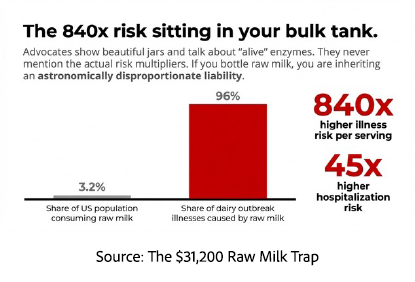
“Unpasteurized milk, consumed by only 3.2% of the population, and cheese, consumed by only 1.6% of the population, caused 96% of illnesses caused by contaminated dairy products.” - CDC
While the absolute numbers of individuals consuming unpasteurized milk and cheese are quite small, their risk of foodborne illness is 150 times greater and their risk of hospitalization is 13 times greater than those who do not consume unpasteurized dairy products.
The Coverage Conundrum
Hunt is not opining on the medical dangers of raw milk, per se, but rather on the legal and financial hazards, including procuring insurance coverage. Even when coverage is available, the per-claim limits can be easily exceeded by the cost of care, leaving dairy owners without coverage and holding the bag for legal fees.
“Most specialty policies carry $1–2 million per‑occurrence limits…. …. [and] treatment of a child or senior with severe E. coli O157:H7 or Listeria complications “not uncommonly” results in direct medical costs exceeding $1 million…..”
Hunt cites a case involving a five-year-old who developed a potentially fatal kidney disease after drinking raw milk linked to an E. coli outbreak. “She was on dialysis… endured six blood transfusions, two surgeries, and… medical bills topped $125,000 in just the first two weeks…”
The truth includes the WHOLE truth
Hunt next dissects the 'Raw Milk’ champion's claims that their new nectar and ambrosia is replete with health benefits, including a protective effect against asthma. He notes that the PARSIFAL study they rely on has limitations that conflict with these claims.
Another key problem with the PARSIFAL study is its failure to account for confounding. While the results may be reproducible, their validity is suspect because the children in that study were also exposed to dust, mites, and allergens commonly found on farms (e.g., hay, straw, grass). These exposures have a known protective effect against asthma and allergies because early exposure to allergens can prime the immune system, confounding any positive results attributed to raw milk consumption.
“The PARSIFAL study … has been misused by raw milk advocates ever since it was published. The … study found an inverse association of farm milk consumption, not raw milk consumption, with asthma and allergy.”
The FDA concurs, writing, “Raw milk does not cure or treat asthma and allergy.” They go even further, stating that “raw milk can carry harmful pathogens, as demonstrated by numerous scientific studies” and outbreak data, emphasizing that “pasteurization effectively kills raw milk pathogens risks without significant impact on nutritional quality.”
Raw Milk Can Be Dangerous to Your Financial Health
Hunt concludes with a holistic assessment weighing financial and health risks against his assessment of a distinct lack of benefits:
“email your broker, your field rep, and your lender one question each: “How would this policy or contract respond if I started selling raw milk from this farm?” If any of those answers makes your stomach tighten, you’ve already got more clarity than most people bottling straight from the tank.”
Raw milk may feel nostalgic, but the real story is whether we’re willing to heed the canaries before the mine collapses.
[1] Someone who analyzes the financial consequences of risk and uncertainty using mathematics, statistics, and financial theory.
[2] “The Bullvine is an independent, online community for professionals in the dairy breeding industry.”
Source: Former New York Cheese Producer Pleads Guilty in Connection with Raw Milk Products Linked to Listeria Outbreak US DOJ Press Release
Raw Milk Cheesemaker Pleads Guilty to Listeria Outbreak Charges

Barbara Pfeffer Billauer JD MA (Occ. Health) PhD
Professor Barbara Pfeffer Billauer is an internationally recognized scholar of public health law, bioethics, and the laws of medical care, focusing on the integration of science and law and its impact on day-to-day policy and legal outcomes. She has lectured and published extensively, in scholarly journals and law reviews, and has written and edited seven books for lay and academic audiences.