
In a jarring reversal for a product that had become steadily cheaper over the previous two decades, consecutive drought-stricken harvests in Spain and the spread of the olive tree disease Xylella fastidiosa in Italy sent prices soaring. Although farm-level supplies are finally beginning to recover, supermarket prices remain high, leaving many American shoppers wondering whether a daily drizzle of extra virgin olive oil (EVOO) is still worth the expense.
This persistent price premium raises a long-overdue question: Are consumers paying for genuinely irreplaceable nutritional and biochemical benefits, or for a compelling cultural narrative?
How Olive Oil Became Nutrition’s Favorite Fat
Much of its reputation stems from decades of research on Mediterranean dietary patterns, culminating in the landmark PREDIMED trial. In that study, individuals at high cardiovascular risk following a Mediterranean diet supplemented with EVOO or nuts experienced roughly 30% fewer major cardiovascular events than those following a standard low-fat diet.
The study was a milestone. However, over the years, its findings have frequently been extended beyond what the data can actually support. PREDIMED did not compare olive oil with canola, sunflower, or corn oil, so it cannot be used to support the increasingly common wellness claim that extra virgin olive oil is uniquely healthy while other unsaturated vegetable oils are inherently inferior. Rather, much of olive oil's reputation stems from its role as the defining fat of the Mediterranean dietary pattern, rather than from direct evidence that it is superior to other unsaturated vegetable oils.
Olive Oil's First Identity: An Unsaturated Fat
If you strip olive oil down strictly to its macro-level fatty acid profile, it looks considerably less unique than popular nutrition narratives suggest.
Olive oil is celebrated for its high content of oleic acid, a monounsaturated fatty acid (MUFA) that makes up roughly 70–80% of its composition. MUFAs help lower unhealthy LDL cholesterol and generally preserve more beneficial HDL cholesterol levels when they replace saturated fats such as butter or lard. However, standard canola oil is also rich in oleic acid, and high-oleic varieties of sunflower oil, bred to increase oleic acid content, which improves heat stability and shelf life, often contain even higher amounts.
Furthermore, when the goal is lowering LDL cholesterol, polyunsaturated fatty acids (PUFAs)—the omega-6 and omega-3 fats abundant in many seed oils—have consistently outperformed monounsaturated fats in tightly controlled feeding studies.
Canola oil, in particular, offers a favorable balance of both MUFAs and PUFAs, including roughly 9–11% alpha-linolenic acid (ALA), an essential plant-based omega-3. Olive oil contains only trace amounts of ALA (typically less than 1%).
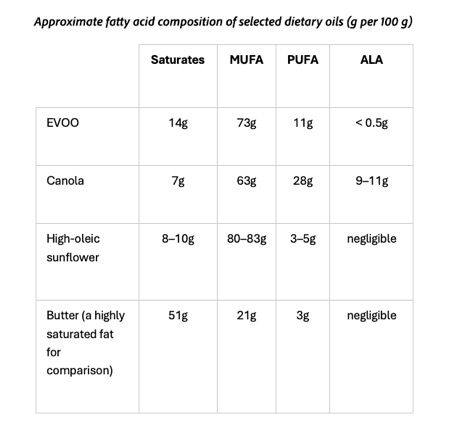
However, when clinical trials compare different types of unsaturated oils with higher or lower amounts of mono- or polyunsaturated fatty acids, the impacts on blood pressure, lipid profiles, and insulin sensitivity tend to be similar, suggesting that the replacement of saturated fat with unsaturated fat may be more important than the specific choice of oil.
The Polyphenol Factor: Crucial or Overrated?
To defend the premium status of EVOO, proponents typically pivot away from fatty acids and point toward its minor components, the rich array of bioactive plant compounds, particularly unique polyphenols such as hydroxytyrosol and oleuropein.
Because extra virgin olive oil is unrefined, it retains these specific compounds, which have been shown to protect LDL particles from oxidation and support blood vessel function. However, this argument comes with two rarely discussed, but important caveats:
- Cold-pressed seed alternatives, including cold-pressed canola, cold-pressed sunflower, and virgin avocado oils, contain lower concentrations of the specific polyphenols found in olives. However, they retain their own distinct biochemical matrix—including vitamin E, phytosterols, and other naturally occurring antioxidant compounds, yet they are routinely ignored by narratives that canonize EVOO.
- Dietary redundancy: Polyphenols are widely abundant across the entire plant kingdom. A single cup of coffee, a handful of blueberries, a square of dark chocolate, or a generous serving of dark leafy greens can provide as much, or substantially more, total polyphenol intake as a standard two-tablespoon serving of extra-virgin olive oil. If an individual’s broader diet is already rich in whole foods and vegetables, the minor fractions of polyphenols scraped from an expensive bottle of olive oil become much less significant.
Putting Olive Oil in Perspective
The modern conversation surrounding dietary fats has devolved into a strangely upside-down narrative. The exact same wellness circles that dogmatically vilify seed oils are often the ones treating extra virgin olive oil as an irreplaceable, miraculous medicine.
The actual clinical reality is far less dogmatic and far more practical:
- Substitution is the real driver: The vast majority of the cardiovascular benefit derived from any vegetable oil comes from what it replaces in the diet—namely, swapping liquid unsaturated fats for solid, highly saturated tropical oils or animal fats.
- The basket matters more than the bottle: A diet built on heavily processed foods will not be saved by a splash of expensive Italian EVOO. Equally, a nutrient-dense diet rich in fiber, lean proteins, and whole foods will not be compromised by cooking with a cheaper oil.
There is no high-quality clinical evidence that refined vegetable oils are inherently harmful. Although refining removes many naturally occurring antioxidants and other minor compounds, comprehensive reviews consistently conclude that diets rich in refined unsaturated oils do not increase biomarkers of inflammation or oxidative stress.
Extra virgin olive oil is a highly flavorful, culturally rich, and a demonstrably healthy fat. But it is not a nutritional prerequisite for a long, healthy life. As supply volatility and economic pressures continue to impact global agricultural markets, consumers should feel reassured by the science: a variety of unsaturated vegetable fats—whether refined or cold-pressed—can deliver similar heavy lifting for your cardiovascular health without demanding a premium price tag.

Angela Dowden
Angela Dowden is a British health journalist, author, and Registered Nutritionist. She has nearly 30 years’ experience bringing food, nutrition, and health science to life for international audiences through her print and online work.