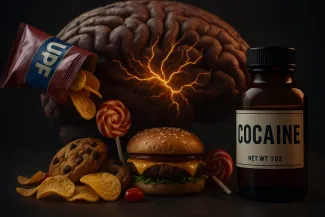
A more controversial hypothesis has emerged: are these “Frankenfoods” addictive in ways similar to drugs?
Food Addiction Through Time
Although food addiction is often associated with ultra-processed foods, its history dates back much further. The first mention appeared in 1890 in The Journal of Inebriety, which focused “primarily on the medical treatment of alcohol and opiate addiction within a growing international network of inebriate homes and asylums,” which described an addictive effect of chocolate.
The concept of "food addiction" emerged in 1955 in the article The Descriptive Features of Food Addiction: Addictive Eating and Drinking, authored by physician allergist Theron Randolph.
Randolph defined it as a specific sensitivity to regularly consumed foods, functioning like a “reverse food allergy” where individuals show signs of addiction, such as withdrawal and escalating consumption.
He identified commonly involved foods, such as corn, wheat, coffee, milk, eggs, and other everyday items. Even then, he distinguished between unrefined foods (natural or minimally processed) and refined foods, identifying a greater risk in the latter.
The Modern Case For Food Addiction
Today, two leading voices supporting the view that ultra-processed foods can be addictive are Ashley Gearhardt, Ph.D., co-creator of the Yale Food Addiction Scale [1], and Erica Lafata, Ph.D., who recently published a correspondence in Nature Medicine. They argue that substance use disorders (SUDs) should also include “ultra-processed food addiction.” Their main points are:
- Compulsive overeating shows neurobiological and behavioral hallmarks of classic addictions.
- Cravings, failed attempts to cut back, and use despite harm fit professional “substance-use disorder” criteria.
- ~300 studies in 36 countries link addictive-style intake specifically to ultra-processed foods.
- Neuroimaging consistently finds addiction-like shifts in brain activation and connectivity.
- Reward circuits spike during anticipation but dull during eating, while self-control networks falter.
To illustrate their supposed harm, the authors use a metaphor that fits their logic but is largely hyperbolic. In a summarized version:
“In the brain’s reward system, ultra-processed foods high in sugar and fat resemble addictive substances more than natural foods. Like nicotine — made more addictive through processing, additives, and rapid delivery in cigarettes — these foods isolate and concentrate sugars and fats, add flavor and texture enhancers, and package them to reinforce conditioning. Just as a cigarette barely resembles a tobacco leaf, an Oreo has little in common with the corn and soy from which it comes.”
However, no single chemical component in ultra-processed foods has been proven addictive in the same way as nicotine. This does not rule out the possibility of food addiction — absence of evidence is not evidence of absence — but it does call for more rigorous research before accepting such comparisons.
Sweet Reward, Small Response
To address the lack of direct neurobiological evidence, researchers at the National Institutes of Health put the dopamine theory to a rigorous test. A recent study published in Cell Metabolism took a significant step in exploring the connection between the brain’s reward system and ultra-processed foods. In it, the researchers tested how this system would respond to the sugar-and-fat bomb better known as a milkshake.
They hypothesized that if ultra-processed foods were truly “addictive,” drinking a milkshake should trigger a sharp rise in dopamine levels, similar to what happens with addictive drugs or pleasurable activities.
Yet, to the authors’ surprise, the milkshake did not flood the brain with dopamine like drugs of abuse. Instead, it produced responses in the reward system that were virtually imperceptible. This doesn’t rule out food addiction; it simply suggests it may operate in an entirely different way.
So how did the researchers reach these unexpected results?
The study evaluated brain dopamine responses 30 minutes after consuming that ultra-processed, high-fat, high-sugar milkshakes.
Researchers set out with two big questions in mind: Would a rich milkshake trigger a measurable dopamine surge — seen as a drop in D2-receptor “binding potential”—after a long fast? And if so, would those dopamine sparks be weaker in people with higher body fat, hinting at a dulled reward system in obesity?
Sixty-one healthy adults (ages 18–45) volunteered. After several days on a carefully balanced maintenance diet prepared by NIH nutritionists, they entered the clinic for a five-day stay. Researchers first performed a baseline [11C]-raclopride PET scan [3], a technique commonly used in drug abuse research, after about 17 hours of fasting. Each participant then consumed a 418-calorie, high-fat milkshake within five minutes, rated its taste and their hunger, and rested. Half an hour later, a second scan measured the brain’s dopamine response.
By comparing dopamine activity before and after the milkshake, and aligning those changes with each person’s body-fat levels, the team tested whether the brain’s reward circuitry behaves differently in lean versus heavier individuals, and whether a simple indulgence activates the same pathways as addictive substances.
As a result, the study found:
- Glucose and insulin spiked at 30 & 90 minutes, but dopamine didn’t budge—fasted brains and post-milkshake brains looked the same.
- BMI barely nudged the dopamine dial (and that was after controlling for age and sex).
- Fat mass, body-fat %, insulin, energy intake—all those biometrics? Zero meaningful links to the brain’s response.
- What did matter: how much the shake tamped down hunger. Bigger hunger drop → stronger dopamine burst.
The authors conclude that milkshake consumption produces small but highly variable changes in dopamine, unrelated to adiposity but possibly linked to perceived hunger and hedonic responses. These results do not dismiss the experiences of individuals who struggle to control their intake of such foods, nor do they claim that addictive effects are impossible. However, they challenge the narrative that dopaminergic responses equivalent to those triggered by illicit drugs drive excessive consumption of ultra-processed foods.
The study has limitations. It did not include a control group that consumed a minimally processed milkshake with equivalent nutrients to compare dopaminergic responses. Furthermore, PET scans capture only a snapshot of dopamine variation, reflecting the balance between release and clearance. It is possible that clearance exceeded release in response to the milkshake, which could explain the low values observed.
The Sweet Debate
The big question remains: are ultra-processed foods addictive? If we follow NOVA’s definition, classifying any food with industrial ingredients and processes as ultra-processed, without considering its nutritional composition, the answer is simple: no.
When focusing on foods high in sugar, fat, and often sodium, the issue becomes more complex. To date, no convincing evidence demonstrates that addiction to these products exists, but that doesn’t mean it is impossible.
Ultra-processed foods pose problems for several reasons: marketing aimed at children, high caloric density, and a composition rich in ingredients that should be consumed in moderation — all factors contributing to overweight and obesity. Some individuals may struggle to reduce or control their intake of these foods, which can cause harm across multiple areas of life. It is impossible to determine whether this qualifies as an addiction, a disorder, or another phenomenon.
What can be stated with greater certainty is that claiming ultra-processed foods are as addictive as drugs of abuse is an unfounded exaggeration.
[1] A 35-item questionnaire that assesses 11 symptoms of addiction associated with foods high in sugar, salt, fat, or starch. It considers behaviors over the past 12 months, such as “continuing to eat even when not hungry.”
[2] An imaging technique using a radioactive tracer to detect metabolic changes. [11C]raclopride selectively binds dopamine D2 receptors, allowing PET studies to measure basal receptor availability and alterations due to dopamine fluctuations.
Sources: The Journal of Inebriety (1876-1914): history, topical analysis, and photographic images. Addiction (2007). DOI: 10.1111/j.1360-0443.2006.01680.x
The Descriptive Features of Food Addiction. Addictive Eating and Drinking. Quarterly Journal of Studies on Alcohol. DOI: 10.15288/qjsa.1956.17.198
Now is the time to recognize and respond to addiction to ultra-processed foods. Nat Med (2025). DOI: 10.1038/s41591-025-03858-6.
Brain dopamine responses to ultra-processed milkshakes are highly variable and not significantly related to adiposity in humans. Cell Metabolism (2025). DOI: 10.1016/j.cmet.2025.02.002.

Mauro Proença
Mauro Proença is a nutrition graduate student with a postgraduate degree in Clinical Nutrition from the University of São Paulo (USP), Brazil.