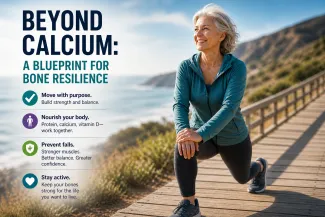
Today, the clinical consensus has shifted. While calcium remains essential, we now understand that bones are living tissues, not inert mineral stores. Fracture risk depends on far more than mineral intake alone; bone strength reflects a dynamic system that includes muscle, movement, and, critically, fall risk. The modern view isn’t that calcium doesn’t matter—it’s that it was never the whole story and was perhaps overrelied on.
Calcium: A Necessary Baseline, Not a Breakthrough
Calcium plays a central structural role in bone. When intake is too low, the body compensates by mining calcium from the skeleton, weakening it over time.
The US recommended amount of 1,200mg a day for women aged 50 plus is, however, not as firmly evidence-based as often assumed. It originates from short-term calcium balance studies conducted decades ago, whereas later evidence suggests that calcium balance should ideally be assessed over much longer periods.
Simply chasing higher calcium intake is unlikely to be the solution many women are looking for—particularly when that increase comes from high-dose supplements, which have been associated in some analyses with an increased risk of heart attacks and strokes and in a large randomized trial with an increased risk of kidney stones.
A large meta-analysis in the BMJ found that increasing calcium intake yields modest gains in bone mineral density—typically 0.6–1.8% over one to two years—with little additional gain thereafter. Crucially, those starting with low calcium intakes did not consistently gain more than those already consuming higher amounts, and higher doses did not outperform more modest ones.
In effect, calcium appears to provide a small, real, early “bump” in bone density when intake is increased,, and is unlikely to dramatically reduce fracture risk on its own. After that, its role is largely to maintain, not build bone.
That said, maintaining a reliable baseline intake remains essential to prevent the body from drawing on its own skeleton. But it’s likely that around 700 mg per day may be a more practical and sufficient foundation for many adults, including menopausal women. Achieving this intake through diet provides the raw materials for bone maintenance without the potential cardiovascular and kidney stone risks associated with high-dose calcium supplementation.
Fractures Are About Falls, Not Just Bones
A crucial but underappreciated fact is that most fractures in older women result from falls, not just low bone density.
Prospective cohort studies consistently show that fall risk—driven by muscle weakness, impaired balance, and slower reaction time—is a major determinant of fractures, particularly hip fractures. Age-related muscle loss (sarcopenia) plays a central role. The overlap between osteoporosis and sarcopenia, sometimes called osteosarcopenia, is where fracture risk increases most.
Muscle protects bone in two ways: it reduces the likelihood of falling and provides mechanical loading that helps maintain bone.
This shifts the focus from bone alone to the entire musculoskeletal system and highlights where intervention is most effective.
Exercise As a Fall Preventative
Exercise is one of the most effective tools for preserving bone—and one of the most underused. But not all movement is equal.
Resistance (weight) training and impact loading (such as jumping or hopping) have the strongest evidence supporting improvements in bone density. Randomized trials, including the landmark LIFTMOR trial, have shown that this type of training in postmenopausal women can improve bone density at clinically important sites such as the spine and hip.
By contrast, swimming and cycling, where the body is supported by the water or a bike, and walking, where the physical impact is lower, are excellent for cardiovascular health but, on their own, have a limited effect on bone density.
Targeted programs that include resistance training two to three times per week, coupled with appropriate jump training where tolerated, can be especially effective. Beyond bone density, exercise also improves balance, coordination, and reaction time—key factors in reducing fall risk.
Importantly, women with prior fractures, advanced osteoporosis, or balance limitations may require modified or supervised programs.
Protein: The Overlooked Partner
Bone is not just mineral—it is a matrix of minerals and proteins. Higher protein intake has been associated with better preservation of bone mass and a significantly lower risk of hip fractures in clinical reviews.
Protein provides the essential building blocks for the bone's collagen matrix. For this reason, expert consensus now suggests older adults benefit from 1.0–1.2 g/kg/day, a higher threshold than traditional minimums, but more in line with the new 2025-2030 Dietary Guidelines for Americans. Calcium and protein are complementary: one mineralizes, while the other maintains the structural framework.
Vitamin D and Other “Bone Nutrients”
Vitamin D facilitates calcium absorption and supports muscle function, two systems central to bone health. However, large randomized trials—and guidance from the US Preventive Services Task Force—suggest that routine daily supplementation with up to 400 i.u. of Vitamin D, combined with up to 1,000 mg of calcium, does not reduce fracture risk in a generally healthy population of postmenopausal women.
That does not make vitamin D irrelevant, and many people may want to take a supplement because insufficiency is common. However, in the context of bone protection, testing and targeted supplementation are likely more appropriate than blanket use.
Magnesium, potassium, and vitamin K also play supporting roles in bone and muscle health. However, evidence that taking these as standalone supplements reduces fracture risk is limited. As with most aspects of nutrition, overall dietary quality matters more than any single nutrient.
Dairy: Useful, Not Essential
Dairy foods remain among the richest sources of calcium in Western diets. They also provide high-quality protein, phosphorus, and, when fortified, reasonable amounts of vitamin D. But it’s not just the amount of calcium that matters; it’s about bioavailability, or how well the mineral is absorbed.
Calcium from dairy is absorbed at a rate of roughly 30–35%, but brassica veggies like broccoli, kale and bok choy often exceed dairy in absorption efficiency, as shown in controlled absorption studies. On the other hand, some plant foods, like spinach, contain oxalates that significantly reduce absorption.
In practical terms, well-chosen plant sources can be just as effective as dairy. Within dairy, not all foods appear to behave the same way. A review of bone health outcomes found that milk is associated with small increases in bone mineral density but with inconsistent fracture outcomes. By comparison, fermented dairy products, such as cheese and yogurt, show more consistent protective associations against fractures.
Medications Matter
While lifestyle is foundational, it is not always sufficient. For women with diagnosed osteoporosis, prior fragility fractures, or a high fracture risk, medications can often significantly reduce fracture risk, far more than lifestyle changes alone. These include medications that slow bone breakdown (antiresorptive therapies) and anabolic treatments that actively build bone.
A complete conversation about bone health with your doctor should always include risk assessment and, when appropriate, targeted therapy.
Putting It All Together
Bone health isn’t built on a single nutrient or habit—but on a set of factors that work together over time.
For most women, that means:
- Meeting a consistent baseline intake of calcium
- Eating enough protein to support muscle and bone
- Engaging in regular resistance and, where appropriate, impact exercise
- Getting an overall high-quality diet
- Where necessary, medication to reduce fracture risk
The lowest fracture risk is seen not in those who simply consume the most calcium, but in those who support the entire system: bones that are adequately mineralized, muscles that are strong, and a body that is less likely to fall.

Angela Dowden
Angela Dowden is a British health journalist, author, and Registered Nutritionist. She has nearly 30 years’ experience bringing food, nutrition, and health science to life for international audiences through her print and online work.